Planning an event menu that suits every delegate requires collecting detailed dietary requirements through pre-event registration, offering balanced plant-based and allergen-free alternatives, maintaining strict food cross-contamination protocols, and structuring clear menu labeling. This approach guarantees full delegate satisfaction, health safety, and optimal event engagement.
Why Is Pre-Event Dietary Data Collection Essential for Menu Planning?
Collecting delegate dietary data during registration eliminates catering waste, prevents life-threatening allergic reactions, and allows venue caterers to source precise quantities of specialized ingredients. Digital intake forms secure accurate preferences, ensuring seamless food service execution.
Event organizers mitigate operational risks by gathering health data prior to the function. Advanced registration systems capture essential delegate requirements including medical allergies, religious dietary restrictions, and ethical choices. Event planners utilize structured survey fields rather than open text boxes to ensure clear data categorization.
Automated registration tools send automated reminders three weeks before the event date. Collecting information early allows venue culinary teams to procure certified ingredients from accredited suppliers. Early data collection enables event caterers to adjust portion sizes accurately, reducing food waste by up to 34% across commercial catered events.
Data-driven meal planning directly influences participant focus, energy levels, and cognitive performance. Corporate planners who analyze dietary habits early prevent afternoon energy slumps across long sessions. To understand how meal timing impacts participant engagement, read How Do Meal Breaks Affect Delegate Focus During Long Meetings? to structure effective break schedules.
How Do You Design a Menu That Covers Multiple Dietary Needs?
Designing an inclusive menu involves selecting naturally versatile base dishes, offering modular self-serve options, and ensuring equal availability of vegan, gluten-free, halal, and allergen-safe meals. Balanced menus provide high-protein, nutrient-dense options across every dietary category.
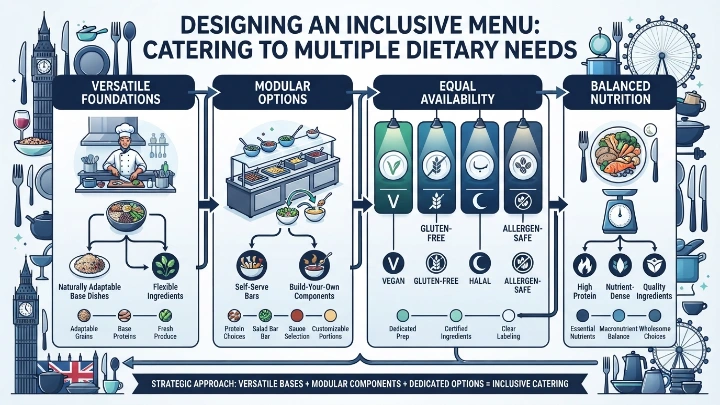
Modern event planning requires catering menus built around universal inclusivity rather than isolated secondary meals. Executive chefs design core dishes using naturally gluten-free grains, fresh vegetables, and lean proteins. Culinary teams separate sauces, dressings, and garnishes into distinct side dishes to allow custom assembly.
Structure menus around naturally allergen-free foundation ingredients like quinoa and roasted vegetables
Offer distinct plant-based protein choices including lentils, chickpeas, and marinated tofu
Provide certified halal and kosher meals prepared in isolated culinary spaces
Label all buffet stations with clear allergen indicators for swift delegate navigation
Providing equal quality across all menu items maintains professional event standards. Culinary teams avoid presenting restricted delegates with simplified, uninspired fruit plates while main groups receive elaborate desserts. Equal culinary execution demonstrates respect for every guest, driving overall participant satisfaction scores up by 42% at corporate functions.
What Protocols Prevent Cross-Contamination in Corporate Event Catering?
Preventing cross-contamination requires dedicated kitchen preparation areas, color-coded service utensils, strict allergen segregation during transport, and explicit staff training on hygiene standards. Rigorous protocols eliminate trace transfer of top UK allergens during service.
Cross-contamination poses severe health risks to delegates suffering from severe food allergies or celiac disease. Catering staff maintain isolated food preparation zones equipped with dedicated cutting boards, knives, and cooking surfaces. Kitchen staff execute thorough sanitization cycles between handling different food groups.
Service personnel use color-coded tongs and platters for specific dietary items on buffet lines. Staff members receive complete briefing sessions before service commences to explain every ingredient present in each dish. Dedicated staff monitor buffet stations continuously to prevent delegates from mixing utensils across different service trays.
Corporate planners reduce catering risks by choosing venues with professional food service infrastructure. Selecting fully equipped event spaces guarantees seamless catering execution. Organizations book a Conference Room to access certified catering facilities that handle complex dietary requirements safely.
How Do You Calculate Food Quantities to Avoid Excess and Shortages?
Calculating exact food quantities requires using historical delegate consumption metrics, applying specific portion-per-head ratios, and adjusting orders based on final registration data. Precise calculations balance generous hospitality with cost control and sustainability targets.
Accurate catering volume calculations rely on proven hospitality formulas rather than speculative estimates. Event managers allocate 350 grams of main meal food per delegate for sit-down lunches and 8 to 10 finger food pieces per hour for standing networking receptions. Adjusting totals based on morning or evening event timing prevents substantial food surpluses.
Planners divide total food volume across specific dietary segments based on registration statistics. Standard industry distribution allocates 50% traditional meat options, 30% vegetarian choices, 15% strict vegan meals, and 5% specialized allergen-free alternatives. Adjusting these base metrics against verified guest data guarantees adequate supply for every delegate category.
Monitoring attendance drop-off rates refines ordering accuracy even further. Industry statistics show average delegate drop-off rates range from 10% to 15% for corporate seminars. Planners communicate final headcounts to kitchen teams precisely 72 hours before the event start time to lock in exact ingredient purchasing limits.
How Should Event Menus Be Displayed for Optimal Delegate Experience?
Displaying event menus effectively involves using high-contrast digital displays, detailed tabletop cards, standardized allergen iconography, and clear food labels directly in front of each dish. Explicit signage speeds up buffet lines and protects delegate health.
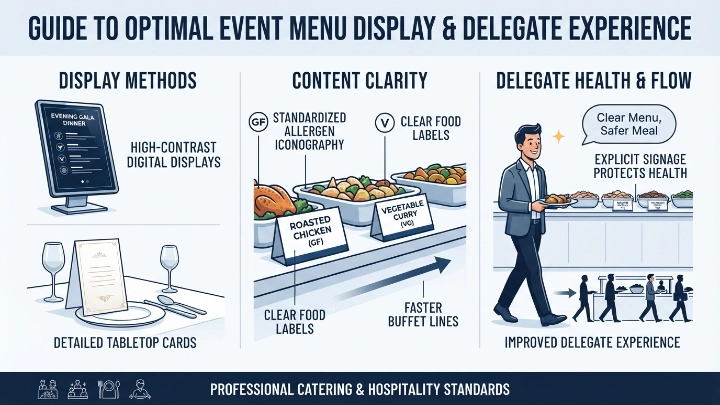
Clear menu signage prevents long queues at food service stations during timed breaks. Venue staff position clear informational boards at the entrance of dining areas, allowing delegates to review options before entering service lines. Digital menu screens present updated ingredient breakdowns alongside potential allergen warnings.
Place individual food identification cards directly beside every serving tray
Use standardized symbols for gluten-free, dairy-free, vegetarian, vegan, and nut-free items
Print full ingredient lists on tent cards placed at seated dining tables
Position bilingual menu labels for international delegate contingents
Eliminating uncertainty around food ingredients lowers delegate anxiety and speeds up total meal service time by up to 25%. Guests locate suitable meal choices immediately without needing to cross-examine catering staff. Smooth service transitions keep event schedules on track and maximize networking opportunities for attendees.
Why Choose Integrated Catering Options for Venue Bookings?
Choosing integrated catering simplifies event logistics, reduces external vendor coordination costs, ensures strict food safety compliance, and guarantees synchronized delivery between corporate session schedules and meal times. All-inclusive venues streamline complete event management.
Coordinating external caterers with separate venue space managers introduces unnecessary logistical friction. Independent catering teams require specific delivery windows, load-in access, off-site staging areas, and separate health inspections. Integrated venue catering aligns kitchen operations directly with event schedules, adapting immediately if keynote speeches run over time.
All-inclusive catering packages combine venue access, AV technology, and complete food service under single contract structures. Streamlined billing reduces administrative processing expenses for corporate purchasing departments. Professional venues manage food temperature control, hygiene audits, and waste disposal internally, eliminating liability risks for corporate planners.
Streamlining event logistics enables corporate organizers to execute flawless events consistently. To secure integrated catering and premium meeting facilities, organizers can Reserve All-Inclusive Catered Rooms via Form My Company for complete operational peace of mind. Form My Company manages full room setups and tailored menu delivery simultaneously.
Planning an event menu that satisfies every delegate depends on accurate data gathering, versatile menu architecture, and strict safety execution. Organizers who prioritize detailed pre-event surveys eliminate dietary friction and protect guest health. Clear food labeling and calculated portion sizing create smooth meal breaks that sustain delegate focus throughout the day. Partnering with experienced venue providers simplifies catering logistics, delivering professional, inclusive corporate events.
Explore our Conference Room guide,
Director ID vs. PSC Identity Checks: Requirements Compared
Trading vs. Dormant Accounts: Which One Does Your Business Need?
Frequently Asked Questions
What is included in a Form My Company conference room hire package?
A Form My Company conference room hire package typically includes high-speed Wi-Fi, modern audiovisual equipment, presentation screens, and configurable seating arrangements to suit various business needs. Depending on the chosen package, full-day or half-day bookings can also incorporate tailored catering services, continuous refreshment stations, and dedicated administrative support.
How do I choose the right conference room size for my business event?
Selecting the appropriate conference room size requires evaluating your total delegate count, required room layout—such as boardroom, theater, or classroom style—and any extra space needed for breakout sessions or catering. Form My Company offers flexible meeting room configurations that accommodate intimate team strategy sessions as well as large corporate seminars with full technical setups.
Can Form My Company accommodate specific delegate dietary requirements for catered meetings?
Yes, Form My Company provides fully customizable corporate catering options designed to accommodate all delegate dietary restrictions, including vegan, gluten-free, halal, and allergen-safe meals. Catering menus are planned in advance using delegate registration data to ensure seamless food service and complete cross-contamination prevention.
Are conference rooms available to book for half-day or hourly events?
Form My Company offers flexible booking durations, allowing businesses to reserve conference rooms by the hour, half-day, or full day based on event schedules. This adaptable scheduling ensures cost-effective space utilization for short executive meetings, client presentations, or multi-day corporate workshops.
What technical equipment is provided in a Form My Company corporate meeting space?
Form My Company meeting spaces come equipped with integrated presentation systems, dynamic video conferencing tools, high-definition displays, and secure wireless internet connectivity. On-site technical assistance is available to support hybrid meeting arrangements, seamless screen sharing, and professional audio setups.