

The five conditions defining a Person with Significant Control (PSC) in a UK company include holding over 25% of shares, holding over 25% of voting rights, holding the right to appoint or remove a majority of the board of directors, exercising significant influence or control, or controlling a trust or firm that meets any of the first four criteria.
What Is a Person with Significant Control?
A Person with Significant Control is an individual or eligible relevant legal entity that maintains ultimate ownership or operational governance over a UK corporate structure through specific statutory thresholds.
UK corporate transparency regulations mandate that every registered business identifies its primary decision-makers. Companies House requires clear documentation regarding who holds ultimate authority. Transparency builds trust across commercial networks. Accurate records prevent illicit financial activities. Businesses maintain legal compliance by tracking these ownership markers continuously.
Which Ownership Condition Involves Shares?
Condition one requires an individual to hold directly or indirectly more than 25 percent of the nominal share capital in the registered company.
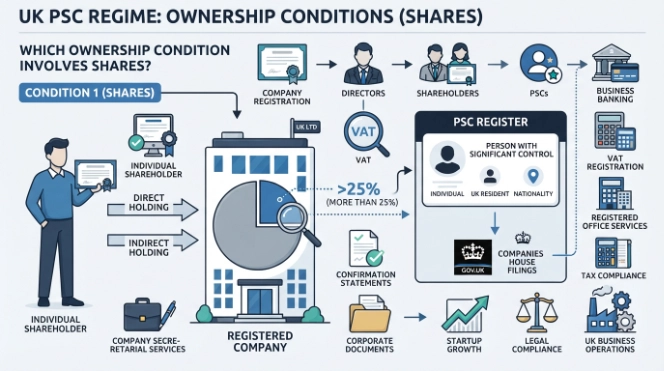
Share ownership forms the baseline metric for corporate control. When an investor owns more than 25% of issued shares, they meet the first statutory ownership test. Exact percentages matter during compliance audits. Companies calculate this figure using total nominal value. Ordinary shares and preference shares with voting rights factor into this calculation.
Which Voting Condition Establishes Control?
Condition two requires holding directly or indirectly more than 25 percent of the voting rights in the company.
Voting rights dictate how decisions pass during annual general meetings. An individual holding more than 25% of these rights can block special resolutions. This level of power influences strategic business directions. Corporate governance standards treat voting power separately from nominal share value. Dual-class share structures often separate these two metrics. Companies must evaluate voting agreements that pool shareholder power together.
How Does Board Control Define a PSC?
Condition three grants the right to directly or indirectly appoint or remove a majority of the board of directors.
Board control bypasses standard shareholding percentages completely. An investor holds significant control if they possess contractual authority to select executive directors. Removing board members shifts corporate leadership instantly. Articles of association frequently outline these appointment powers. Investors secure this condition through specific shareholder agreements.
What Constitutes Significant Influence or Control?
Condition four involves regularly exercising dominant direction over corporate operations without holding direct equity or voting power.
Significant influence applies when an individual dictates commercial policy outside formal ownership channels. Business relationships or advisory contracts sometimes create this dynamic. Companies House evaluates real-world operational control rather than paper titles. Decision-making power must mirror the authority held by majority shareholders. Regulatory bodies investigate these arrangements during compliance reviews. Trusts and informal agreements often trigger this specific condition.
How Do Trusts and Firms Trigger PSC Status?
Condition five covers individuals who control a trust, partnership, or unincorporated firm that meets any of the first four conditions.
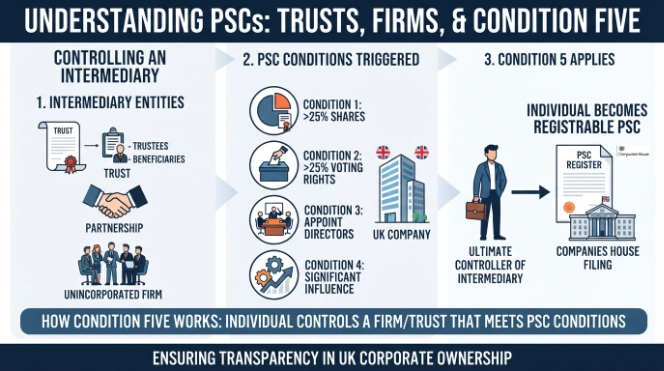
Trust structures complicate standard ownership tracking. When a trust holds 30% of company shares, the trustees or beneficiaries often qualify as PSCs. Trustees exercising control over corporate assets must register their status. Legal frameworks pierce through multi-tiered ownership layers. Entities operating through unincorporated associations evaluate control through similar statutory lenses.
Why Must Companies Maintain Accurate PSC Registers?
Companies must maintain accurate PSC registers to satisfy statutory transparency mandates enforced by Companies House.
Maintaining an updated register prevents severe legal penalties for corporate officers. Directors face criminal fines or default charges for non-compliance. Businesses must submit official filings whenever ownership structures shift. Transparent records facilitate smoother UK corporate registration frameworks for incoming investors. Stakeholders rely on verified data before entering commercial contracts.
The following table summarizes the five statutory conditions for quick reference:
| Condition Number | Control Mechanism | Statutory Threshold |
| Condition 1 | Share Capital Ownership | More than 25% of nominal shares |
| Condition 2 | Voting Rights Held | More than 25% of total votes |
| Condition 3 | Board Appointments | Power to appoint or remove majority directors |
| Condition 4 | Significant Influence | Directing commercial policy without equity |
| Condition 5 | Trust or Firm Control | Controlling an entity meeting conditions 1 to 4 |
How Do You Ensure Full Compliance?
Ensuring full compliance requires conducting regular ownership audits, issuing formal information notices, and updating public registers promptly.
Companies must investigate ownership changes proactively. Issuing formal notices to suspected PSCs is a statutory obligation. Recipients must respond within one month of notification. Ignoring these statutory requests leads to restrictions on shares and voting rights. Businesses streamline this administrative burden by utilizing structured workflows outlined in How to Record PSC Details Accurately on the Register. Professional administrative support ensures that statutory filings meet strict regulatory deadlines without administrative errors.
Identifying Persons with Significant Control safeguards corporate transparency across the United Kingdom. Five distinct conditions establish whether an individual exercises ultimate ownership or operational governance. Companies must evaluate share capital, voting rights, board appointments, operational influence, and trust structures carefully. Form My Company helps businesses File Accurate PSC Details With Form My Company to maintain flawless compliance records with Companies House effortlessly.
Explore our PSC Register guide,
How Professional Meeting Rooms Help You Maintain a High Standard of Presentation
What Happens if a Company Fails to Appoint a New Director Correctly?
Frequently Asked Questions
Who must be registered as a PSC on the UK corporate register?
Any individual or relevant legal entity holding more than 25% of shares, more than 25% of voting rights, or the right to appoint a majority of directors must be registered. Form My Company assists businesses in identifying these qualifying individuals to ensure complete statutory compliance.
What happens if a company fails to maintain an accurate PSC register?
Failing to maintain or update an accurate PSC register is a criminal offense under UK company law. Directors can face personal fines, unlimited penalties, and potential prosecution by Companies House for non-compliance.
Can a corporate entity be classified as a Person with Significant Control?
A relevant legal entity can be classified as a PSC if it keeps its own PSC register or is subject to specific UK disclosure rules. Form My Company helps corporations untangle complex multi-tiered corporate structures to identify the correct registrable entities.
How often must a company update its PSC register information?
Companies must update their internal PSC register as soon as any ownership changes occur and file confirmation statements with Companies House annually. Utilizing the PSC Register service ensures that all statutory filing deadlines and public disclosures are met promptly.
Is the PSC register information available for public viewing?
The People with Significant Control register is a matter of public record maintained by Companies House and is accessible via online government portals. Form My Company guides businesses on how to submit accurate data while protecting sensitive personal details where statutory exemptions apply.