PSC conditions determine whether an individual has significant ownership or control over a UK company. The five statutory tests cover share ownership, voting rights, the power to appoint or remove directors, significant influence or control, and control exercised through a trust or qualifying firm. A person generally becomes a Person with Significant Control when at least one applicable condition is met.
Companies must identify their PSCs and report the required information to Companies House. Since 18 November 2025, companies have no longer been required to maintain a separate internal statutory PSC register. However, their responsibility to identify PSCs, submit accurate information and report relevant changes remains in force.
PSC Conditions: What Are the Five Tests?
The five PSC conditions are statutory tests used to identify who owns or controls a UK company. They cover holding more than 25% of shares, holding more than 25% of voting rights, having the right to appoint or remove a majority of directors, exercising significant influence or control, and controlling a trust or qualifying firm that meets another condition.
A person only needs to meet one applicable condition to qualify as a PSC. Companies must assess direct and indirect ownership, voting arrangements and other rights rather than relying solely on the names appearing in their shareholder records.
What Is a Person with Significant Control?
A Person with Significant Control is an individual who meets one or more statutory conditions for owning or controlling a company. PSCs are commonly described as beneficial owners because they have a level of ownership or influence that gives them significant authority over the business.
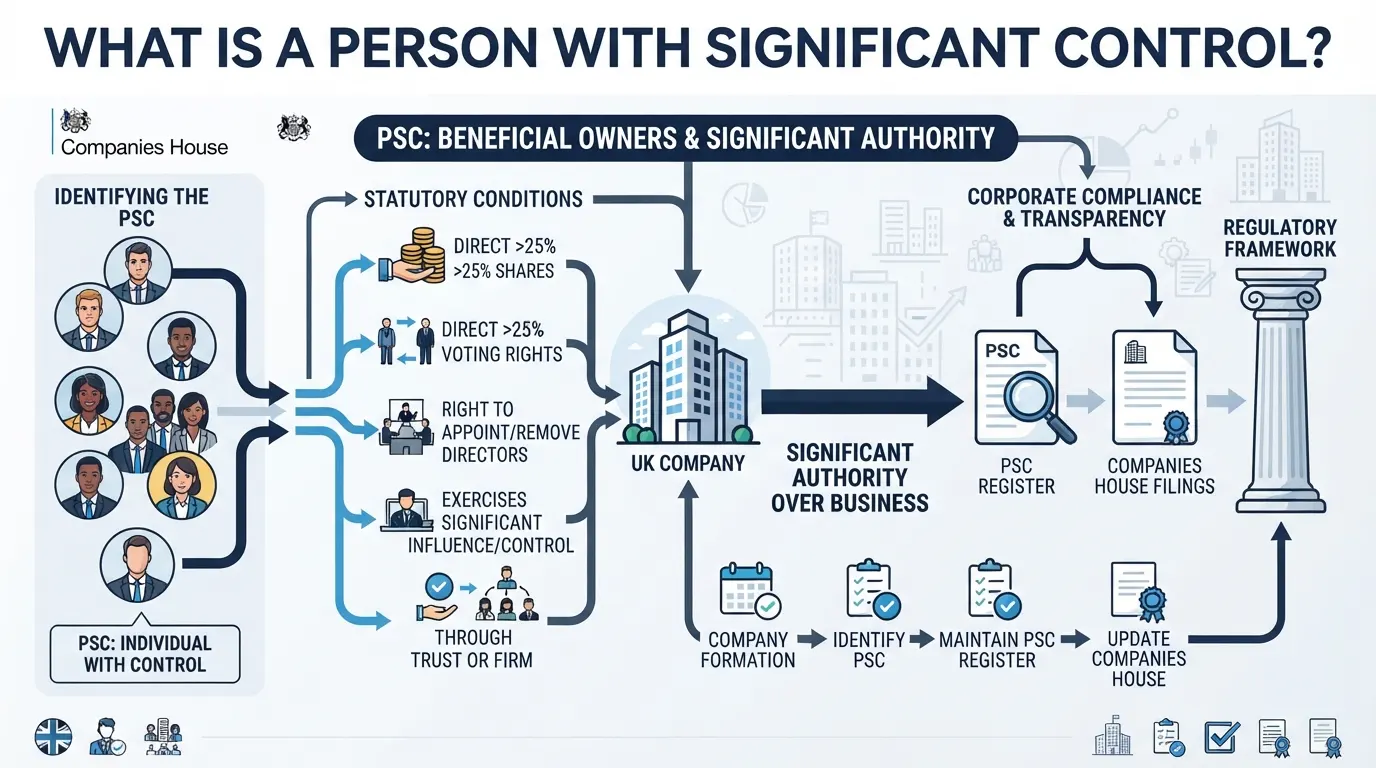
A PSC does not have to be a company director or take part in everyday management. An investor, founder, shareholder or another individual may qualify because of their ownership percentage, voting rights, appointment powers or influence over company decisions.
In certain ownership structures, a relevant legal entity may also be registrable as a PSC. The company must assess the applicable legal requirements to determine whether an individual or qualifying entity should be reported.
The PSC framework supports corporate transparency by identifying the people and qualifying entities behind UK businesses. Companies House uses this information to make ownership and control details available for public inspection, subject to applicable protection rules.
Explore our PSC Register guide,
Why Offsite Training Rooms Can Boost Creativity and Morale for Your Employees
What Counts as Proof of Address in the UK?
The Five PSC Conditions Explained
Each condition examines a different way in which an individual may exercise ownership or control. Companies should review their shareholding information, articles of association, shareholder agreements and other relevant arrangements before deciding whether a person qualifies.
1. Holding More Than 25% of the Company’s Shares
The first condition applies when an individual holds, directly or indirectly, more than 25% of the company’s shares.
The threshold is strictly more than 25%. Holding exactly 25% does not satisfy this condition by itself, although the individual may qualify under another condition.
For example, consider a company with 100 ordinary shares:
- Shareholder A owns 40 shares.
- Shareholder B owns 30 shares.
- Shareholder C owns 20 shares.
- Shareholder D owns 10 shares.
Shareholders A and B each hold more than 25% of the shares. They therefore meet the first PSC condition, subject to the applicable rules and assessment of the ownership structure.
Companies should examine both direct and indirect ownership. An individual may hold an interest through another company or an ownership arrangement rather than appearing as the immediate shareholder.
What to check:
- The company’s current shareholdings.
- The total number and relevant value of issued shares.
- Any indirect ownership arrangements.
- Shareholder agreements that affect how ownership rights are held.
- Whether changes to share capital have altered an individual’s percentage.
The company’s register of members is an important starting point for this assessment. However, it should be considered alongside the articles of association and other documents that may affect ownership rights.
2. Holding More Than 25% of the Voting Rights
The second condition applies when an individual holds, directly or indirectly, more than 25% of the company’s voting rights.
Share ownership and voting rights are separate tests. A person may hold a particular percentage of shares but have a different percentage of voting rights because of the rights attached to different share classes or other arrangements.
For example, an investor may hold 20% of the company’s shares but control 35% of its voting rights through a class of shares carrying additional voting power. That individual meets the second condition even though their shareholding does not exceed 25%.
Companies should not assume that each share carries one vote. They must examine the rights attached to the shares and consider agreements that affect how voting rights are exercised.
What to check:
- Voting rights attached to each share class.
- Weighted or enhanced voting arrangements.
- Shareholder agreements affecting voting decisions.
- Agreements to exercise voting rights jointly.
- Indirect voting rights held through another entity.
The key question is who controls more than 25% of the company’s voting rights, not simply who owns the largest number of shares.
3. Having the Right to Appoint or Remove a Majority of Directors
The third condition applies when an individual has the direct or indirect right to appoint or remove a majority of the company’s board of directors.
This condition focuses on the legal power to determine board composition. It can apply even when the individual does not hold more than 25% of the shares or voting rights.
For example, a company has five directors. An individual has a contractual right to appoint or remove three of them. As three directors represent a majority of the five-member board, the individual meets the third condition.
The right may arise through the company’s articles of association, shareholder agreements or another legally relevant arrangement. It is the existence and scope of the right that matter, not simply whether the individual has used it.
Where a company has only one director, the right to appoint that director can satisfy this condition.
What to check:
- The company’s articles of association.
- Shareholder or investment agreements.
- Rights relating to director appointments and removals.
- Any arrangements that give an individual indirect appointment powers.
- The number of directors and the voting structure of the board.
Companies should distinguish between the right to appoint or remove directors and ordinary participation in board decisions. Being influential in discussions does not automatically establish this third condition.
4. Exercising Significant Influence or Control Over the Company
The fourth condition applies when an individual has the right to exercise, or actually exercises, significant influence or control over the company.
This test looks beyond share ownership and formal board appointment rights. An individual may qualify even without holding a significant shareholding or an official management position if their rights or actions give them substantial influence over how the company operates.
For example, an individual may have an absolute right to make or veto important decisions about the company’s business plan, borrowing arrangements or appointment of senior executives. Depending on the circumstances, those rights may indicate significant influence or control.
An individual may also exercise significant influence in practice. For instance, someone who regularly directs a substantial part of the board’s decision-making may fall within this condition, even if they are not formally appointed as a director.
However, ordinary professional advice, a senior job title or routine minority-protection rights do not automatically make someone a PSC. The actual rights and circumstances must be assessed against the statutory guidance.
What to check:
- Rights contained in the company’s constitution.
- Shareholder and investment agreements.
- Decision-making and veto powers.
- Arrangements that influence the board’s decisions.
- The individual’s actual role in directing company activities.
The Department for Business and Trade published updated statutory guidance on significant influence or control on 4 March 2026. Companies should consider this guidance when assessing complex arrangements under the fourth condition.
5. Exercising Significant Influence or Control Over a Trust or Firm
The fifth condition concerns an individual who has the right to exercise, or actually exercises, significant influence or control over the activities of a trust or a firm that meets one of the other PSC conditions in relation to the company.
This condition is particularly relevant to indirect ownership structures. A trust or qualifying firm may hold shares, voting rights or other control rights in a company. The company must then consider who controls the activities of that trust or firm.
For example, a trust may hold more than 25% of a company’s shares. An individual who exercises significant influence or control over the activities of that trust may meet the fifth condition, depending on the trustees’ position and the applicable statutory rules.
The assessment is not automatic for every trustee, beneficiary, partner or person connected with the arrangement. The company must examine the actual control structure and identify the people who meet the legal test.
What to check:
- The trust deed or relevant partnership documentation.
- The identity and role of trustees or firm members.
- The shares, voting rights or other control rights held through the structure.
- Who can direct or influence the activities of the trust or firm.
- Whether the trust or firm meets one of the first four conditions in relation to the company.
Complex trust and partnership arrangements may require specialist advice. Companies should not assume that the person named as a beneficiary or trustee automatically qualifies without examining the relevant rights and activities.
PSC Conditions at a Glance
The following table summarises the five statutory conditions and the main evidence a company should review.
| PSC condition | Control test | Example |
|---|---|---|
| Condition 1 | More than 25% of shares | An individual holds 40% of the company’s shares |
| Condition 2 | More than 25% of voting rights | An investor controls 35% of voting rights |
| Condition 3 | Right to appoint or remove a majority of directors | An individual can appoint three of five directors |
| Condition 4 | Right to exercise or actual exercise of significant influence or control | An individual has decisive rights over important business decisions |
| Condition 5 | Significant influence or control over a trust or qualifying firm that meets another condition | An individual controls a trust that holds a qualifying interest in the company |
A person may meet more than one condition. Companies should identify all applicable conditions when reporting the person’s nature of control to Companies House.
Examples of How PSC Conditions Apply
Practical examples help companies understand why the five tests must be considered separately.
Example 1: Share Ownership and Voting Rights
A company has two shareholders. Each holds 50% of its shares and has an equal proportion of voting rights.
Both individuals meet condition 1 because each owns more than 25% of the shares. They also meet condition 2 because each controls more than 25% of the voting rights.
The company should identify and report both individuals as PSCs, recording the applicable nature of control.
Example 2: Voting Rights Differ From Share Ownership
An investor holds 20% of a company’s shares but has enhanced voting rights that give them control of 35% of the total votes.
The investor does not meet condition 1 through that shareholding alone. However, they meet condition 2 because their voting rights exceed 25%.
This example shows why companies must review voting arrangements separately from share ownership.
Example 3: Board Appointment Rights
An investor holds only 15% of a company’s shares but has a contractual right to appoint four members of a seven-person board.
The investor meets condition 3 because they can appoint a majority of the directors. Their relatively small shareholding does not remove the significance of their appointment rights.
Example 4: Significant Influence Without Share Ownership
An individual has no shares and is not formally appointed as a director. However, an agreement gives that person absolute decision-making rights over important aspects of the company’s business.
Depending on the scope of those rights, the individual may meet condition 4. The company should assess the agreement against the statutory guidance rather than relying on the individual’s formal job title.
Example 5: Control Through a Trust
A trust holds a qualifying interest in a company. An individual has the right to direct or significantly influence the activities of that trust.
The company should assess the trust’s position and the individual’s authority over its activities to determine whether condition 5 applies. The outcome depends on the trust structure, the rights held by its trustees and the relevant control arrangements.
How Should a Company Identify and Assess Its PSCs?
Companies should carry out a structured review of ownership and control arrangements to identify every individual or qualifying entity that meets the PSC conditions.
A practical assessment should include the following steps:
- Review the shareholding structure: Examine the register of members and identify individuals holding more than 25% of shares, directly or indirectly.
- Check voting rights: Review the rights attached to each share class and any agreements that affect voting power.
- Examine board appointment rights: Review the articles of association and relevant agreements to identify who can appoint or remove a majority of directors.
- Assess significant influence: Consider contractual rights and actual decision-making arrangements that may give someone significant influence or control.
- Review trusts and qualifying firms: Identify ownership structures involving trusts or firms and assess who controls their activities.
- Confirm the relevant information: Obtain and check the details required for the Companies House PSC filing.
- Report the information: Submit the required PSC information through the appropriate Companies House process.
Companies should retain appropriate supporting documents and make sure their assessment reflects the actual ownership and control structure. Where arrangements are complicated or disputed, independent professional advice may be necessary.
For practical guidance on the information and reporting process, read How to Record PSC Details Accurately on the Register.
What Should a Company Do If Someone Meets a PSC Condition?
If an individual meets one or more PSC conditions, the company must take the appropriate steps to confirm their information and report it to Companies House.
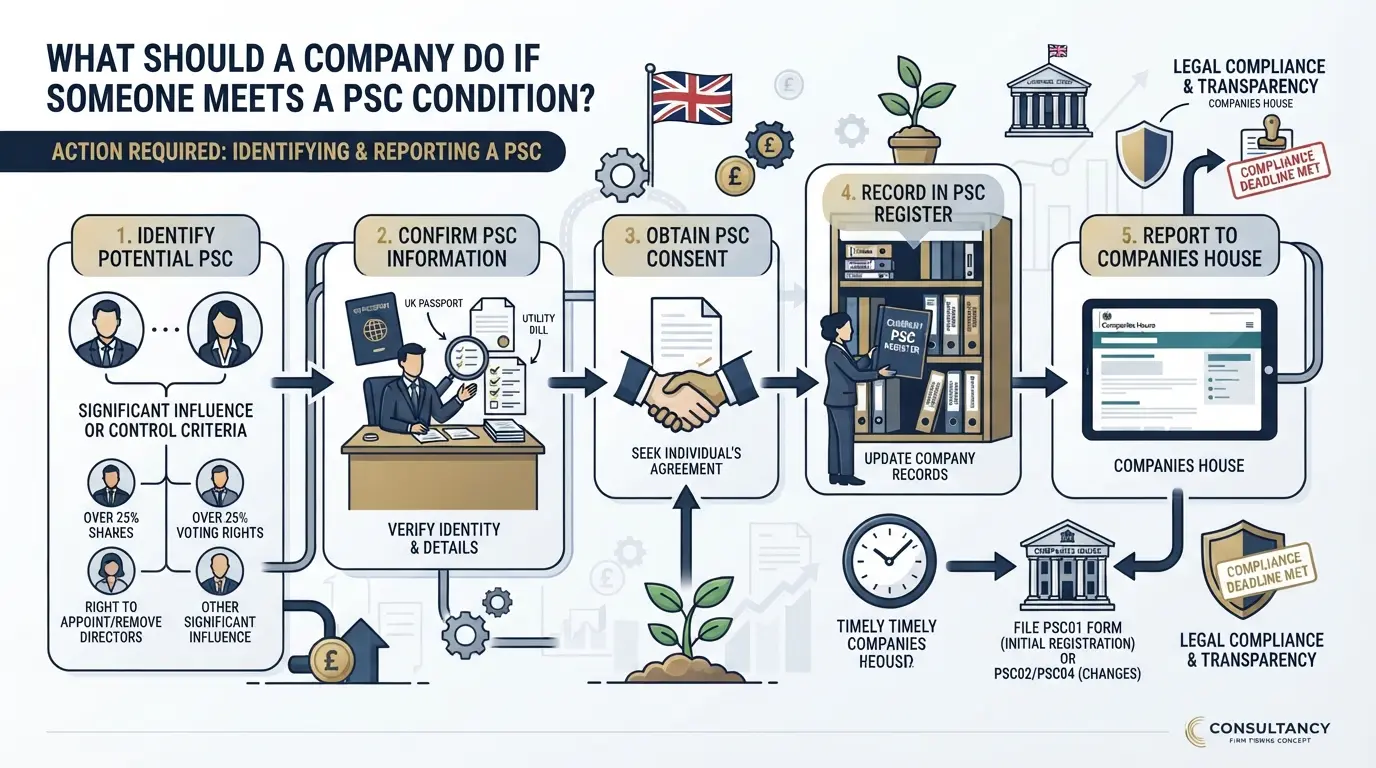
The company should not wait until its next annual confirmation statement to report a newly identified PSC or a confirmed change in PSC information. The reporting process has specific statutory time limits.
Confirm the PSC’s Details
Before submitting information, the company must obtain and confirm the required details. These generally include:
- Full name.
- Date of birth.
- Nationality.
- Country or part of the UK where the person usually lives.
- Service address.
- Usual residential address, which is not publicly disclosed.
- Date the individual became a PSC.
- The applicable nature of control.
- The relevant shareholding or voting-rights category, where applicable.
Companies should check the information carefully before submission. Incorrect names, dates or control descriptions can make the public record inaccurate.
Report the Information to Companies House
Companies must provide the required PSC information to Companies House within the applicable statutory period. Under current guidance, the information must generally be provided within 14 days of being confirmed.
Where a PSC’s details or control position changes, the company must update the Companies House information within 14 days of confirming the change, subject to the relevant reporting rules.
If the company cannot identify a PSC or has no registrable PSC, it must report the appropriate statement rather than leave the information incomplete.
Understand the Changes to Internal PSC Registers
From 18 November 2025, companies no longer need to maintain a separate internal statutory register of people with significant control. The required PSC information is reported to and maintained on the Companies House register.
This change does not remove the company’s responsibility to identify PSCs, investigate its ownership structure, confirm information or report changes. Companies should continue keeping appropriate supporting documents and internal records to explain their ownership and control assessments.
For a broader explanation of the purpose of PSC information and the reporting framework, read our PSC Register guide.
What Are the PSC Identity Verification Requirements?
PSC identity verification became a legal requirement on 18 November 2025. Individuals who qualify as PSCs must verify their identity with Companies House and provide their Companies House personal code through the required process.
Every PSC has a 14-day period for providing their personal code and verification statement. The dates depend on the person’s circumstances, including whether they were already registered as a PSC before 18 November 2025 and whether they are also a director of the company.
Companies should check the applicable deadline for each PSC rather than assume that everyone has the same verification date.
Read our guide to PSC Identity Verification in the UK for further information about the verification process.
Companies or individuals who need assistance can also review Form My Company’s Identity Verification Service for Directors and PSCs.
What Happens If a Company Does Not Meet Its PSC Reporting Duties?
Failing to provide accurate PSC information or ignoring statutory information notices can result in legal consequences. Companies and individuals must respond to the applicable requirements and should not treat PSC reporting as an optional administrative task.
Under current government guidance, failure to provide accurate PSC information without a reasonable excuse can constitute a criminal offence. Failure to comply with a company notice requesting information can also have serious consequences, including potential fines or imprisonment of up to two years.
Companies should take reasonable steps to identify people who may qualify as PSCs, confirm the information and report it within the relevant time limits. Where a person does not provide requested information, the company should follow the statutory notice process and obtain professional advice before considering restrictions on shares or voting rights.
Accurate reporting supports transparency and helps the company demonstrate that it has taken its legal responsibilities seriously.
How Can Form My Company Help With PSC Compliance?
Identifying PSCs can be straightforward where ownership is simple. However, companies with different share classes, indirect ownership, shareholder agreements or trust arrangements may need additional support to assess their control structure correctly.
Form My Company provides a PSC Register service for businesses that need assistance with PSC-related administration. Companies can review the service to understand the available support for organising PSC information and associated compliance tasks.
Businesses looking to file accurate PSC details with Form My Company can explore the service as a practical next step. Before using any service, confirm the scope of support and ensure that it reflects the current Companies House requirements, including the changes to internal statutory registers introduced in November 2025.
Frequently Asked Questions
What are the five PSC conditions in the UK?
The five PSC conditions cover holding more than 25% of shares, holding more than 25% of voting rights, having the right to appoint or remove a majority of directors, exercising significant influence or control over a company, and exercising significant influence or control over a qualifying trust or firm connected with the company.
Does holding exactly 25% of shares make someone a PSC?
No. The first condition requires an individual to hold more than 25% of the company’s shares. An individual holding exactly 25% does not meet this condition on that percentage alone, although they may qualify through voting rights or another form of control.
Can someone be a PSC without owning shares?
Yes. Someone may qualify without owning shares if they hold more than 25% of the voting rights, have the right to appoint or remove a majority of directors, or meet the significant influence or control tests.
Can a person meet more than one PSC condition?
Yes. An individual may meet multiple conditions at the same time. For example, someone holding 40% of the shares and 40% of the voting rights meets both the first and second conditions.
Does every UK company need to identify its PSCs?
Companies subject to the PSC regime must take reasonable steps to identify their PSCs and report the required information to Companies House. If a company has no registrable PSC or cannot identify one after taking the required steps, it must report the appropriate statement.
Do companies still need to maintain an internal PSC register?
No. Since 18 November 2025, companies have no longer been required to maintain a separate internal statutory PSC register. They must still identify PSCs, provide the required information to Companies House and report relevant changes.
When must PSC information be reported to Companies House?
Companies must generally provide PSC information within 14 days of confirming it. Changes to reported information must also be submitted within the applicable 14-day period after the change is confirmed.
Do PSCs have to verify their identity?
Yes. PSC identity verification became a legal requirement on 18 November 2025. Each PSC must provide their Companies House personal code and verification statement within their applicable 14-day period. The deadline depends on their circumstances.
Identify PSCs Correctly and Maintain Accurate Company Information
The five PSC conditions help establish who owns or controls a UK company. They cover share ownership, voting rights, board appointment powers, significant influence or control, and control through qualifying trusts or firms.
Companies should assess each condition carefully, confirm the relevant information and report qualifying PSCs to Companies House within the applicable time limits. Although a separate internal statutory PSC register is no longer required, the responsibility to identify PSCs and maintain accurate public information remains.
Form My Company provides support for businesses managing PSC-related administration. Review the PSC Register service to explore the available assistance with your company’s PSC compliance requirements.