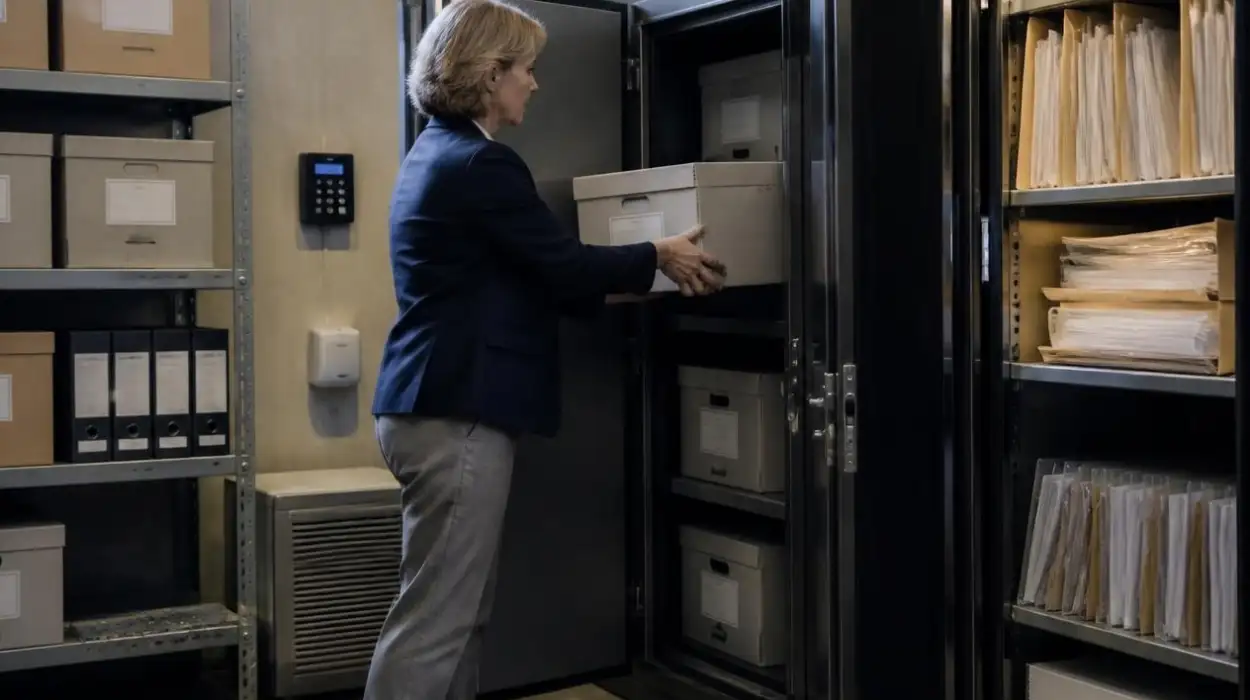
Safely store original company documents by placing physical certificates, share registers, and legal seals in a secure fireproof container at your registered office, while backing up all digital statutory compliance files in an encrypted cloud repository with strict multi-factor authentication controls.
Why Do Original Company Documents Require Dedicated Physical and Digital Storage Protocols?
Original company documents require dedicated security protocols because physical certificates establish legal corporate existence, protect against asset fraud, and satisfy strict regulatory verification audits mandated by UK financial institutions and corporate oversight bodies.
UK corporate compliance rules state that limited companies must maintain definitive records of incorporation. When managing vital paperwork such as the Certificate of Incorporation, Memorandum of Association, and Articles of Association, business owners face unique operational risks. If an enterprise loses its physical statutory books, corporate recovery requires costly replacement filings through Companies House. Every corporate entity must establish robust storage workflows to secure sensitive files.
Maintaining proper document security prevents unauthorized access or physical degradation. Paper documents remain susceptible to environmental hazards such as fire, moisture, and general wear over decades of operation. Establishing dual storage systems ensures that physical registry books and digital backups complement each other seamlessly. Directors must categorize documents based on their legal retention timelines and statutory importance.
What Are the Best Practices for Storing Physical Corporate Paperwork?
Store physical corporate paperwork by organizing statutory registers in tabbed binders, housing paper certificates inside waterproof containers, and locking physical administration tools within a certified fire-resistant office safe.
Protecting physical paperwork involves specific environmental controls and physical security measures. When directors handle items such as share certificates and corporate seals, organization prevents misplacement during audits. Business owners manage physical security by implementing three core preservation steps:
Archive paper certificates inside heavy-duty, fireproof filing boxes.
Restrict physical access to authorized company directors only.
Maintain physical registers at the registered office or a registered Single Alternative Inspection Location.
Paper documentation remains a legal requirement for specific corporate actions, even in modern digital environments. Regulatory bodies often inspect physical minute books during formal corporate investigations. Utilizing a comprehensive Company Pack from Form My Company ensures that your initial registers, seals, and stamps are delivered in a format ready for secure archiving. Proper physical organization eliminates administrative confusion during high-stakes corporate reviews.
How Should Businesses Secure Digital Backups of Statutory Registers?
Secure digital backups of statutory registers by utilizing AES-256 cloud encryption, enforcing mandatory multi-factor authentication protocols, and restricting file modification permissions to designated corporate officers.
Digital asset security requires deliberate technical safeguards to prevent unauthorized data interception or malicious deletion. When companies digitize incorporation forms, tax certificates, and shareholder resolutions, cybersecurity vulnerabilities emerge if networks lack proper defense layers. Enterprise data protection relies on three primary technical controls:
Encrypt all archived PDF scans using advanced cryptographic standards.
Implement multi-factor authentication across all administrative cloud portals.
Distribute read-only digital access permissions to secondary management personnel.
Cloud repositories offer immense convenience for remote executive teams requiring rapid access to corporate data. However, convenience must never compromise data integrity or regulatory compliance standards. Business owners should review their digital folder structures quarterly to delete obsolete file drafts and verify backup integrity. Maintaining clean, version-controlled digital archives ensures that regulatory filings align perfectly with internal company registers.
What Retention Timelines Apply to Different Categories of Corporate Records?
Apply statutory retention timelines by keeping core incorporation registers for the entire company lifecycle, maintaining financial accounts for at least six years, and archiving board meeting minutes for a minimum of ten years.
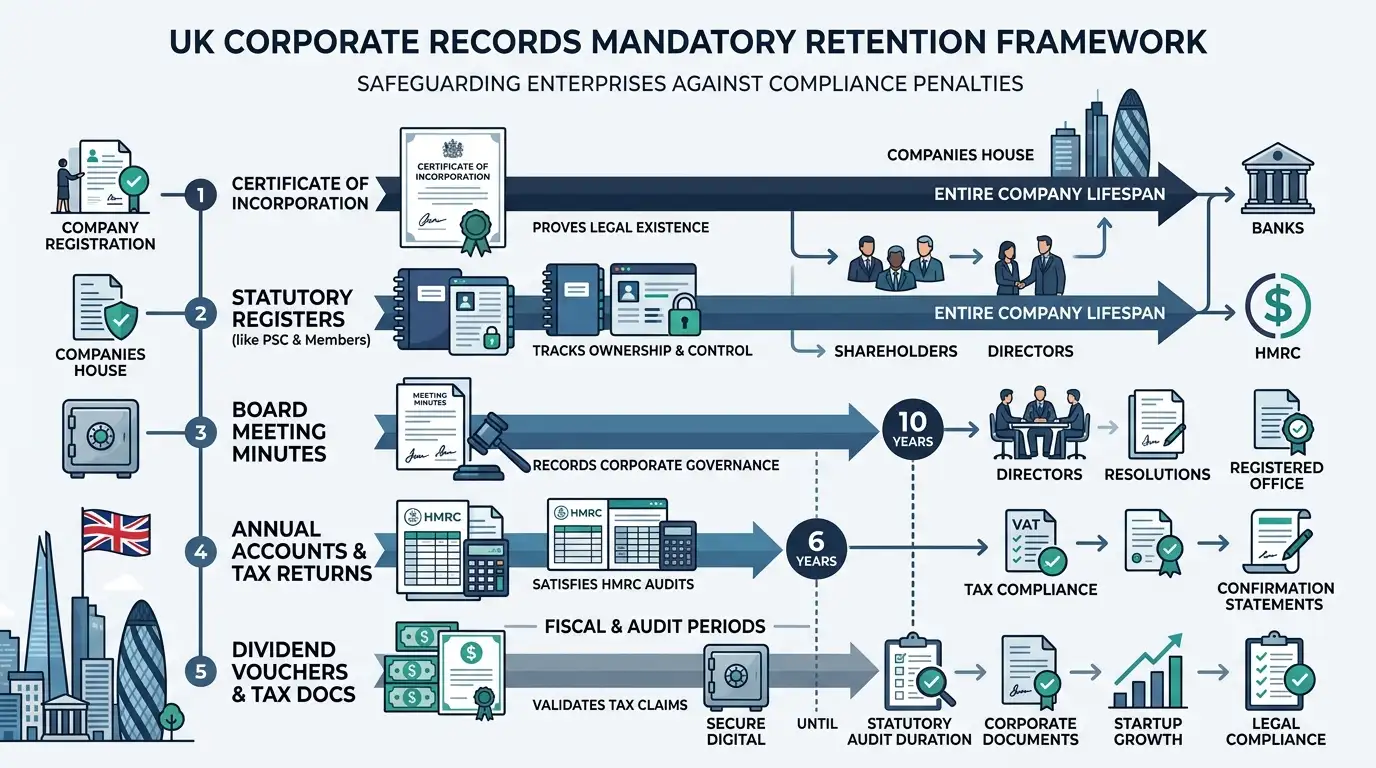
UK regulatory frameworks specify exact retention windows for every document category generated by a private limited company. When compliance officers evaluate document lifecycles, understanding specific legal deadlines prevents premature disposal of critical evidentiary material. The following quick-reference guide outlines mandatory retention periods for UK corporate records:
| Document Category | Minimum Retention Period | Statutory Purpose & Destination |
| Certificate of Incorporation | Entire Company Lifespan | Proves legal corporate existence to banks and HMRC |
| Statutory Registers (PSC & Members) | Entire Company Lifespan | Tracks current share ownership and control structures |
| Annual Accounts & Tax Returns | 6 Years from Fiscal Year End | Satisfies HM Revenue and Customs financial audits |
| Board Meeting Minutes | 10 Years from Meeting Date | Records official corporate governance and resolution history |
| Dividend Vouchers & Tax Docs | Statutory Audit Duration | Validates personal and corporate tax liability claims |
Adhering strictly to these retention schedules safeguards the enterprise against unexpected compliance penalties. Business founders should integrate these timelines into their internal operations manual. For additional insights into optimizing your operational framework, read our guide on Are Digital Company Documents Enough for Banks and Investors? to understand modern acceptance standards.
How Can Founders Streamline the Organization of New Company Records?
Streamline new company record organization by purchasing a pre-bundled administrative kit, centralizing digital document dashboards, and establishing standardized file-naming conventions from day one of business operations.
Administrative efficiency directly influences a startup’s capacity to pass compliance evaluations smoothly. When founding a new enterprise, sorting through dozens of digital downloads and physical slips creates unnecessary administrative friction. Business leaders can optimize their initial setup phase by executing three structural actions:
Deploy standardized file-naming conventions across all digital folders.
Centralize administrative tools using professional startup bundles.
Schedule bi-annual compliance reviews to verify document completeness.
Establishing disciplined document management habits protects corporate standing throughout rapid business growth phases. When you are ready to secure your corporate foundation, review our guide on Want to Buy the All-In Company Pack With Form My Company? to evaluate comprehensive structural solutions. Form My Company delivers structured administrative packages designed to keep your physical tools and digital certificates organized from incorporation onward.
Safeguarding original company documents requires a balanced approach combining physical environmental protection with advanced digital encryption protocols. Maintaining clear physical registers alongside secure cloud backups ensures absolute compliance with UK regulatory frameworks. Form My Company delivers dependable solutions through professional incorporation packages and administrative tools, ensuring your business stays protected.
Explore our Company Pack guide,
City Centre vs Out-of-Town Venues: Which Suits Your Event?
How to Choose a Well-Connected Conference Venue?
Frequently Asked Questions
What is included in a standard UK company pack?
A standard UK company pack typically includes printed copies of the Memorandum and Articles of Association, the Certificate of Incorporation, share certificates, and a corporate metal seal. When founders order through Form My Company, these essential statutory items are professionally organized to streamline initial corporate governance.
Do UK companies legally need a physical corporate seal?
UK company law does not legally mandate the use of a physical corporate seal for signing everyday contracts, though many corporate constitutions still recommend having one for executing formal deeds. Utilizing the items provided in a professional Company Pack ensures your business meets traditional verification expectations from older banking institutions.
How long must a UK private limited company keep statutory records?
UK private limited companies must retain statutory registers of members and people with significant control for the entire corporate lifespan, while financial accounting records must be kept for at least six years. Maintaining these documents securely within your Form My Company corporate bundle guarantees readiness for routine HM Revenue and Customs audits.
Can digital document storage completely replace physical company books?
Digital document storage is heavily adopted across the UK, but certain historical agreements and formal banking compliance checks still benefit from having physical certificates readily available. Combining encrypted cloud backups with a physical Company Pack from Form My Company provides a balanced, audit-proof record-keeping strategy.
What is a Single Alternative Inspection Location for company records?
A Single Alternative Inspection Location is an officially registered alternative address where a company keeps its statutory registers open for public inspection instead of its registered office address. Registering this location correctly ensures compliance with Companies House transparency mandates while keeping sensitive physical files protected.