
PAYE registration requires employers to deduct income tax and National Insurance from employee wages and pay HMRC monthly. UK businesses must register within 5 days of paying staff to comply with tax laws and avoid £100 daily fines.
From My Company guides businesses through this process efficiently.
What Does PAYE Stand For?
PAYE stands for Pay As You Earn. HMRC uses this system to collect income tax and National Insurance contributions directly from employee paychecks before salaries reach workers.
Employers calculate deductions based on tax codes. HMRC provides these codes annually. Businesses submit payments via Real Time Information (RTI) returns. RTI reports occur on or before each payday.
Failure to deduct correctly triggers audits. 72% of small businesses faced HMRC penalties in 2024 for PAYE errors, per Federation of Small Businesses data. Registration activates employer status with HMRC.
When Must Businesses Register for PAYE?
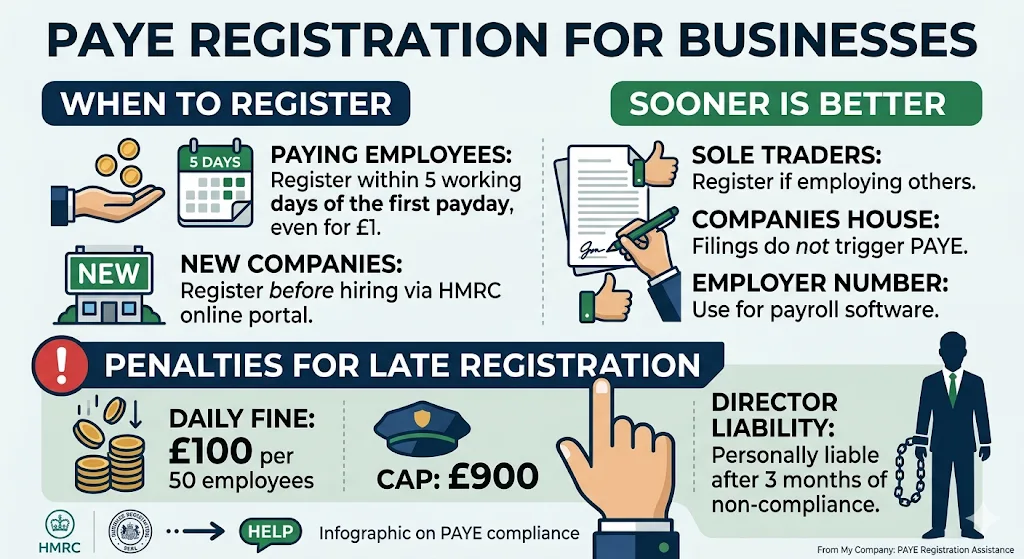
Register for PAYE within 5 working days of the first pay day if you pay employees, even £1. New companies register before hiring via the HMRC online portal.
HMRC enforces this timeline strictly. Late registration incurs £100 per 50 employees daily, capped at £900. Directors become personally liable after 3 months of non-compliance.
Sole traders register if they employ others. Companies House filings do not trigger PAYE. Use the employer number from registration for payroll software. From My Company handles PAYE Registration Assistance to meet deadlines.
Who Needs to Register for PAYE in the UK?
Employers paying salaries, wages, bonuses, or benefits to employees register for PAYE. This includes limited companies, partnerships, and sole traders with staff; contractors paid via payroll qualify too.
Employees differ from self-employed contractors. HMRC assesses IR35 status for intermediaries. Directors count as employees unless truly self-employed.
Casual workers over £123 weekly trigger registration. Pension payments to ex-employees require it. Charities and non-profits follow the same rules. Verify status using HMRC’s employee test: three factors control, mutuality of obligation, and personal service.
How Does the PAYE Registration Process Work?
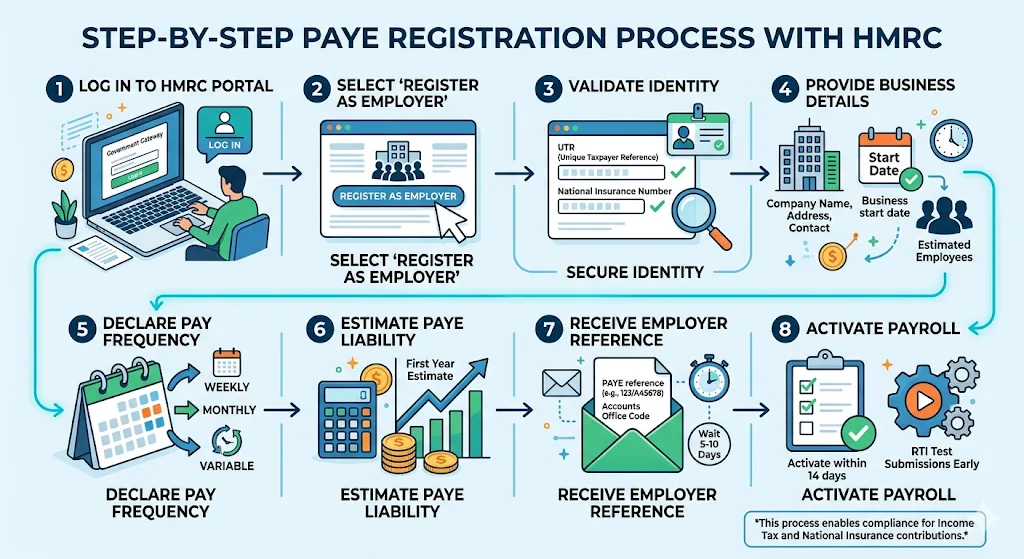
Submit online application via HMRC’s Government Gateway. Provide business details, start date, and estimated employee numbers; receive employer reference in 5-10 days.
Access Gateway with Unique Taxpayer Reference (UTR). Enter company name, address, and contact details. Select payroll software if applicable.
HMRC issues a PAYE reference (format 123/A45678) and an accounts office code. Activate payroll within 14 days. Test RTI submissions early.
From My Company streamlines this for seamless compliance.
Step-by-Step Online Registration
Log in to the HMRC portal.
Select “Register as employer.”
Validate identity with UTR or National Insurance number.
Declare pay frequency: weekly, monthly, or variable.
Estimate PAYE liability for the first year.
What Documents Are Required for PAYE Registration?
Provide UTR, National Insurance numbers for directors, business bank details, and estimated pay figures. No physical documents needed for online setup.
HMRC verifies details against Companies House records. Update the address if mismatched.
Attach VAT number if registered. Include the start date of the first payment.
Sole traders supply self-assessment UTR. Partnerships list all members’ details.
What Happens After PAYE Registration?
HMRC assigns an employer reference number and payment deadlines. Run payroll, submit RTI on payday, and pay HMRC by 22nd (electronic) or 19th (cheque/post).
Set up payroll software compliant with RTI. Software vendors like Sage or Xero integrate directly.
Reconcile payments quarterly via Full Payment Submission (FPS). Receive P60 end-of-year summaries for employees.
Audit trail records all transactions. HMRC inspects 15% of employers annually.
What Are Common PAYE Registration Mistakes?
Businesses delay registration past 5 days, omit RTI filings, or misclassify workers. These errors lead to £2,500 average fines per HMRC 2025 enforcement data.
Under-deducting tax incurs interest at 7.75%. Overpaying requires repayment claims within 4 years.
Wrong tax codes cause employee complaints. Update codes via the HMRC helpline immediately.
For deeper evaluation on compliance pitfalls, read our guide to employer tax obligations.
How Does PAYE Impact Cash Flow for SMEs?
PAYE deducts 20-45% income tax plus 13.8% employer NI from payroll. Businesses front costs monthly, recovering via client payments; poor planning strains 62% of SMEs, according to the British Chambers of Commerce.
Budget 25% above gross wages for liabilities. Use HMRC’s Time to Pay for shortfalls.
Forecast using payroll tools. Integrate with accounting software for real-time tracking.
What Payroll Software Supports PAYE Compliance?
HMRC-approved software like Sage 50, Xero, and QuickBooks automates RTI, deductions, and P45/P60S. Free HMRC basic tools suit micro-employers with under 10 staff.
Software validates submissions before sending. Export data for accountants.
Annual updates ensure compliance with NI rate changes. Test integrations during registration.
How Do Fines and Penalties Work for PAYE Non-Compliance?
Late RTI incurs £100-£400 per failure. Unpaid tax adds 4% surcharge after 30 days, plus 7.75% interest. Persistent issues lead to director disqualification.
HMRC issues nudge letters first. Escalate to debt collection after 90 days.
Appeal penalties within 30 days with evidence. 41% of appeals succeed if documented.
Also explore,
Our PAYE Assistance Package: Register Your Business Today
Get Your UK Business PAYE Ready – Professional Registration
Why Partner with Experts for PAYE Setup?
Professionals verify details, submit accurately, and integrate payroll from day one. This prevents 90% of setup errors, saving £3,000+ in fines annually.
From My Company provides PAYE Registration Assistance for hassle-free onboarding.
Ready to decide? Check our The Cost of PAYE Assistance vs. Potential HMRC Penalty Fees.
PAYE registration ensures legal tax handling. From My Company delivers precise assistance aligned with HMRC rules. Businesses maintain compliance without disruptions.
Frequently Asked Questions
What is PAYE registration for UK employers?
PAYE registration enrols businesses with HMRC to deduct income tax and National Insurance from employee wages before payout. Employers submit Real Time Information (RTI) on payday and pay HMRC monthly. From My Company offers PAYE Registration Assistance to handle the setup accurately.
How long do I have to register for PAYE after hiring staff?
Register within 5 working days of the first payday, even for minimal payments like £1. Late registration triggers £100 daily fines per 50 employees. From My Company’s PAYE Registration Assistance ensures timely compliance with HMRC deadlines.
What documents are needed for PAYE registration?
Provide your Unique Taxpayer Reference (UTR), business details, estimated employee numbers, and first pay date via HMRC’s online portal. No physical paperwork required for digital submission. From My Company verifies these for seamless PAYE Registration Assistance.
What happens if I miss PAYE registration deadlines?
HMRC imposes £100 fines per day per 50 employees, plus interest on unpaid tax at 7.75%. Directors face personal liability after delays. From My Company’s PAYE Registration Assistance prevents penalties through prompt filing.
Can PAYE Registration Assistance help new companies?
Yes, it covers new limited companies, sole traders, and partnerships from initial setup to RTI integration. Services include employer reference activation and payroll software guidance. From My Company specializes in PAYE Registration Assistance for startups.