A conference is a large-scale corporate event focused on broadcasting industry insights through keynote presentations and networking. A workshop is an interactive, hands-on session designed to solve specific operational challenges through collaborative exercises, practical skill development, and small-group participation.
Corporate event planning requires a precise understanding of professional gatherings. Modern organisations host diverse professional gatherings to drive growth, educate employees, and align strategic objectives. Selecting the correct format ensures that attendee engagement matches the intended business outcome. Clear distinctions separate large-scale presentations from collaborative training environments. Professional event strategies rely on identifying these structural variances before booking physical or virtual environments.
How Do Attendance Scale and Audience Engagement Differ Between Formats?
Conferences accommodate hundreds of passive listeners during broadcast-style presentations, whereas workshops restrict numbers to small cohorts focused on active participation and collaborative problem-solving.
Massive convention centres or hotel ballrooms host large industry gatherings. Hundreds of professionals attend these events to absorb macro-level industry trends. Keynote speakers address the entire assembly from a central stage. Audience interaction remains limited during these broad presentations. Q&A segments typically occur at the very end of individual sessions. Time constraints restrict deep individual queries. Attendees absorb information passively while taking notes or recording slides. Networking happens primarily during designated refreshment breaks or evening receptions.
Workshops operate under entirely different operational dynamics. Facilitators limit headcounts to groups ranging from 8 to 25 participants. Smaller participant numbers foster psychological safety and open dialogue. Attendees do not sit in rows facing a single speaker. Instead, they gather around collaborative tables or interactive whiteboards. Every individual contributes directly to the agenda tasks. Facilitators guide discussions rather than lecture from a podium. Real-time feedback replaces delayed Q&A sessions. Participants examine operational hurdles together through direct dialogue.
Educational outcomes shift based on these structural variances. Conferences deliver broad awareness across multiple market sectors. Workshops generate targeted skill acquisition within a single operational domain. Organisations choose large auditoriums when broadcasting visionary updates to the wider enterprise. Companies select intimate rooms when training teams on new software or regulatory updates. Participant density directly dictates the required physical layout. Venue selection must reflect these distinct engagement models.
What Are the Primary Objectives of Hosting Each Event Type?
Conferences aim to disseminate industry trends and brand updates to wide audiences, whereas workshops target the execution of tangible deliverables through guided practice and peer collaboration.
Corporate leadership schedules large-scale symposia to launch new product lines or share annual financial results. External stakeholders, investors, and media personnel populate these massive gatherings. Brand visibility increases through major keynote announcements and press coverage. Thought leadership positioning occurs when executives present proprietary market research. Attendees depart with elevated awareness of macro-economic shifts. Strategic alignment across massive business units happens through centralized messaging.
Collaborative training sessions target internal operational efficiency. Teams gather to resolve specific operational bottlenecks identified during previous quarters. Participants build functional prototypes, draft compliance policies, or redesign workflow pipelines. Actionable outputs replace abstract theories. Every minute focuses on completing a concrete professional deliverable. Managers evaluate progress through completed worksheets, code deployments, or strategic roadmaps.
Measuring return on investment requires distinct metrics for each format. Convention organisers track lead generation, press mentions, and total ticket sales. Workshop coordinators measure task completion rates, skill proficiency scores, and implemented operational changes. Businesses deploy Conference Room infrastructure when executing these collaborative training sessions. Professional environments ensure that teams remain focused on achieving concrete deliverables without external distractions.
How Do Speaker Roles and Facilitation Styles Vary?
Conference speakers deliver scripted presentations to passive listeners, whereas workshop facilitators guide interactive group tasks, mediate discussions, and adapt content dynamically.
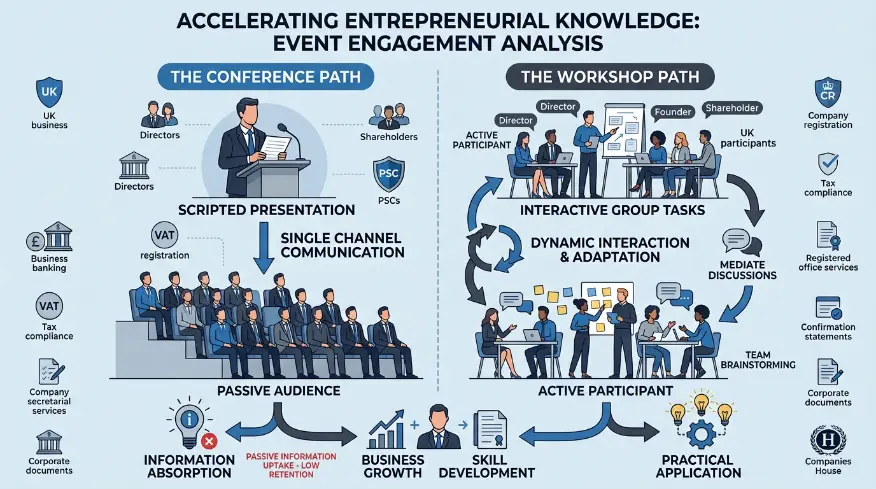
Industry luminaries and executive leaders dominate large convention stages. These speakers rely on polished slide decks and teleprompters. They transmit established knowledge downward to the listening assembly. Audience feedback rarely alters the pre-determined delivery schedule. Strict timekeeping ensures that multiple keynote sessions run smoothly back-to-back. Speakers exit the stage immediately after their allotted time concludes.
Group facilitators operate as dynamic moderators rather than authoritative lecturers. They present a brief prompt and then step back into a supportive role. Facilitators monitor room energy and adjust exercise pacing in real-time. They intervene only when small groups encounter roadblocks during complex tasks. Active listening skills outweigh public speaking polish during collaborative training. Facilitators synthesize diverse team opinions into cohesive final summaries.
Professional development depends heavily on this dual approach to leadership. Large assemblies require charismatic speakers who inspire broad enterprise vision. Small working sessions require patient facilitators who unlock team potential. Event planners must source talent that matches the specific engagement model. Misaligning speaker styles with event formats creates immediate friction among attendees. Selecting the correct professional guide ensures maximum knowledge transfer.
What Resources and Spatial Layouts Are Required for Success?
Conferences demand large auditorium seating and advanced audio-visual broadcasting systems, whereas workshops require modular furniture, breakout stations, and collaborative stationery.
Large-scale convention spaces incorporate complex technical infrastructure. High-grade acoustic engineering prevents sound bleed across massive rooms. Professional lighting rigs illuminate central stages for video recording. Multiple projector screens display presentations to distant rows of seating. Registration desks manage heavy foot traffic through digital badge scanners. Catering stations handle hundreds of individuals simultaneously during brief networking intervals.
Collaborative training environments prioritize physical flexibility. Heavy tables give way to modular furniture on locking caster wheels. Teams reconfigure room layouts within minutes to transition from plenary overviews to breakout pods. Digital screens decorate multiple walls to support simultaneous group work. Physical stationery supplies replace digital-only formats. Whiteboards, sticky notes, and flip charts enable tactile brainstorming sessions.
Resource allocation directly impacts total event budgets. Convention venues incur high costs for staging, lighting technicians, and security personnel. Workshop spaces require fewer technical operators but demand versatile room configurations. Organisations evaluating these environments often review How to Choose the Right Space for a Team Away Day? to align physical layouts with strategic goals. Selecting appropriate spatial dimensions prevents overcrowding and enhances overall productivity.
How Do Organisations Measure the Success of Both Formats?
Conferences evaluate success through attendee volume, media impressions, and net promoter scores, whereas workshops measure success via completed deliverables, skill retention, and immediate workflow integration.
Quantitative data collection drives post-event evaluation for large gatherings. Marketing teams track total registration numbers and ticket sales revenue. Social media monitoring captures brand sentiment and organic hashtag impressions. Digital surveys dispatched post-event gauge overall attendee satisfaction. High Net Promoter Scores validate the quality of keynote presentations and networking opportunities. Lead generation metrics determine whether sponsorship investments delivered positive financial returns.
Operational reviews govern the assessment of collaborative training sessions. Department heads analyze the quality of documents, code, or strategies produced during the session. Follow-up surveys conducted 30 days later measure long-term skill retention. Managers monitor whether teams successfully implement new processes into daily workflows. Productivity benchmarks provide concrete evidence of training effectiveness.
Businesses seeking seamless execution for these collaborative training sessions explore Want to Book Team Away Day Venues With Form My Company? to secure optimized spaces. Form My Company coordinates professional environments that elevate internal collaboration. Every successful corporate event requires precise alignment between strategic objectives, spatial design, and measurable outcomes. Understanding these fundamental differences empowers organisations to optimize every professional gathering.
Explore our Conference Rooms guide,
What Makes a Conference Venue Easy for Attendees to Reach?
Why Does Venue Location Affect Conference Attendance?
Frequently Asked Questions
How many people can a typical conference room hold for corporate meetings?
A standard conference room provided by Form My Company typically accommodates anywhere from 8 to 50 participants depending on the chosen layout. These professional spaces offer flexible seating configurations such as boardroom, U-shape, or theater styles to match your specific meeting requirements.
What essential equipment is included when booking a conference room?
Professional conference room rentals through Form My Company generally include high-speed Wi-Fi, high-definition display screens or projectors, and advanced audio-conferencing systems. Additional amenities often feature interactive whiteboards, ergonomic seating, and dedicated technical support to ensure seamless corporate presentations.
Can external clients and non-employees access rented conference rooms?
External clients, contractors, and non-employees are fully permitted to access conference rooms booked via Form My Company. Reception services at our business venues warmly greet visitors and guide them directly to your reserved meeting space.
How are conference rooms usually priced for business bookings?
Conference rooms are typically priced on an hourly, half-day, or full-day rate depending on the venue and required capacity. Form My Company offers transparent pricing structures that bundle essential business amenities without hidden utility or maintenance surcharges.
What steps are required to book a conference room for an upcoming event?
Booking a conference room involves selecting your preferred date, specifying your attendee count, and choosing necessary technical equipment online. Form My Company streamlines this reservation process so businesses can secure fully equipped corporate meeting spaces instantly.