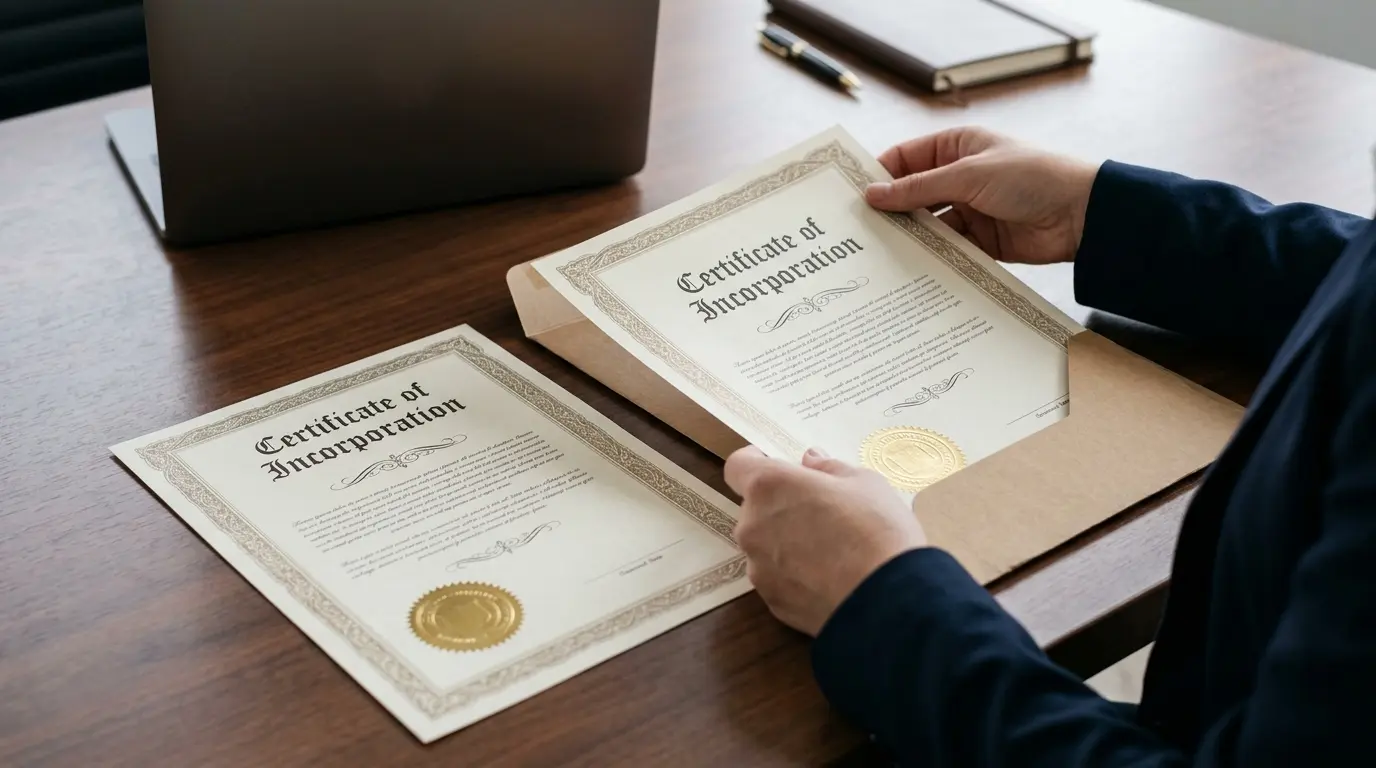
Suppliers ask for a Certificate of Incorporation to verify that a business is a legally registered corporate entity in the UK. This official document confirms company registration, prevents fraud, validates director authority, and satisfies mandatory anti-money laundering compliance before opening trade accounts or issuing credit terms.
What Information Does a Certificate of Incorporation Contain?
A Certificate of Incorporation contains official details including the legal company name, unique company registration number, date of formation, governing jurisdiction, and the Companies House seal confirming lawful corporate existence in the United Kingdom.
Companies House issues this statutory document upon official registration. The legal name proves the company operates under an approved commercial title. The unique company number acts as a permanent corporate identifier across all UK financial and legal systems.
The formation date establishes exact corporate age. Financial institutions and suppliers review this date to evaluate operational longevity. The jurisdiction clause specifies whether the business operates under the legal framework of England and Wales, Scotland, or Northern Ireland. The official seal authenticates the document against corporate fraud.
Why Do Suppliers Need to Verify Your Legal Company Existence?
Suppliers verify legal company existence to prevent identity fraud, confirm corporate legitimacy, ensure contract enforceability, and guarantee that the trading entity possesses valid standing under UK company law.
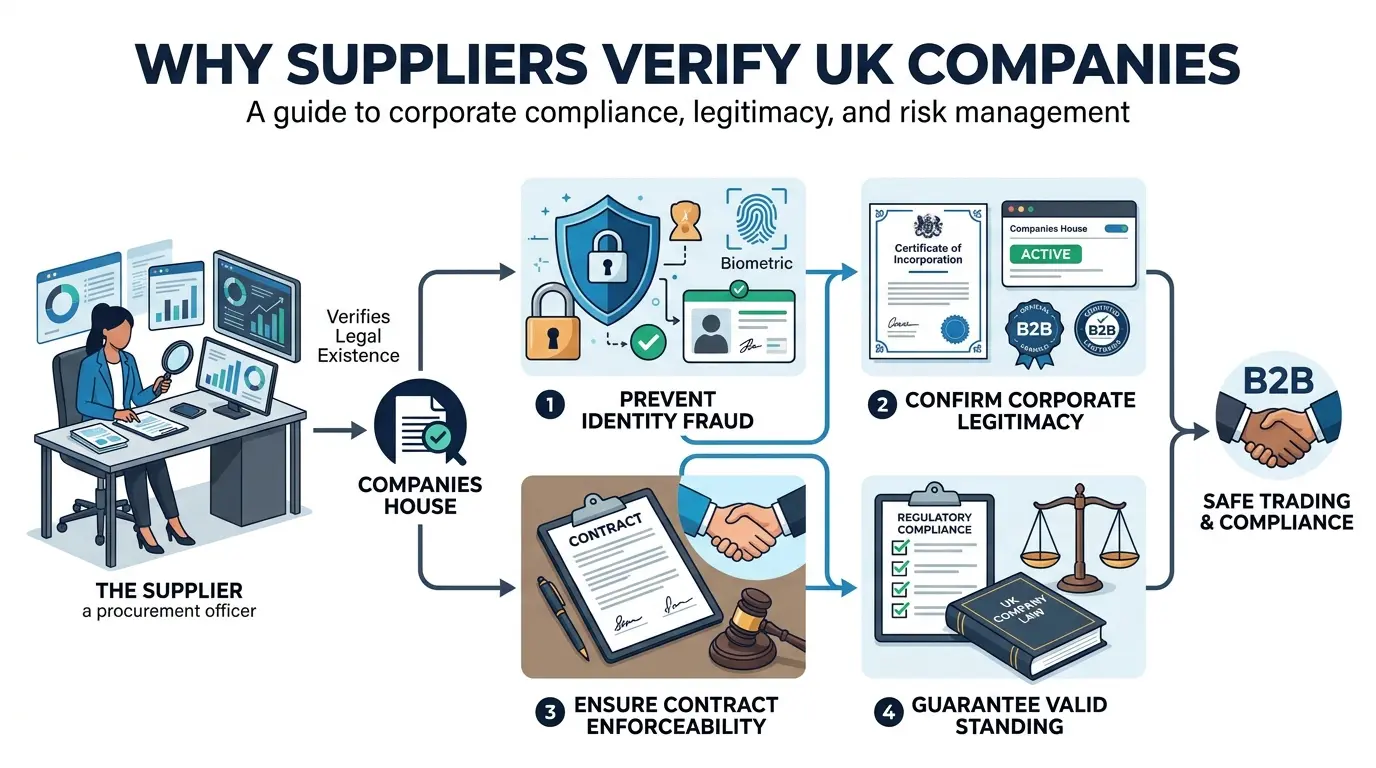
Unregistered entities cannot enter legally binding commercial contracts. Suppliers check corporate records to ensure that purchase agreements hold legal force in court. Trading with an unregistered business exposes suppliers to unrecoverable debts and legal invalidity.
Corporate verification protects supply chains from shell companies and impersonation scams. Fraudulent actors often fake business credentials to secure goods without payment. Checking official credentials ensures that the business exists as a distinct legal person capable of incurring debt and owning assets.
When commercial buyers require verified corporate documentation to pass onboarding checks, ordering supplementary company documents ensures rapid legal authentication without transaction delays.
How Does a Certificate of Incorporation Protect Suppliers From Trade Credit Risk?
A Certificate of Incorporation protects suppliers from credit risk by establishing the corporate structure, enabling accurate credit reference checks, confirming limited liability status, and validating financial accountability.
Commercial credit terms allow buyers to receive inventory before submitting payment. Suppliers extend 30-day, 60-day, or 90-day trade credit lines based on risk assessments. The official company number allows credit reference agencies to pull precise financial histories, filing records, and public balance sheets.
Limited liability status changes how creditors pursue unpaid debts. Suppliers must know whether they deal with a sole trader, partnership, or limited company. Sole traders hold personal liability for business debts. Limited companies restrict liability to corporate assets.
Understanding this distinction dictates trade credit limits and payment terms. Credit risk managers examine public filing histories to detect past insolvencies, late accounts, or county court judgments before approving credit lines.
What Compliance Regulations Require Suppliers to Request Incorporation Proof?
Anti-money laundering laws, Know Your Customer regulations, and tax compliance frameworks require suppliers to collect official incorporation proof before establishing ongoing B2B commercial relationships.
The UK Money Laundering Regulations mandate strict due diligence on commercial clients. B2B businesses must verify customer identities to prevent financial crime, money laundering, and terrorist financing. Failing to verify commercial clients results in severe regulatory fines and criminal liability for supply chain operators.
Know Your Customer frameworks demand independent verification of corporate structures. Suppliers must identify ultimate beneficial owners who control more than 25% of corporate shares. The incorporation document serves as the foundational legal record for tracing corporate ownership chains.
Tax authorities inspect corporate trading records during routine audits. Suppliers must prove that VAT invoices correspond to legitimate, registered corporate entities. Unverified client accounts trigger tax penalties and auditing red flags during statutory compliance reviews.
How Do Suppliers Verify the Authenticity of Your Incorporation Certificate?
Suppliers verify authenticity by cross-referencing company details against the Companies House public register, checking corporate filing histories, and confirming active director appointments.
Digital verification systems match the certificate details against official government databases. Compliance officers enter the unique registration number into the public register. Any discrepancy in company name, registered address, or incorporation date flags the application for manual investigation.
Suppliers analyze the corporate status listed on government registries. Active status confirms that the business maintains compliance and authority to trade. Statuses like active proposal to strike off, liquidation, or administration signal immediate financial distress and lead to rejected credit applications.
If you need to prepare official proof for trade credit applications, reviewing how to supply incorporation proof for trade credit accounts simplifies vendor onboarding workflows.
Who Has the Authority to Submit an Incorporation Certificate to Suppliers?
Appointed company directors, registered company secretaries, and formally authorized corporate officers hold legal authority to submit incorporation documentation to commercial suppliers.
Corporate governance rules dictate who represents a limited company. Directors carry fiduciary duties and legal standing to sign contracts and submit official documentation. Suppliers cross-check applicant names against listed director records on official registers to prevent unauthorized employee requests.
Company secretaries manage administrative compliance and official documentation. When authorized officers submit onboarding paperwork, suppliers require formal confirmation of their administrative capacity. Unauthorized submissions increase fraud risks and delay account approvals.
Third-party agents or procurement officers require explicit written authorization. Power of attorney documents or official board resolutions prove administrative authority. Suppliers reject documentation submitted by unverified individuals to ensure corporate contract validity.
What Other Company Documents Do Suppliers Request Alongside Incorporation Proof?
Suppliers request register of directors, confirmation statements, utility bills, VAT registration certificates, and bank account statements alongside incorporation proof to complete full vendor onboarding.
Verification requires multiple overlapping proof points. The incorporation document proves legal formation, but secondary documents confirm active operational status. Confirmation statements prove that statutory filings remain up to date with government registrars.
Proof of address documents validate physical operational premises. Suppliers request recent utility bills, commercial lease agreements, or bank statements dated within 3 months. Address validation ensures that the business operates from a physical location rather than a temporary mailing address.
VAT registration certificates confirm tax compliance for high-value B2B transactions. Bank account details must match the exact corporate name listed on the registration certificate. Mismatched account names trigger anti-fraud alerts and pause commercial onboarding.
What Happens If a Company Cannot Provide a Certificate of Incorporation?
Failing to provide a Certificate of Incorporation results in immediate credit rejection, mandatory advance payment terms, restricted trade account access, or vendor application cancellation.
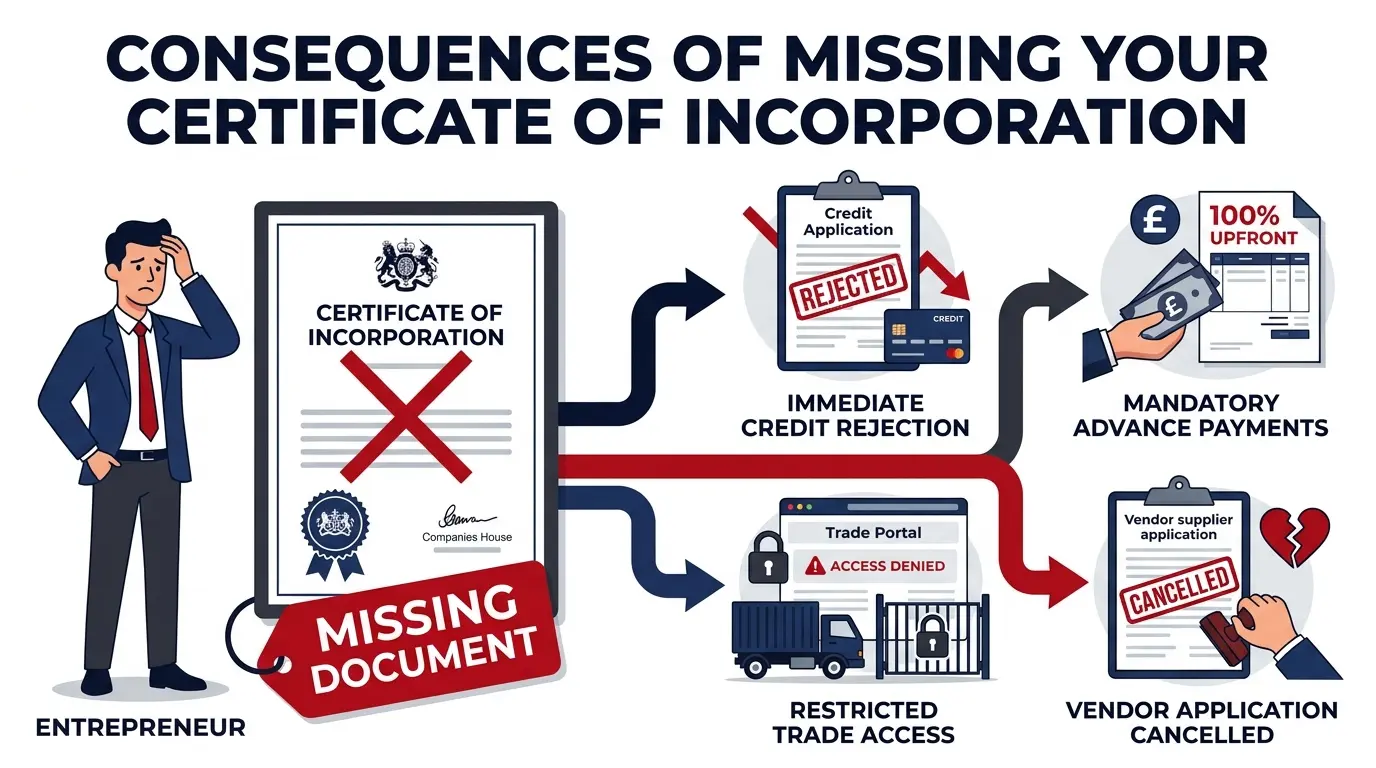
Commercial suppliers maintain strict risk thresholds for vendor onboarding. Missing incorporation documents prevent compliance officers from clearing Know Your Customer protocols. Uncleared accounts remain blocked from accessing wholesale pricing structures and credit facilities.
Suppliers shift unverified clients to cash-on-delivery or advance payment terms. Proving financial stability without legal documentation remains difficult. Businesses face restricted order volumes until complete corporate documentation satisfies internal risk policies.
To secure official documentation quickly for vendor setup, you can get a supplier-ready Certificate of Incorporation from Form My Company to streamline your commercial approvals.
Streamlining Your Vendor Onboarding Process
Providing official incorporation proof is a standard B2B compliance requirement across the UK commercial sector. Suppliers demand this statutory documentation to verify legal status, satisfy regulatory mandates, and manage credit risk effectively.
Maintaining accurate, accessible corporate records ensures seamless vendor account setup and uninterrupted supply chain operations. Form My Company assists businesses by retrieving, preparing, and delivering official company documentation required for commercial trade verification.
Explore More Supplementary Company Documents Guide,
What Do Investors Look for in Your Articles of Association?
What Are the Share Transfer Rules in Articles of Association?
Frequently Asked Questions
What are supplementary company documents in the UK?
Supplementary company documents are official legal certificates and administrative filings issued by Companies House that provide proof of a business’s standing beyond the basic Certificate of Incorporation. These records include documents such as Certificates of Good Standing, Memorandum and Articles of Association, and official change of name certificates. Businesses frequently order supplementary company documents through Form My Company to satisfy bank onboarding, international trade, or vendor compliance requirements.
How do I obtain official supplementary company documents for my business?
You can request official supplementary company documents directly from Companies House or through a corporate service provider like Form My Company. These documents are generated from public registry filings and can be delivered as digital PDFs or certified hard copies. Form My Company retrieves and prepares certified supplementary company documents to help businesses complete legal and commercial verification quickly.
Why do banks and suppliers request supplementary company documents?
Financial institutions and trade suppliers require supplementary company documents to conduct Know Your Customer (KYC) checks and verify corporate governance structures. Documents like shareholder registers and confirmation statements confirm current ownership, registered addresses, and active trading status. Providing verified supplementary company documents ensures compliance with UK anti-money laundering regulations during account setup.
What is the difference between a Certificate of Incorporation and supplementary company documents?
A Certificate of Incorporation is the foundational document issued when a company is first registered, proving its initial legal formation. Supplementary company documents consist of ongoing statutory records and official updates that reflect the company’s current operational status, management, and regulatory compliance. Form My Company assists business owners in obtaining both primary incorporation documents and updated supplementary filings for legal proof.
Can supplementary company documents be apostilled or legalised for international use?
Yes, UK supplementary company documents can be certified, apostilled by the Foreign, Commonwealth & Development Office (FCDO), or legalised by foreign embassies for overseas trade and branch operations. Official certificates like a Certificate of Good Standing are regularly legalised to prove legal capacity abroad. Form My Company helps businesses acquire official supplementary company documents formatted and legalised for international regulatory compliance.