
To properly close a dormant company in the UK, directors must apply for voluntary strike-off using form DS01, ensure all liabilities are settled, notify relevant stakeholders, and submit final dormant accounts if required. Companies House then reviews and dissolves the company within approximately 3 months.
What does it mean to close a dormant company in the UK?
Closing a dormant company means legally removing it from the Companies House register through a formal dissolution process. The company must have no trading activity, no debts, and must meet strict eligibility criteria before directors can initiate voluntary strike-off procedures.
A dormant company holds no significant accounting transactions during a financial year. Companies House defines this clearly under UK compliance rules. Transactions such as filing fees, penalties, or share allotments do not count as trading activity. Closing such a company involves striking it off the register. This differs from liquidation, which applies to active or insolvent businesses. Dormant company closure remains simpler but still requires legal accuracy.
Directors must confirm three key conditions before applying. The company has not traded within the last 3 months, holds no outstanding liabilities, and has not changed its name during that period. Failure to meet these conditions can result in rejection or investigation. Companies House maintains strict oversight to prevent misuse of dissolution processes.
When is the right time to close a dormant company?
The right time to close a dormant company is when it has remained inactive for at least 12 months, holds no assets or liabilities, and no longer serves a strategic, financial, or legal purpose for the directors or shareholders.
Dormant companies often remain registered for future use. However, keeping an unused entity active increases compliance risks. Annual filing obligations still apply, including confirmation statements and dormant accounts. Late filings trigger penalties starting from £150 and rising to £1,500 depending on delays. Directors remain legally responsible even if the company is inactive.
Closure becomes practical when no future trading is planned. For example, businesses formed for testing ideas, holding intellectual property, or reserving a name often become redundant. Timing also matters when aligning with accounting periods. Filing final dormant accounts before closure ensures compliance and avoids enforcement action.
What steps are required to close a dormant company?
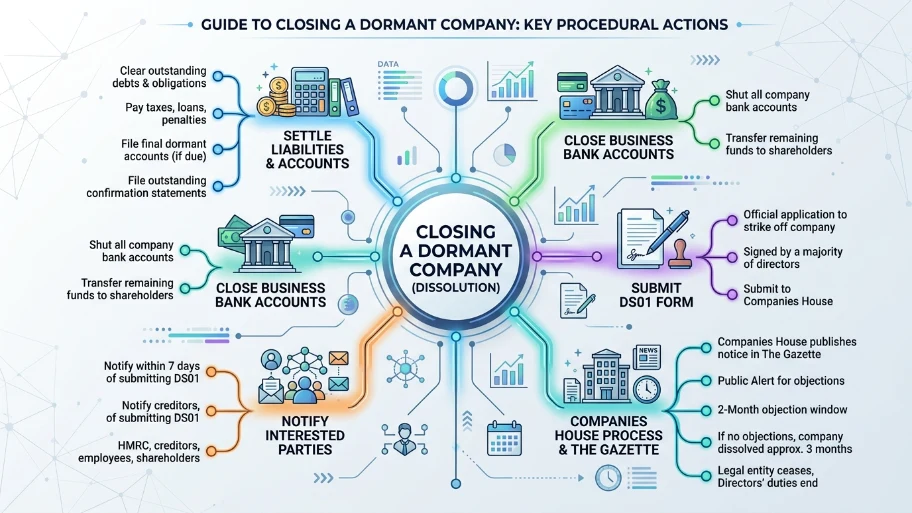
Closing a dormant company involves submitting form DS01, notifying interested parties within 7 days, ensuring all liabilities are cleared, filing final dormant accounts if due, and waiting for Companies House to publish and process the dissolution request.
The process follows a structured sequence regulated by Companies House.
Key procedural actions
- Submit the DS01 form signed by a majority of directors
- Notify stakeholders, including HMRC, creditors, employees, and shareholders
- Settle outstanding liabilities, including taxes, loans, and penalties
- Close business bank accounts and transfer any remaining funds
- File outstanding confirmation statements or dormant accounts
After submission, Companies House publishes a notice in The Gazette. This serves as a public alert. Interested parties can object within a 2-month window. If no objections arise, the company will be dissolved after approximately 3 months. The legal entity ceases to exist, and directors’ responsibilities end. Accuracy at each step ensures smooth processing. Errors or omissions can delay dissolution or lead to reinstatement risks.
Do you need to file dormant accounts before closing?
Yes, dormant companies must file any outstanding dormant accounts before closure if they are due. Companies House requires all compliance obligations to be met, ensuring accurate financial records are maintained up to the point of dissolution.
Dormant accounts confirm that the company has had no significant financial activity. These filings remain mandatory even if the company is inactive. Missing deadlines leads to automatic penalties. Filing before closure prevents enforcement actions and protects director records.
Using a professional service such as File Accounts for Dormant Companies ensures compliance accuracy. This service validates records, prepares compliant submissions, and reduces filing errors. For companies nearing their accounting deadline, completing filings before submitting DS01 avoids rejection. Companies House cross-checks compliance history before approving dissolution.
What happens after submitting the DS01 form?
After submitting the DS01 form, Companies House publishes a strike-off notice in The Gazette, allowing objections within 2 months. If no objections occur, the company is removed from the register and legally dissolved within approximately 3 months.
The Gazette acts as an official public record. It ensures transparency and allows creditors or stakeholders to raise concerns. Objections may arise for several reasons. Examples include unpaid debts, ongoing legal disputes, or HMRC investigations. Any valid objection pauses the process.
Directors must monitor communication during this period. Companies House may request clarification or additional documentation. Once dissolved, the company’s assets, if any remain, transfer to the Crown under bona vacantia rules. This reinforces the importance of clearing all assets before applying.
Can a dormant company be restored after closure?
Yes, a dissolved dormant company can be restored within 6 years through administrative restoration or court order, provided the eligibility criteria are met, and all outstanding documents and fees are submitted to Companies House.
Restoration allows businesses to recover legal status if closure was premature or incorrect. Administrative restoration applies in most standard cases. Directors must submit missing filings, pay penalties, and provide a valid reason for reinstatement. The process typically takes 2 to 8 weeks, depending on complexity.
Court restoration applies when administrative routes are unavailable. This involves legal proceedings and higher costs. Restoration does not erase compliance history. Late filings and penalties remain on record. This makes accurate closure procedures essential from the start.
Why is professional support useful when closing a dormant company?
Professional support ensures accurate filings, prevents compliance errors, and reduces the risk of objections or penalties. Experts manage documentation, verify eligibility, and ensure Companies House requirements are fully met throughout the closure process.
Closing a company appears simple, but it involves strict compliance checks. Errors in DS01 submission, missed filings, or incorrect notifications can delay or invalidate the process. Professional services streamline this process. They verify eligibility, prepare documentation, and ensure all statutory obligations are fulfilled. For deeper insight into compliance accuracy and deadlines, see this guide on why professional filing services ensure compliance with legal deadlines. Using structured services reduces administrative burden. It also ensures that records align with Companies House standards.
What risks should directors consider before closing a dormant company?
Directors must consider risks such as unresolved liabilities, stakeholder objections, loss of company name, and potential restoration costs. Failure to follow proper procedures can result in legal consequences, financial penalties, or delays in dissolution.
Closing a company permanently removes its legal identity. Directors lose rights to the company name once dissolved. Another entity can register it immediately. Outstanding liabilities remain a critical risk. Creditors can object to dissolution and initiate legal recovery processes.
Incorrect filings or failure to notify stakeholders within 7 days breaches the Companies Act requirements. This can lead to fines or disqualification risks. Directors must also consider future business plans. Re-registering a company involves additional time, cost, and administrative effort. Evaluating these risks ensures informed decision-making before initiating closure.
Explore our File Accounts for Dormant Companies guides,
Why Your Dormant Company Needs a Registered Office Address for Official Mail
Understanding the Role of HMRC and Companies House for Inactive Business Entities
How does closing a dormant company compare to keeping it active?
Closing a dormant company eliminates ongoing compliance obligations, filing costs, and administrative responsibilities, while keeping it active preserves future business opportunities but requires annual filings, confirmation statements, and adherence to UK corporate regulations.
Maintaining a dormant company requires annual submissions. These include confirmation statements and dormant accounts. Even without trading, compliance remains mandatory. Closing removes these obligations entirely. This reduces administrative workload and eliminates late filing risks.
However, keeping a dormant company active offers strategic advantages. Businesses often retain entities for future expansion, intellectual property holding, or brand protection. The decision depends on business goals. If no future use exists, closure provides efficiency. If flexibility is required, maintaining dormant status remains viable.
Properly closing a dormant company in the UK requires strict adherence to Companies House procedures, accurate filings, and timely notifications. Directors must ensure all obligations are fulfilled before submitting the DS01 form to avoid delays or legal risks.
From My Company supports this process through structured compliance services, including File Accounts for Dormant Companies, ensuring accurate documentation and regulatory alignment. For those ready to proceed efficiently, explore expert dormant account support and company closure assistance to manage every step with precision.
Frequently Asked Questions
What is included in the File Accounts for Dormant Companies service?
The File Accounts for Dormant Companies service prepares and submits compliant dormant accounts to Companies House, ensuring directors meet UK filing obligations without trading activity. From My Company handles the documentation, validation, and submission to prevent penalties.
When must a dormant company file accounts with Companies House?
A dormant company must file dormant accounts within 9 months after its accounting reference date, even if no trading occurred. From My Company’s File Accounts for Dormant Companies service ensures timely submission to avoid late-filing penalties.
How do I know if my company qualifies as dormant for accounting purposes?
A company qualifies as dormant if it has had no significant accounting transactions during the financial year, excluding filing fees or share allotments. The File Accounts for Dormant Companies service from From My Company verifies eligibility and prepares compliant filings.
What happens if I fail to file dormant accounts on time?
Late filing triggers automatic penalties starting at £150 and rising to £1,500 depending on delays, plus potential enforcement action. From My Company’s File Accounts for Dormant Companies service ensures accurate, on-time submissions to avoid these consequences.
Can I file dormant accounts myself or should I use a professional service?
Directors can file dormant accounts themselves using Companies House forms, but professional support reduces errors and ensures compliance. From My Company’s File Accounts for Dormant Companies service provides expert validation and submission for peace of mind.