
Minimising distractions during corporate training requires structured environments, controlled digital access, and purpose-designed training rooms. Organisations achieve this by limiting interruptions, enforcing device protocols, and selecting dedicated off-site venues that optimise focus, engagement, and measurable learning outcomes across all participants.
What are the main causes of distractions during corporate training sessions?
The main causes include digital interruptions, poor room setup, unclear agendas, and external noise. These factors reduce attention span, disrupt knowledge retention, and lower engagement levels, especially in sessions exceeding 90 minutes without structured breaks or controlled environments.
Digital interruptions remain the leading issue. Internal studies across UK workplaces show that employees check their devices every 11 minutes during training. Notifications, emails, and messaging apps break concentration and extend session time by up to 25%. Room setup directly affects cognitive focus. Poor lighting, uncomfortable seating, and overcrowded layouts create physical discomfort. When participants shift attention to comfort, learning efficiency drops.
Unclear agendas reduce mental engagement. When training lacks defined outcomes, participants disengage within the first 20 minutes. Structured timelines and clearly stated objectives maintain attention. External noise also plays a measurable role. Open office environments introduce unpredictable disruptions such as conversations, phone calls, and movement. These interruptions reduce retention rates by approximately 30% in group learning environments.
How does the training environment impact focus and engagement?
The training environment influences attention by controlling sensory input, seating dynamics, and interaction flow. Purpose-built environments improve concentration levels by up to 40% compared to standard office settings, enabling participants to process information faster and retain it longer.
Environmental control starts with spatial design. Dedicated training rooms use layouts such as U-shape, classroom, and boardroom styles. Each layout supports different interaction types, including discussion, presentation, or collaboration. Lighting and acoustics also determine engagement levels. Natural lighting improves alertness by 15%, while soundproofing reduces cognitive fatigue caused by background noise. These factors directly influence how long participants remain focused.
Temperature control affects cognitive performance. Studies show that temperatures between 20°C and 22°C maintain optimal concentration. Environments outside this range lead to faster mental fatigue. Organisations that use professional training rooms for corporate sessions benefit from controlled environments that eliminate common workplace distractions. These spaces are designed specifically for structured learning and consistent engagement.
Why do digital devices reduce training effectiveness?
Digital devices reduce effectiveness by fragmenting attention, increasing cognitive switching, and lowering retention rates. Participants exposed to frequent notifications retain up to 37% less information compared to those in controlled, device-managed training environments.
Attention fragmentation occurs when participants shift between tasks. Each interruption forces the brain to reprocess context, which slows comprehension and reduces learning efficiency. Cognitive switching increases mental fatigue. When participants alternate between training content and digital tasks, their ability to absorb complex information declines significantly. Notifications create habitual distraction loops. Even silent alerts trigger attention shifts. This behaviour becomes automatic, especially in sessions longer than one hour.
Organisations implement three control methods to manage device distractions:
- Enforce device-free policies during key sessions
- Use scheduled breaks for digital access
- Provide printed or offline training materials
These methods create structured engagement and improve information retention across teams.
How can structured agendas reduce distractions?
Structured agendas reduce distractions by defining clear timelines, learning objectives, and session flow. Participants remain focused when they understand session goals, expected outcomes, and time allocation for each activity within the training program.
Clarity improves engagement. When participants know what they will learn and how long each segment lasts, they allocate attention more effectively. This reduces mental drift. Time segmentation supports sustained focus. Sessions are divided into 30–45 minute blocks to maintain attention levels. Each segment introduces a new concept, discussion, or activity.
Defined outcomes create accountability. When participants expect measurable results, such as skill application or assessment, they remain engaged throughout the session. Structured agendas also reduce unnecessary interruptions. Trainers spend less time clarifying objectives or redirecting discussions. This improves overall session efficiency and learning consistency.
What role does professional venue selection play in distraction control?
Professional venues reduce distractions by offering controlled environments, dedicated resources, and optimised layouts. These venues eliminate workplace interruptions and provide consistent conditions that support structured learning and high participant engagement.
Venue selection directly influences training outcomes. Office-based sessions face interruptions from internal operations, including meetings, calls, and employee movement. Off-site venues remove these variables. Professional venues provide essential infrastructure. This includes high-quality audiovisual systems, ergonomic seating, and reliable connectivity. Each element supports uninterrupted delivery of training content.
Dedicated support staff also improve session flow. Technical issues are resolved quickly, reducing downtime and maintaining engagement. Organisations managing multi-location teams often prefer centralised facilities. Insights from centralised training room advantages for corporate teams explain how unified venues improve coordination and reduce logistical distractions across branches.
How can facilitators actively manage participant distractions?
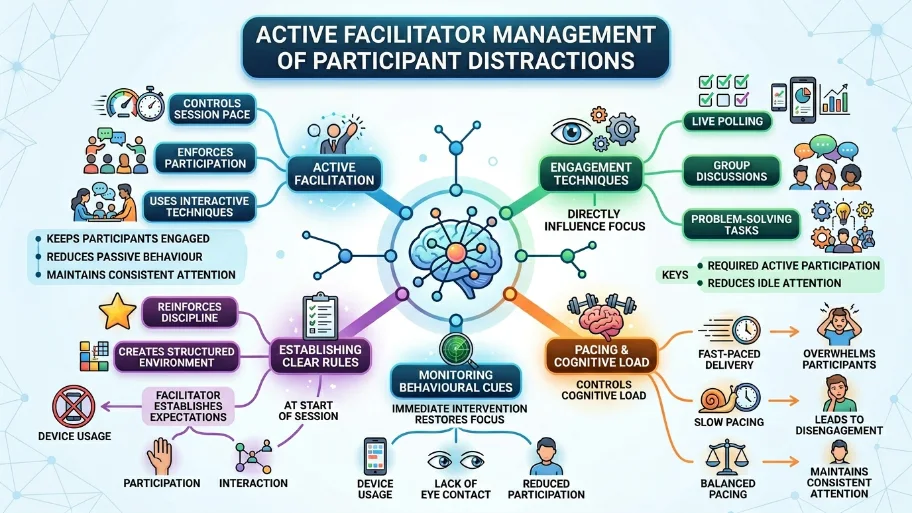
Facilitators manage distractions by controlling session pace, enforcing participation, and using interactive techniques. Active facilitation keeps participants engaged, reduces passive behaviour, and maintains consistent attention throughout the training session.
Engagement techniques directly influence focus. Facilitators use methods such as live polling, group discussions, and problem-solving tasks. These activities require active participation, which reduces idle attention. Pacing controls cognitive load. Fast-paced delivery overwhelms participants, while slow pacing leads to disengagement. Balanced pacing maintains consistent attention.
Facilitators also monitor behavioural cues. Signs such as device usage, lack of eye contact, or reduced participation indicate disengagement. Immediate intervention restores focus. Clear rules reinforce discipline. At the start of the session, facilitators establish expectations regarding device usage, participation, and interaction. This creates a structured environment.
How does room layout influence attention and collaboration?
Room layout influences attention by directing visual focus, controlling movement, and supporting interaction. Structured layouts improve engagement by aligning participant positioning with training objectives and communication flow.
Different layouts serve specific purposes. A classroom layout supports structured learning and note-taking. A U-shaped layout encourages discussion and visibility. A boardroom setup facilitates decision-making sessions. Visual alignment improves comprehension. When all participants face the presenter or screen, distractions reduce significantly. Misaligned seating leads to side conversations and disengagement.
Space management also affects comfort. Overcrowded rooms restrict movement and reduce focus. Adequate spacing allows participants to remain comfortable during longer sessions. Movement pathways influence interaction. Facilitators who can move freely within the room maintain stronger engagement. Physical proximity encourages participation and accountability.
What strategies improve long-session focus and retention?
Long-session focus improves through scheduled breaks, varied content delivery, and interactive learning techniques. These strategies prevent cognitive fatigue and maintain consistent engagement over sessions lasting more than two hours.
Break scheduling plays a critical role. A 10-minute break every 60–90 minutes resets attention levels. Without breaks, retention declines rapidly after the first hour. Content variation sustains interest. Combining presentations, discussions, and practical exercises prevents monotony. Each format engages different cognitive processes.
Interactive learning reinforces retention. Activities such as case analysis, simulations, and group tasks increase knowledge application. Participants retain up to 60% more information when actively involved. Hydration and nutrition also affect focus. Providing water, tea, and light refreshments supports sustained energy levels during extended sessions.
Explore our training rooms guides,
The Connection Between a Professional Training Space and Successful Skills Development Outcomes
Why Modern Training Rooms Need High-Speed Internet and Advanced Digital Tools
How can organisations measure and reduce distraction levels effectively?
Organisations measure distractions using engagement metrics, feedback data, and performance outcomes. These insights identify weak points in training delivery and support targeted improvements in environment, structure, and facilitation methods.
Engagement metrics include participation rates, session completion, and interaction frequency. These indicators reveal how actively participants engage with the content. Feedback surveys provide qualitative insights. Participants report environmental issues, pacing concerns, and distraction sources. This data guides improvements in future sessions.
Performance outcomes validate effectiveness. Post-training assessments measure knowledge retention and skill application. Lower scores often indicate distraction-related issues.
Tracking three key indicators improves optimisation:
- Monitor participation levels during sessions
- Analyse post-training assessment scores
- Evaluate feedback on the environment and delivery
Organisations that consistently analyse these metrics achieve measurable improvements in training effectiveness.
Minimising distractions during corporate training requires deliberate control over the environment, structure, and participant behaviour. Disruptions originate from digital devices, poor planning, and unsuitable venues. Each factor directly impacts engagement, retention, and overall training outcomes.
Organisations achieve consistent results by using structured agendas, enforcing device management, and selecting purpose-built environments. Professional venues provide controlled settings that eliminate common workplace interruptions and support focused learning.
For decision-stage planning, organisations seeking reliable outcomes often explore booking professional corporate training sessions with guaranteed results. Providers such as From My Company deliver dedicated training rooms designed for structured, distraction-free learning environments that support measurable performance improvement.
Frequently Asked Questions
What are training rooms used for in corporate businesses?
Training rooms are dedicated spaces used for corporate learning sessions, workshops, and team development programs. From My Company provides professional training rooms designed to support focused, distraction-free learning for organisations of all sizes.
How much does it cost to book a corporate training room in the UK?
Pricing for corporate training rooms varies based on location, capacity, and duration, typically ranging from £50 to £150 per half-day. From My Company offers flexible booking options for training rooms with transparent pricing tailored to SME and enterprise needs.
What features should a good corporate training room have?
A good corporate training room includes ergonomic seating, reliable AV equipment, soundproofing, and controlled lighting. From My Company equips its training rooms with these essential features to ensure smooth delivery of professional development sessions.
Can I book a training room for a full-day corporate workshop?
Yes, corporate training rooms can be booked for full-day workshops, with many venues offering packages including refreshments and technical support. From My Company enables full-day bookings for training rooms to accommodate multi-session team development programs.
Where can I find centralised training rooms for multi-branch companies?
Centralised training rooms are available in key business hubs, ideal for multi-branch organisations seeking consistent learning environments. From My Company offers centralised training rooms that support coordination across multiple corporate locations.