
Brunei residents can open UK companies in 2026 by registering a private limited company (Ltd) with Companies House, appointing at least one director, and meeting identity and address verification requirements. They may use a UK service address and a nominee or agent for compliance.
What legal structure can a Brunei resident use to form a UK company?
A Brunei resident can register a private company limited by shares (Ltd) as the standard structure for trading and holding activities in the UK.
A private company limited by shares limits shareholder liability to unpaid share capital. Companies House accepts overseas directors and shareholders. The company requires at least one director (natural person) and one shareholder, who may be the same individual. The company needs a registered office in the UK to receive statutory correspondence. This structure suits trading, holding assets, and simple cross-border operations.
What are the director and shareholder requirements for non‑UK residents?
At least one natural person must act as director; shareholders may be individuals or corporate entities, including overseas residents.
Directors must be 16 or older and provide personal details to Companies House. Companies House does not require directors to live in the UK. The company must maintain a register of directors and shareholders and file confirmation statements annually. For corporate shareholders, register the legal entity name, registration number, and registered address. The company must keep statutory records and file accounts with HMRC and Companies House.
What identity and verification steps must Brunei residents complete?
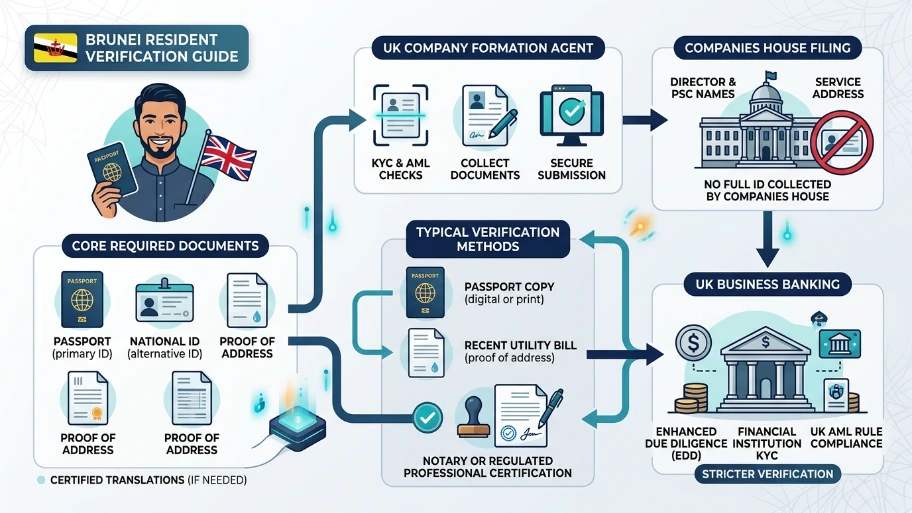
Brunei residents must verify identity using a passport or national ID and validate a service or residential address during company formation and ongoing KYC checks.
Formation agents and banks require passport scans, proof of address (utility bill, bank statement), and sometimes certified translations. Companies House collects director names and service addresses, but not full ID. Financial institutions run enhanced due diligence under UK anti‑money laundering rules. Typical verification methods: provide a passport copy, submit a recent utility bill, or complete a certification by a notary or regulated professional.
Can a Brunei resident use a UK-registered office and agent?
Yes. A Brunei resident can appoint a UK-registered office provider and a company formation agent to act as the company’s service address.
The registered office must be a UK postal address and is publicly available on Companies House records. Agents often provide mail forwarding, statutory filing, and compliance reminders. Use a reputable provider to ensure timely handling of Companies House notices and filing deadlines. Appointing a UK resident agent does not replace the legal obligations of directors and shareholders.
How does UK tax residency affect a company controlled from Brunei?
A UK company is taxed on worldwide profits if it is a UK tax resident, which depends on where central management and control are exercised.
HMRC considers where board meetings are held, where directors make strategic decisions, and where day‑to‑day management occurs. If central management and control remain in Brunei, the UK company may be non‑resident for corporation tax but still subject to UK tax on UK‑source income. Directors should document decision locations and hold meetings in the intended jurisdiction to support residency status. Seek professional tax advice to avoid inadvertent UK tax residency.
Will forming a UK company create double tax exposure for Brunei residents?
Forming a UK company does not automatically create double taxation if the company’s tax residency and dividend treatment are managed using tax rules and available reliefs.
The UK and Brunei do not have a comprehensive double taxation agreement covering all taxes. Brunei has territorial taxation for individuals and certain tax rules for companies. To prevent double taxation, use strategies: determine corporate residency, apply unilateral tax reliefs, and use tax-efficient dividend policies. For income repatriation, follow both jurisdictions’ rules and document transactions. The article
How Brunei Residents Structure Income Through a UK Company Without Double Tax Exposure explains structure options and reliefs in detail. And build a Tax-Efficient UK Company from Brunei with Form My Company.
What bank and payment options are available to UK companies owned by Brunei residents?
UK companies can open UK bank accounts, use international business accounts, and accept card and electronic payments after passing KYC checks.
Banks require company incorporation documents, director IDs, proof of registered office, and business plans. Some UK banks restrict onboarding for high‑risk jurisdictions; use specialist international banks or fintech providers when necessary. Options include UK high‑street banks, challenger banks, and regulated payment providers. Each provider enforces anti‑money laundering checks and may require in‑person verification or video ID checks.
What ongoing compliance and filing obligations apply to UK companies?
Companies must file annual accounts, confirmation statements, corporation tax returns, and update Companies House within 14 days of registered officer or director changes.
Annual accounts report the financial position and must be filed with Companies House on schedule. File a confirmation statement every 12 months to confirm company details. Register for Corporation Tax within 3 months of starting trading. Comply with PAYE and VAT rules if employing staff or exceeding VAT thresholds. Non‑compliance triggers fines and enforcement actions. Use a registered agent or accountant to manage deadlines.
What practical steps should a Brunei resident follow to form a UK company?
Register a company with Companies House, appoint a registered office and director, verify identity, open bank accounts, and register with HMRC for tax purposes.
Step 1: Choose a company name and structure and check availability. Step 2: Complete incorporation documents and submit to Companies House online or via an agent. Step 3: Appoint director(s) and a UK-registered office provider. Step 4: Provide KYC documents to the formation agent and the bank. Step 5: Register for Corporation Tax with HMRC within 3 months of trading. Step 6: Maintain statutory registers and file accounts and confirmation statements on time.
How do compliance costs and timelines typically look?
Incorporation via an agent costs from £50 to £400 and completes within 24 hours to 5 business days; bank onboarding can take 2–6 weeks.
Formation-only services start around £50 for basic packages; premium packages with registered office and agent services range from £150 to £400 annually. Accountancy and tax advisory fees typically run £500–£2,500 per year, depending on transaction volume. Bank account approval depends on the provider and the complexity of ownership; expect 2–6 weeks for standard checks, longer for enhanced due diligence.
Explore our Non‑UK Residents (Bangladesh) guide,
UK Company Formation from Bangladesh: Taxes & Risks (2026)
What risks should Brunei residents manage when owning a UK company?
Key risks include inadvertent UK tax residency, banking access issues, and anti‑money laundering scrutiny from UK regulators.
Document decision‑making locations to evidence management control. Maintain transparent records for transactions and beneficial ownership. Use reputable formation and banking partners to reduce onboarding refusals. Ensure timely filings to avoid fines. Engage UK tax and legal advisors for cross‑jurisdiction planning and to address complex scenarios like transfer pricing or controlled foreign company rules.
Forming a UK private limited company is a practical option for Brunei residents in 2026. The process requires Companies House registration, director appointment, identity verification, a UK registered office, and ongoing tax and filing compliance. From My Company provides formation support, registered office services, and compliance guidance to help Brunei residents set up and maintain UK companies while managing tax and regulatory obligations.
Frequently Asked Questions
Can Brunei residents open a UK company?
Yes, Brunei residents can open a UK private limited company (Ltd) through Companies House by appointing a director, providing identity verification, and using a UK registered office. From My Company helps Brunei residents complete formation, verification, and compliance steps efficiently.
What documents do Brunei residents need to form a UK company?
Brunei residents typically need a valid passport or national ID, proof of address (such as a utility bill or bank statement), and details of the proposed company structure. From My Company guides Brunei applicants through document collection, KYC checks, and Companies House submission.
Do Brunei residents need to live in the UK to own a company?
No, Brunei residents do not need to live in the UK to own or direct a UK company; overseas directors and shareholders are permitted. From My Company provides UK-registered office and agent services to support Brunei residents without requiring UK residency.
How long does it take for a Brunei resident to set up a UK company?
Company incorporation via an agent usually completes within 24 hours to 5 business days, while bank onboarding can take 2–6 weeks, depending on the provider. From My Company streamlines formation and KYC for Brunei residents to reduce delays and ensure timely setup.
Are Brunei residents taxed on UK company profits?
UK company profits are taxed in the UK if the company is UK tax resident; tax residency depends on where central management and control are exercised. Brunei residents should determine corporate residency and use reliefs to avoid double taxation, and From My Company offers compliance support for Brunei-based UK companies.