
You can launch a UK company that obtains bank accounts, scales revenue, and stays compliant by registering a UK limited company, appointing qualified directors, implementing HMRC and Companies House compliance, and using regulated business banking and payments providers.
What steps register a UK company that banks, scales, and stays compliant?
Register a UK limited company with Companies House, register for HMRC taxes, open a regulated business bank account, and implement ongoing governance and compliance processes.
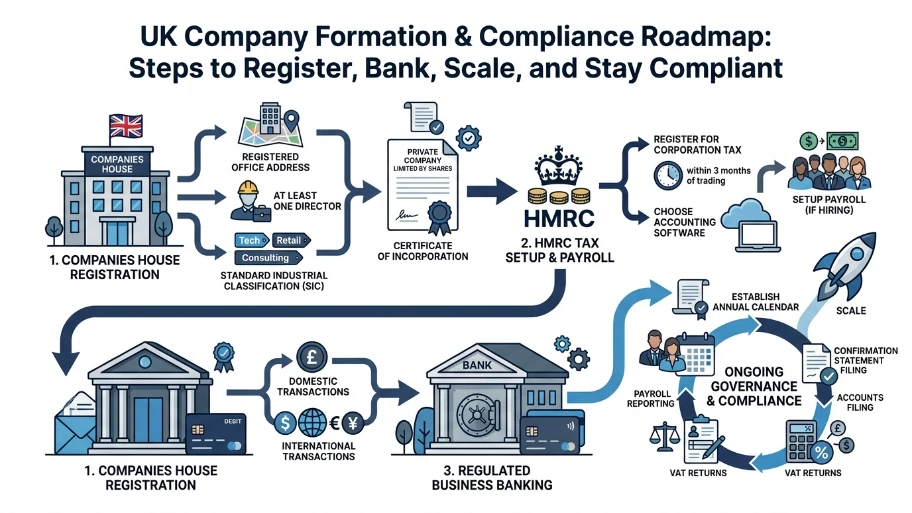
Register a private company limited by shares at Companies House using a registered address, at least one director, and a standard industrial classification (SIC). Register for Corporation Tax within three months of starting trading. Choose accounting software and set up payroll if hiring. Select a regulated bank or payment provider that supports domestic and international transactions. Establish an annual calendar for confirmation statements, accounts filing, VAT returns, and payroll reporting to ensure continuous compliance.
How do you secure reliable UK banking for a new company?
Provide verified company documents, director identity verification, proof of business activity, and a UK-registered address to banks and regulated fintechs.
Banks and fintechs validate company formation documents, director passports, proof of address, and evidence of trading activity or contracts. High-street banks require in-person meetings more often than fintechs. Specialised business accounts and payment service providers accept international founders if they supply certified translations and notarised documents. Expect onboarding timelines from 3 days (fintech) to 4–6 weeks (traditional banks). Use professional intermediary services when directors live abroad to reduce rejection risk.
Read our articles, UK vs Offshore: Tax Exposure, Credibility, and Banking Access Compared and Why Global Founders Choose UK Companies Over Offshore Jurisdictions.
Which compliance obligations maintain a UK company’s legal standing?
File annual accounts and confirmation statements with Companies House, submit Corporation Tax returns to HMRC, operate PAYE for employees, and comply with VAT registration and anti-money-laundering (AML) rules when thresholds apply.
Companies House requires annual accounts and a confirmation statement every 12 months. HMRC requires Corporation Tax registration and a tax return each financial year. Register for VAT if taxable turnover exceeds £85,000 in 12 months. Use RTI (Real Time Information) to report payroll and make PAYE payments monthly or quarterly, depending on size. Maintain accurate statutory registers for shareholders and directors. Implement an AML policy and customer due diligence when providing or receiving regulated services or when banks request enhanced checks.
What corporate structure best supports growth and investment?
Use a private company limited by shares with a clear share class structure, articles of association, and option pools to attract investors and grant equity incentives.
A standard limited company protects the founder’s personal assets and simplifies investor due diligence. Create multiple share classes to separate voting rights from economic rights. Include investor-friendly provisions such as pre-emption rights, drag-along, and tag-along clauses. Implement an employee share option plan (ESOP) to grant equity-linked incentives to staff. Keep a shareholders’ agreement to document decision-making and exit rules. These measures improve credibility with banks and venture investors and reduce disputes as revenue scales.
How is tax efficiently managed while staying compliant?
Register with HMRC, maintain detailed accounting records, use legitimate reliefs (e.g., R&D tax relief), and file taxes on time to avoid penalties.
Maintain monthly bookkeeping to separate revenue, expenses, and capital costs. Claim allowable expenses such as office costs, travel, and software subscriptions. Where applicable, submit R&D tax relief claims following HMRC’s guidelines to reduce Corporation Tax liabilities. Use capital allowances for qualifying capital expenditure. Ensure directors’ salaries and dividends follow PAYE rules and dividend legislation. Hire a chartered accountant for periodic tax planning and annual return preparation.
Which operational systems help scale revenue and control risk?
Implement cloud accounting, customer relationship management (CRM), payment processing, and regular internal controls for cash management and compliance.
Use cloud accounting software to reconcile bank feeds, automate VAT returns, and prepare management accounts. Deploy a CRM to track sales pipelines and customer contracts. Integrate PCI-compliant payment gateways and multiple currency accounts for international clients. Set approval workflows for expenditures and regular bank reconciliations to detect anomalies. Schedule quarterly compliance audits to review statutory filings, payroll, VAT treatment, and AML records.
How do UK companies maintain credibility with customers and partners?
Register for a UK domain and company number, publish clear terms, and maintain transparent financial records to build trust with banks, suppliers, and clients.
Display the company registration number and registered address on invoices, website, and contracts. Use a professional website with a UK domain and show key compliance documents, such as anti-money-laundering policies where relevant. Provide audited or reviewed accounts for larger contracts and tender processes. Maintain responsive communications and timely invoicing to support credit checks by partners and banks.
What banking and payments options suit founders with global customers?
Use UK business bank accounts, multi-currency accounts, international payment providers, and FX credit lines to receive payments and manage foreign exchange.
Open a UK business account for GBP clearing and domestic payroll. Add multi-currency accounts or work with payment providers offering EUR, USD, and GBP receiving accounts. Use currency hedging tools or forward contracts when invoices exceed £50,000 to control FX exposure. Select providers that integrate with accounting software to reconcile transactions automatically.
How do regulated requirements affect international founders and remote teams?
Provide notarised identity documents, proof of address, and a clear business purpose; appoint a UK-based service address or nominee for statutory correspondence.
International directors must meet AML checks and provide certified identity documents. Use a professional registered office address if the founders do not live in the UK. Appoint a company secretary or local compliance contact to handle Companies House and HMRC correspondence. Maintain a clear audit trail for cross-border payments and related-party transactions for tax transparency.
How does From My Company support launching compliant, banked, and scalable UK companies?
From My Company provides Company Services that register UK companies, assist with banking introductions, and implement statutory compliance packages for growth-stage firms.
From My Company offers end-to-end formation and compliance workflows. Services include Companies House registration, HMRC tax registration, assistance with business bank account applications, and ongoing statutory filing services. The team supplies document checklists and templates for share structures, shareholder agreements, and ESOP setup. These features help founders reduce onboarding friction and accelerate scaling.
Launching a UK company that obtains bank accounts, scales revenue, and remains compliant requires precise registration, robust governance, and professional systems. Follow a clear incorporation process, secure verified banking partners, maintain timely filings with Companies House and HMRC, and implement scalable accounting, payroll, and payments systems. From My Company’s Company Services streamline incorporation, banking introductions, and ongoing compliance to help founders focus on growth.
Frequently Asked Questions
How do I launch a UK company and get a business bank account?
Register your UK limited company with Companies House, then use From My Company’s Company Services to prepare formation documents and director verification for banking introductions. Most regulated banks and fintechs require certified identity checks, proof of business activity, and a UK-registered address before approving a business account.
What compliance steps keep a UK company legal while scaling?
File annual accounts and confirmation statements with Companies House, submit Corporation Tax returns to HMRC, and register for VAT if turnover exceeds £85,000. From My Company’s Company Services include ongoing statutory filing support and compliance calendars to ensure your UK company stays compliant as revenue grows.
Can international founders register a UK company without living in the UK?
Yes. International founders can register a UK limited company using a UK registered office address and by providing notarised identity documents for director verification. From My Company’s Company Services guide non-UK directors through Companies House registration, HMRC tax setup, and banking onboarding for global founders.
How much does it cost to set up and maintain a UK company?
Companies House registration costs £50–£100, plus annual fees for accounts filing (£13–£150) and tax returns. From My Company’s Company Services bundle formation, registered address, and first-year compliance into a single package, reducing separate vendor costs and simplifying budgeting for new UK companies.
What share structure works best for UK companies seeking investment?
Use a private company limited by shares with standard share classes, clear voting rights, and an employee share option plan (ESOP) for staff incentives. From My Company’s Company Services help founders create investor-friendly articles of association, shareholders’ agreements, and equity structures that support future funding rounds.