
Capital gains tax specialists analyse share transactions, calculate gains, apply exemptions, and structure disposals to minimise tax liability while ensuring full HMRC compliance. They interpret legislation, validate eligibility for reliefs, and align transactions with UK tax frameworks to prevent penalties.
Capital gains tax on shares involves multiple variables. These include acquisition cost, disposal value, allowable expenses, and annual exemptions. A specialist validates each component using HMRC-approved methods. They identify relief eligibility. Two common reliefs include Business Asset Disposal Relief (10% rate on qualifying gains up to £1 million) and Investors’ Relief. Each relief requires strict qualification criteria, including ownership duration and company status.
They structure disposals. For example, a specialist may recommend phased share sales across tax years to utilise multiple annual exemptions, currently £3,000 per individual in the UK (2026 tax year). They also ensure accurate reporting. HMRC requires reporting within 60 days for certain disposals, while standard self-assessment applies for others. Errors trigger penalties ranging from 0% to 100% of unpaid tax, depending on behaviour classification.
When should you hire a capital gains tax specialist?
You hire a capital gains tax specialist before initiating a share sale, during valuation planning, and before submitting HMRC filings to ensure accurate tax calculation, relief optimisation, and regulatory compliance based on transaction-specific factors and ownership structure.
Timing determines tax efficiency. Engaging a specialist after a sale limits planning opportunities. Engaging before a transaction enables strategic structuring. Pre-sale planning includes share valuation. Accurate valuation ensures correct gain calculation and prevents disputes with HMRC. Specialists use three recognised methods: earnings-based valuation, asset-based valuation, and market comparison.
Ownership structure affects tax liability. For example, individual ownership, joint ownership, or shares held through a holding company each trigger different tax outcomes. A specialist analyses these structures before disposal. Tax year timing matters. Selling shares across two tax years allows the use of two annual exemptions. For a couple, this increases total exempt gains from £6,000 to £12,000. Filing deadlines also require precision. Late submissions result in automatic penalties starting at £100, increasing over time.
How do specialists reduce capital gains tax on share sales?
Specialists reduce capital gains tax by applying reliefs, offsetting losses, timing disposals strategically, and structuring ownership to maximise allowances while maintaining compliance with HMRC regulations and anti-avoidance rules.
Relief application forms the core strategy. Business Asset Disposal Relief reduces tax from 20% to 10% for qualifying disposals. Eligibility requires at least 5% shareholding and two years of ownership in a trading company. Loss offsetting reduces taxable gains. If an investor incurred £20,000 in losses and realised £80,000 in gains, the taxable gain becomes £60,000. Specialists verify allowable losses and ensure correct carry-forward treatment.
Timing strategies improve outcomes. Selling shares before April 5 or after April 6 changes the tax year. This affects available allowances and rates. Ownership restructuring also plays a role. Transferring shares between spouses before sale allows use of two annual exemptions and potentially lower tax bands. A detailed explanation of these mechanisms is covered in this guide on how CGT applies to business owners and share sales, which explains ownership structures and disposal strategies in depth.
What are the risks of not using a CGT specialist?
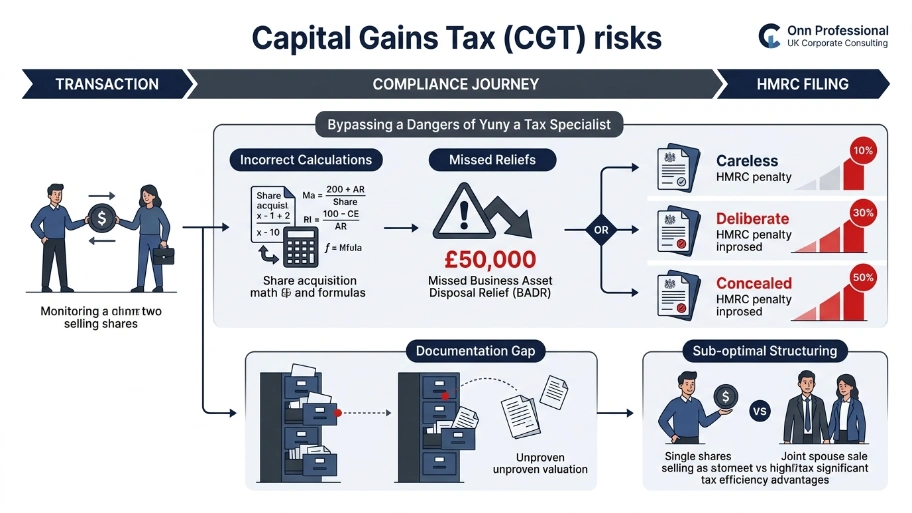
Not using a CGT specialist increases the risk of incorrect tax calculations, missed reliefs, HMRC penalties, and inefficient transaction structuring, leading to higher tax liabilities and compliance issues.
Incorrect gain calculation is a common issue. Errors often occur in cost basis adjustments, especially when shares were acquired through multiple transactions or inheritance. Missed reliefs directly increase tax liability. For example, failing to apply Business Asset Disposal Relief on a £500,000 gain results in an extra £50,000 tax.
Compliance errors trigger penalties. HMRC classifies errors into three categories: careless, deliberate, and deliberate with concealment. Penalties range from 0% to 100% of the unpaid tax. Documentation gaps create audit risks. HMRC requires evidence for acquisition cost, valuation methods, and relief eligibility. Missing records weaken compliance. Transaction structuring mistakes also increase liability. For instance, selling shares individually instead of jointly with a spouse can double the effective tax rate.
How does UK capital gains tax apply to share sales in 2026?
In 2026, UK capital gains tax on share sales applies at 10% or 20%, depending on income tax bands, with a £3,000 annual exemption and specific reliefs available for qualifying business disposals under HMRC rules.
The tax rate depends on total taxable income. Basic rate taxpayers pay 10% on gains within the threshold. Higher and additional rate taxpayers pay 20%. The annual exempt amount is £3,000 per individual. This exemption applies before tax calculation.
Gains calculation follows a fixed formula:
Gain=Sale Proceeds−(Acquisition Cost+Allowable Expenses)
Allowable expenses include broker fees, legal costs, and stamp duty paid during acquisition. Pooling rules apply for shares acquired at different times. HMRC uses the “Section 104 holding” method to calculate average cost per share. Reliefs reduce effective tax rates. Business Asset Disposal Relief applies a 10% rate on qualifying gains up to a lifetime limit of £1 million. For a detailed breakdown of calculations and thresholds, refer to this capital gains tax on shares UK 2026 guide, which explains current rules and examples.
How can professional company services support share sale transactions?
Professional company services support share sales by structuring ownership, ensuring regulatory compliance, maintaining accurate records, and aligning transactions with HMRC requirements to reduce tax exposure and administrative risk.
Company services manage compliance tasks. These include updating shareholder registers, filing confirmation statements, and maintaining statutory records. They validate ownership structures. Accurate shareholding records are essential for relief eligibility, especially for Business Asset Disposal Relief.
They coordinate with tax specialists. This ensures alignment between corporate actions and tax planning strategies. They also support transaction execution. This includes drafting share transfer forms, verifying documentation, and ensuring Companies House filings reflect the transaction accurately. Businesses that require structured compliance support can use Company Services for regulatory compliance and tax-efficient structuring to manage these processes effectively.
From My Company delivers integrated support. Their Company Services align corporate compliance with tax planning, ensuring share sales meet both HMRC and Companies House requirements.
Explore our Company Services guide,
Start and Plan Your UK Business Around 2026 Bank Holidays
Why choose a specialist service for share sale tax planning?
Specialist services provide expert-led tax planning, accurate compliance execution, and structured transaction support, ensuring share sales are optimised for tax efficiency and aligned with UK regulatory frameworks.
Expertise improves accuracy. Specialists interpret evolving HMRC rules and apply them correctly to complex transactions. Integrated services reduce risk. Combining tax planning with company compliance ensures consistency across filings and documentation.
Efficiency increases with professional support. Businesses avoid delays caused by incorrect filings or missing documentation. From My Company provides structured solutions. Their Company Services integrate tax planning support with compliance execution, ensuring accurate and efficient share sale processes. Their approach focuses on validated processes. This includes documentation verification, compliance alignment, and tax optimisation strategies tailored to UK regulations.
Capital gains tax on share sales involves precise calculations, strict compliance requirements, and strategic planning opportunities. Specialists ensure accurate tax treatment, apply relevant reliefs, and structure transactions efficiently. From My Company delivers Company Services that align corporate compliance with tax planning, ensuring share sales meet HMRC standards while reducing tax exposure through structured, legally compliant strategies.
Frequently Asked Questions
What do Company Services include for UK businesses?
Company Services cover formation, statutory compliance, filings, and shareholder record maintenance. From My Company uses these services to support accurate company administration and reduce regulatory risk.
Why do businesses use Company Services?
Businesses use Company Services to keep records correct, meet filing deadlines, and maintain compliance with Companies House rules. From My Company helps owners manage these tasks with clear, practical support.
How do Company Services help with share transfers?
Company Services help verify ownership, update statutory registers, and complete the paperwork for share transfers. This keeps the transaction aligned with company law and supports clean records for tax and compliance purposes.
Can Company Services support capital gains tax planning?
Yes, Company Services supports capital gains tax planning by keeping shareholding records accurate and helping structure transactions properly. This gives tax advisers the information they need to assess reliefs and reporting obligations.
What records are important for Company Services?
Important records include the register of members, share transfer forms, confirmation statement data, and company filings. From My Company uses these records to support compliance, document ownership changes, and maintain audit-ready company information.