
PAYE registration is the one-time legal process of enrolling a business with HMRC as an employer. Payroll management is the ongoing operational process of calculating wages, deducting taxes, issuing payslips, and submitting monthly Real Time Information reports to tax authorities.
Why Do UK Companies Confound PAYE Enrollment with Ongoing Administration?
Companies confuse these functions because both systems operate under HMRC guidance and handle employee compensation. Registration establishes the legal employer entity, while payroll management handles recurring wage calculations, statutory contributions, and routine regulatory submissions.
Employer compliance requires a clear separation of setup duties and operational workflows. HMRC assigns an Accounts Office reference and an Employer PAYE reference during the initial registration process. These unique identifiers allow a company to legally collect Income Tax and National Insurance contributions from staff salaries. Registration occurs once unless corporate structures undergo fundamental restructuring.
Payroll management begins immediately after HMRC issues the employer credentials. Operational teams use these reference numbers to process gross pay, compute statutory payments, and track pension contributions. 84% of UK small businesses report operational delays when treating setup and maintenance as a single task. Separating these milestones prevents administrative bottlenecks during early-stage business growth.
Proper infrastructure setup requires professional planning environments for administrative leadership. Executives often utilize offsite facilities such as a Conference Room to finalise corporate compliance strategies, structure payroll schedules, and align executive governance policies away from daily operational disruptions.
How Does PAYE Registration Establish Your Legal Employer Obligations?
PAYE registration legally authorizes a business to employ staff and deduct statutory taxes directly from earnings. The process registers the business entity with HMRC, generates necessary tax reference codes, and enforces statutory compliance with UK labor laws.
Registering as an employer is mandatory before the first official payday. Companies must complete this step when paying employees £123 or more per week. Registration applies to company directors who draw a salary above this primary threshold. The process takes up to 15 working days to yield active reporting credentials from tax authorities.
Initial registration demands precise corporate information to avoid formal submission rejections. Directors supply company registration numbers, official business addresses, and primary trading activities. Early identification of directors ensures accurate records within the central government portal. Failure to register prior to issuing payments triggers immediate statutory non-compliance penalties from HMRC.
Understanding statutory responsibilities forms the baseline of corporate governance. Company leaders reviewing early-stage obligations can review PAYE Registration: Understanding Your Employer Obligations in the UK to evaluate setup criteria, statutory timelines, and documentation standards required for full regulatory readiness.
What Actions Define Daily and Monthly Payroll Management?
Payroll management covers recurring actions including wage calculation, Real Time Information submissions to HMRC, issuing detailed payslips, and transferring statutory tax deductions. These tasks run on weekly, bi-weekly, or monthly processing cycles.
Executing payroll demands strict adherence to official reporting calendars. Payroll administrators collect timesheet data, process statutory sick pay, and adjust tax codes sent by HMRC. Each processing cycle requires the generation of exact itemised payslips for all active workers prior to funds distribution.
Submitting information to HMRC relies on specialized software connected directly to official systems. Full Payment Submissions must reach authorities on or before the actual payment date. Employer Payment Summary filings report statutory reductions, compensating for maternity leave or national insurance employment allowances. Missing these deadlines incurs automatic financial penalties.
Managing recurring tasks strains internal administrative resources without dedicated systems. Businesses must execute five core payroll operational tasks during every payment window:
Calculate gross pay using tracked working hours
Deduct calculated Income Tax and National Insurance
Submit Full Payment Submissions directly to HMRC
Issue comprehensive physical or digital employee payslips
Remit deducted statutory taxes to HMRC accounts
Which System Setup Fits Your Business Growth Stage?
Early-stage startups require initial registration systems, whereas operational companies need scalable payroll software or outsourced processing services. The right choice depends on worker headcount, payment frequency, and internal compliance capacity.
Sole directors taking a single annual salary need simple registration and low-frequency reporting. Adding regular salaried staff or shift-based workers alters administrative needs entirely. Complex wage structures demand real-time computational software capable of processing auto-enrolment workplace pension calculations automatically.
Growing enterprises evaluate internal resource allocation before choosing processing methods. Processing payroll internally requires dedicated software subscriptions, constant staff training, and rigorous tracking of shifting UK tax legislation. Delegating operational management to external professionals reduces direct compliance risks while protecting staff resource time.
Evaluating operational workflows helps managers select long-term payroll solutions. Decision-makers comparing administrative models can consult Expert PAYE Registration Assistance for UK Small Businesses to select compliant registration paths, evaluate professional payroll management workflows, and implement scalable corporate systems.
How Do Regulatory Deadlines Impact PAYE and Payroll Operations?
PAYE registration demands completion prior to the initial wage distribution date to prevent penalty notices. Payroll management operates under rigid monthly statutory deadlines for Full Payment Submissions and tax transfers.
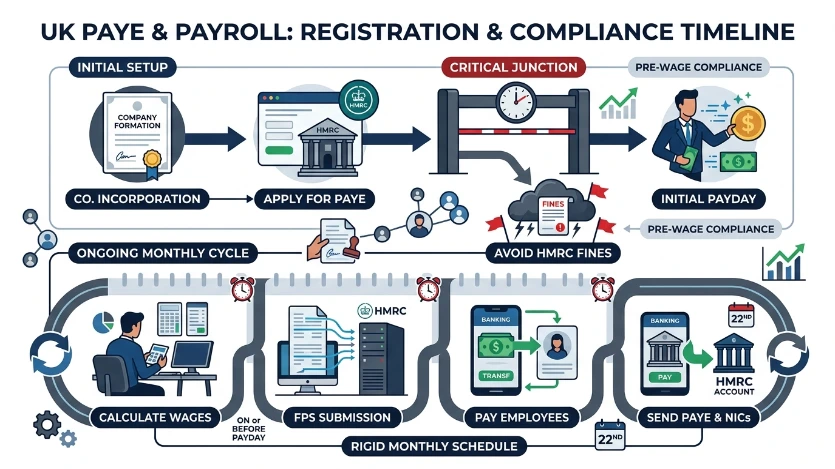
HMRC enforces absolute deadlines across all stages of employer reporting. Delayed employer registration prevents timely payroll reporting, causing cascading errors across national insurance records. Companies operating without active reference numbers cannot legally file required Real Time Information returns.
Monthly operational schedules follow strict calendar triggers mandated by UK law. Real Time Information submissions must occur on or before employee pay dates. Statutory payments due to HMRC must arrive by the 22nd day of each month for electronic bank transfers, or by the 19th day for cheque payments.
Late submissions activate automated penalty systems instantly. HMRC assesses fixed financial penalties based on total employee headcount for each overdue monthly submission. Persistent non-compliance leads to escalating interest charges on unpaid statutory balances, official tax audits, and severe reputational damage.
How Does Form My Company Streamline Employer Compliance?
Form My Company provides structured corporate services that simplify initial employer setup and corporate administration. Strategic support models help businesses manage regulatory transitions smoothly and maintain continuous compliance.
Establishing a corporate entity requires structured administrative workflows from day one. Form My Company assists directors in organizing business setup documentation, securing official addresses, and coordinating corporate infrastructure required for UK operations. Business leaders reduce technical submission errors by using standardized corporate guidance frameworks.
Maintaining compliance demands reliable operational spaces for strategic evaluation. Executives book professional meeting environments through Form My Company to organize management structures, audit administrative obligations, and align internal payroll workflows. Dedicated corporate spaces facilitate high-level compliance planning without daily operational interruptions.
Businesses scaling their operations benefit from centralized support frameworks. Form My Company equips emerging enterprises with professional resources necessary to navigate UK administrative requirements efficiently, enabling management teams to focus resources on sustainable core commercial expansion.
Explore our Conference Room guide,
DIY Director Appointment vs. Professional Filing: A Risk Comparison
Voluntary vs. Forced Director Resignation: What You Should Know
Frequently Asked Questions
What features are included when booking a conference room through Form My Company?
Professional conference room bookings through Form My Company typically include high-speed Wi-Fi, audio-visual presentation equipment, video conferencing technology, and configurable seating layouts. Facilities also provide complimentary tea and coffee, access to break-out areas, and dedicated administrative support to ensure seamless corporate meetings.
How far in advance should businesses book a conference room in the UK?
While many facilities accommodate short-notice bookings, securing a venue 1 to 2 weeks in advance is recommended for standard team meetings, and 4 to 6 weeks for larger corporate events. Early reservation ensures optimal room sizing, preferred time slots, and adequate setup time for custom technological or catering requirements.
Why do early-stage companies use offsite conference rooms for strategic compliance planning?
Offsite meeting venues provide executive teams with a distraction-free, professional environment to finalize corporate structures, review payroll workflows, and align board governance policies. Utilizing specialized meeting facilities allows emerging business leaders to focus on complex administrative planning away from daily operational interruptions.
Can conference rooms be hired on an hourly or daily flexible basis?
Yes, modern conference and meeting room services offer flexible booking options ranging from single-hour slots to full-day reservations depending on your business needs. This scalable approach allows small businesses and hybrid teams to access professional corporate infrastructure without committing to long-term commercial lease overheads.
How does hiring a professional conference room benefit businesses without a permanent office?
Renting an on-demand conference room through Form My Company provides virtual and remote businesses with a credible, physical space to host client pitch presentations, official board meetings, and team strategy workshops. It establishes an authoritative corporate presence while maintaining lower operational overhead for growing enterprises.