
Statutory books are the official records a UK company must maintain to document its ownership, shareholdings and important corporate decisions. Every UK company must keep an accurate register of members and preserve specified records of meetings and resolutions. Companies must also submit required information about directors and people with significant control to Companies House.
Knowing which statutory books a company must keep helps directors maintain accurate corporate information, demonstrate good governance and prepare for investment, audits and business transactions. This guide explains the registers and records required under current UK company law, what information they should contain, where they should be kept and how businesses can manage their record-keeping responsibilities.
Statutory books: What Does a UK Company Need to Keep?
Statutory books are formal company records that document a business’s legal ownership, membership and governance history. They include the register of members and specified records of company meetings and decisions. Companies must also retain supporting documents and submit relevant information to Companies House when required.
The Companies Act 2006 establishes the main legal framework for company record-keeping. However, changes introduced through the Economic Crime and Corporate Transparency Act 2023 have altered some traditional register requirements. As a result, companies need to understand the difference between records they must maintain internally and information they must report to Companies House.
For directors, statutory books provide an organised account of important corporate events. They help establish who owns shares, when membership changes take place and which decisions have been formally approved. Accurate records can also support company transactions, ownership checks and legal reviews.
Which Statutory Registers Must a UK Company Maintain?
The internal registers and records required by a UK company depend on its legal structure and activities. The register of members remains a mandatory internal register. Companies must also keep specified records of meetings and resolutions. However, separate internal registers of directors, directors’ residential addresses, company secretaries and people with significant control are no longer required under the changes effective from 18 November 2025.
The following table summarises the main registers and records businesses should understand.
| Register or record | What it contains | Current position |
|---|---|---|
| Register of Members | Members’ names, addresses, membership dates and relevant shareholding information | Mandatory internal register |
| Register of Directors | Details of director appointments and other officer information | Separate internal register no longer required from 18 November 2025 |
| Register of Directors’ Residential Addresses | Directors’ usual residential addresses | Separate internal register no longer required from 18 November 2025 |
| Register of Secretaries | Details of appointed company secretaries | Separate internal register no longer required from 18 November 2025 |
| PSC Register | Information about people or entities with significant control | Separate internal register no longer required from 18 November 2025 |
| Board Meeting Records | Minutes and records of board proceedings | Required company records |
| Member Resolutions and General Meeting Records | Copies of relevant member resolutions and general meeting minutes | Required company records |
| Historical Charge Documents | Evidence relating to relevant company borrowing and security arrangements | Retain applicable historical and transaction documents |
Companies must still report relevant director, secretary and PSC information to Companies House, even though separate internal registers for these details are no longer required. The official Companies House guidance on changes to company registers explains the updated requirements.
Register of Members
The register of members is one of the most important statutory books a UK company must maintain. It records the people or legal entities that hold membership in the company and provides an official record of its membership and shareholding structure.
The register should contain the relevant information required by the Companies Act 2006, including:
- The full name and address of each member.
- The date on which each person became a member.
- The date on which a person ceased to be a member, where applicable.
- Details of the shares held by each member, where the company has share capital.
- The relevant share class and number of shares.
- The required information about share values and amounts paid or treated as paid.
Companies must update the register when shares are issued, transferred or otherwise change ownership. Accurate entries help establish the company’s membership position and support shareholder communication, dividend administration and corporate transactions.
Under section 113 of the Companies Act 2006, every company must maintain a register of its members. This requirement remains in force following the recent Companies House reforms. Since 26 January 2026, companies can no longer choose to keep their register of members on the central Companies House register. They must maintain their own register at the registered office or an appropriate Single Alternative Inspection Location.
Businesses that need suitable physical documentation for maintaining company records can consider a compliant company register from Form My Company. The register should be completed and updated with accurate company and membership information in accordance with the applicable requirements.
Director and Company Officer Information
Before 18 November 2025, companies were required to maintain separate internal registers of directors, directors’ usual residential addresses and company secretaries. These requirements have since changed.
Companies no longer need to maintain these separate internal statutory registers. However, they must continue to provide the required information to Companies House and notify the registrar when relevant reportable details change.
Directors should ensure that appointments, resignations and changes to reportable information are submitted through the appropriate Companies House filing process. Companies should also retain relevant appointment documents, resignation notices, board decisions and supporting correspondence as part of their corporate records.
Private limited companies are generally not required to appoint a company secretary, although public companies must have one. Where a company appoints a secretary, it must comply with the applicable reporting requirements.
People with Significant Control Information
People with Significant Control, commonly known as PSCs, are individuals or relevant legal entities that meet one or more statutory conditions relating to ownership or control of a company.
A person may qualify as a PSC if they meet conditions such as:
- Holding more than 25% of the company’s shares.
- Holding more than 25% of the company’s voting rights.
- Having the right to appoint or remove a majority of the board of directors.
- Exercising or having the right to exercise significant influence or control over the company.
- Exercising significant influence or control over a trust or firm that meets the relevant statutory conditions.
The requirement to maintain a separate internal PSC register ended on 18 November 2025. However, companies must still identify their PSCs, provide the required information to Companies House and report relevant changes.
Accurate PSC information supports ownership transparency and helps companies respond to corporate due diligence and regulatory reporting requirements. Directors should review the company’s ownership and control arrangements when shares are transferred or significant changes take place.
Records Relating to Company Charges
Company charges are security interests created over company assets, often in connection with borrowing or financing arrangements. Examples include mortgages, fixed charges and floating charges.
Companies should retain relevant loan agreements, security documents, registration evidence and correspondence relating to these arrangements. The applicable Companies House registration requirements depend on the nature and date of the charge.
Historical charges may also involve older record-keeping requirements. Businesses should therefore distinguish between current filing obligations and documents relating to earlier security arrangements. Keeping these records organised helps establish which company assets are subject to security and supports future financing or commercial transactions.
What Board Minutes and Resolutions Should a Company Keep?
Board minutes and shareholder resolutions provide written evidence of important company decisions. They help demonstrate how directors and members have exercised their responsibilities and whether formal approvals were obtained.
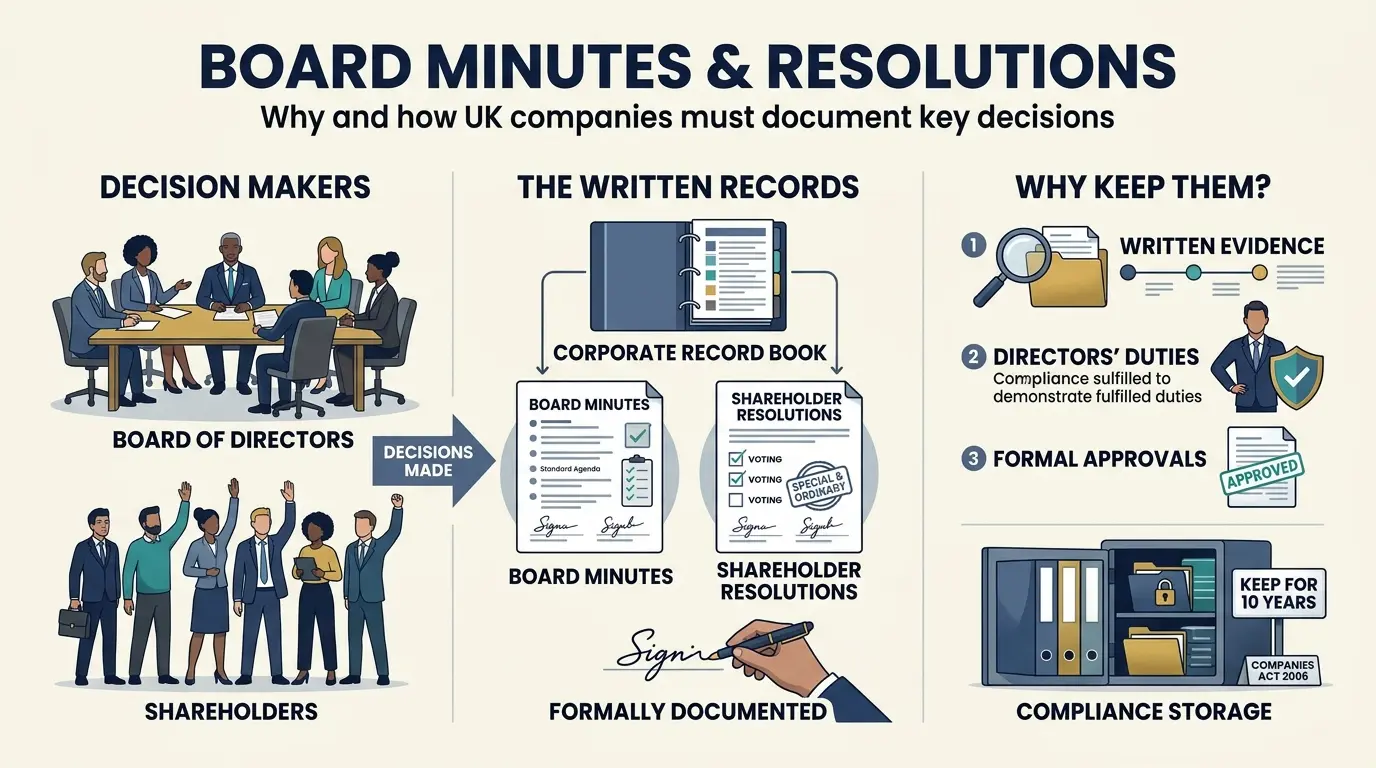
Companies should maintain clear records of relevant meetings and decisions, including matters involving director appointments, share issues, changes to company arrangements and significant business transactions.
Board minutes commonly record:
- The date, time and location of the meeting.
- The names of directors attending.
- The name of the person chairing the meeting.
- The matters discussed.
- Decisions and resolutions approved.
- Any declared conflicts of interest.
- Actions assigned to directors or other responsible individuals.
Minutes should accurately reflect the proceedings and be authenticated in accordance with the company’s procedures and applicable legal requirements.
Member decisions must also be recorded appropriately. An ordinary resolution generally requires more than 50% of votes cast, while a special resolution generally requires at least 75%. Where a special resolution must be filed with Companies House, the company must submit the required copy within the applicable statutory deadline, generally 15 days after it is passed.
The Companies Act 2006 sets out specific record-retention requirements. Section 248 addresses minutes of directors’ meetings, which must be retained for at least 10 years. Section 355 requires companies to keep specified records of member resolutions, general meeting proceedings and sole-member decisions for at least 10 years.
Companies should not treat board minutes and shareholder resolutions as interchangeable documents. Each record serves a different purpose and should be organised according to the relevant legal requirements.
For further guidance on preparing and maintaining meeting documentation, read our article on key board meeting and minute-taking requirements for UK companies.
Where Should Statutory Books Be Kept and Inspected?
A company must keep its register of members at its registered office or an appropriate Single Alternative Inspection Location, commonly known as a SAIL address. The company must also ensure that its other required corporate records are stored securely and can be accessed when legally necessary.
The registered office is the company’s official address for legal and administrative correspondence. A SAIL address allows a company to keep certain statutory records at another suitable location rather than at its registered office.
Companies using a SAIL address must notify Companies House of the relevant location and ensure that the required records are available there for inspection. Directors should also maintain an organised process for responding to valid requests to inspect company records.
Inspection of the Register of Members
The register of members is subject to statutory inspection rights. Members and other eligible applicants can request access in accordance with the Companies Act 2006.
Companies must follow the applicable legal procedure when receiving an inspection request. This includes checking the validity of the request and responding within the relevant statutory timeframe.
An organised register makes it easier to respond to legitimate requests and demonstrate that the company has fulfilled its record-keeping obligations. Businesses should also ensure that information is accurate, accessible and protected against unauthorised alteration.
Can Companies Keep Statutory Books Digitally?
Companies can use electronic systems to organise and maintain corporate records, provided the relevant legal requirements are satisfied. Digital record-keeping can make company administration more efficient, particularly where businesses regularly update their ownership or governance information.
The main benefits include:
- Faster access to company information.
- Easier updates following share transactions.
- Improved organisation of resolutions and meeting records.
- Secure backups and access controls.
- Better tracking of historical changes.
- Simpler preparation for audits and due diligence.
Physical registers also remain useful for companies that prefer traditional bound company records. A physical company register can provide a convenient way to organise membership details, share information and other corporate documentation.
Businesses looking to organise their company documentation in one place can explore the Form My Company Company Pack. It provides a collection of company documents and materials for businesses that prefer to maintain physical corporate records.
Whether a company uses physical or digital records, accuracy, security and accessibility should remain priorities. Directors should also ensure that electronic systems support reliable updates and preserve the information required by law.
What Are the Penalties for Not Keeping Statutory Books?
Failing to maintain required company records or comply with statutory filing obligations can expose a company and its responsible officers to legal consequences. The specific consequences depend on the requirement breached and the relevant provisions of the Companies Act 2006.
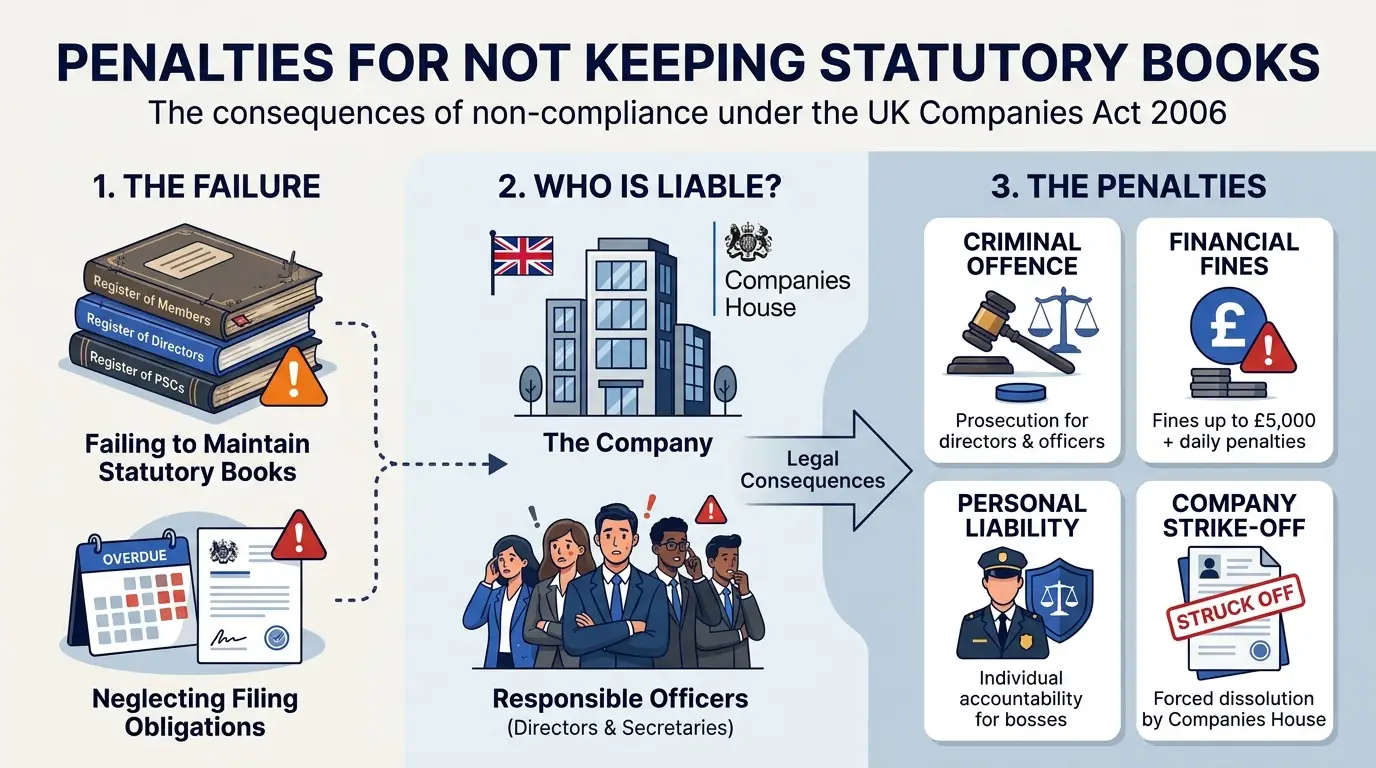
Poor record-keeping can also create commercial difficulties beyond formal penalties. Missing ownership information, incomplete resolutions and inconsistent corporate documents can make it harder to establish who owns a business or whether important decisions were properly authorised.
Potential consequences include:
- Legal action for breaches of statutory record-keeping requirements.
- Financial penalties where applicable.
- Difficulties verifying shareholder ownership.
- Delays during company sales and investment transactions.
- Problems responding to due diligence requests.
- Additional administrative costs when historical records need correction.
- Reduced confidence among lenders, investors and business partners.
For example, if a company fails to update its register of members after a share transfer, its internal records may no longer accurately reflect its membership position. This can create complications when the company distributes dividends, records shareholder decisions or prepares for an investment.
Directors should therefore review company records whenever a significant corporate event occurs rather than waiting until an annual filing deadline. They should also distinguish between internal record-keeping duties and Companies House filing obligations to avoid overlooking either responsibility.
How Can a Company Keep Its Statutory Books Compliant?
Maintaining compliant statutory books requires an organised approach to record management, accurate reporting and regular reviews. Companies should establish procedures to ensure that changes in ownership, governance and corporate structure are properly documented.
The following checklist provides a practical starting point for directors and company administrators.
Statutory Books Compliance Checklist
Maintain an accurate register of members.
Record new members and changes in membership.
Update shareholding details following valid share issues and transfers.
Retain relevant share certificates and supporting transaction documents.
Record board meetings and decisions appropriately.
Keep required copies of member resolutions and general meeting minutes.
Preserve relevant meeting and resolution records for the required retention periods.
Identify people with significant control and submit the required information to Companies House.
Report director and company officer changes through the appropriate Companies House filing process.
Retain relevant historical documents relating to company charges and security arrangements.
Store company records securely at the appropriate location.
Review records regularly to identify missing or inconsistent information.
Respond appropriately to valid statutory inspection requests.
This checklist helps directors maintain a consistent approach to corporate administration. Companies with complex ownership structures, frequent share transactions or multiple directors may need additional administrative support.
For more detailed guidance on ongoing record management, read how to keep your statutory books compliant with the Companies Act. This related guide provides further context on maintaining company records and managing statutory responsibilities.
How Does Company Secretarial Support Help Maintain Compliance?
Company secretarial support helps businesses manage recurring administrative responsibilities, maintain company records and deal with changes in their corporate structure.
Although directors remain responsible for ensuring that their companies meet legal obligations, professional administrative support can make it easier to organise filings, record changes and maintain accurate documentation.
A company secretarial service can assist with responsibilities such as:
- Updating the register of members.
- Recording share transfers and new share issues.
- Handling director appointments and resignations.
- Preparing relevant company documentation.
- Managing confirmation statement filing.
- Supporting company name changes.
- Maintaining organised corporate records.
- Assisting with company dissolution procedures.
Businesses seeking ongoing help with these responsibilities can explore Form My Company’s Company Secretarial Service. The service supports up to 10 company secretarial changes per year, includes confirmation statement filing and offers annual renewal. It is designed for businesses that need continued assistance with company administration rather than support with a single transaction.
Effective company secretarial administration also involves understanding how company records connect with wider governance responsibilities. For a broader overview, read Company Secretarial: The Secret to Long-Term UK Regulatory Compliance.
What Should a Company Do If Its Statutory Books Are Missing or Incomplete?
A company that discovers missing or incomplete statutory records should review its available documents and establish an accurate account of its corporate history.
The process generally begins with collecting incorporation documents, Companies House filings, share certificates, transfer forms, board minutes, shareholder resolutions and other supporting evidence.
Directors should compare these documents with the current register of members and identify discrepancies that need investigation. Where historical information is incomplete, the company should seek appropriate professional assistance before making corrections that could affect legal ownership or shareholder rights.
Reconstructing company records requires particular care because incorrect entries can create disputes or affect future corporate decisions. Companies should also review their articles of association when investigating membership rights, share transfers and decision-making procedures. Our guide explains what articles of association are and why they matter.
Once the records have been reviewed and corrected where legally appropriate, companies should introduce a regular review process to prevent similar problems from recurring. This may include assigning responsibility for updating records, keeping supporting documents together and checking that required Companies House filings have been completed.
Frequently Asked Questions About Statutory Books
What are statutory books in a UK company?
Statutory books are official company records that document membership, shareholdings and important governance decisions. They include the register of members and specified records of meetings and resolutions. Companies must also comply with applicable Companies House reporting requirements.
Which statutory books are legally required in the UK?
Every UK company must maintain a register of members. Companies must also preserve specified records of board meetings, general meetings and member resolutions. Since 18 November 2025, separate internal registers of directors, directors’ residential addresses, secretaries and people with significant control are no longer required. The relevant information must still be reported to Companies House.
Does a UK limited company need a register of members?
Yes. Every UK company must maintain a register of members under section 113 of the Companies Act 2006. It records the company’s members, relevant membership dates and applicable shareholding information. Companies must update it when membership or shareholding details change.
Do companies still need a PSC register?
No. The requirement to maintain a separate internal PSC register ended on 18 November 2025. However, companies must still identify their people with significant control, submit the required information to Companies House and report relevant changes.
Where should statutory books be kept?
The register of members must be kept at the company’s registered office or an appropriate Single Alternative Inspection Location. Companies should also ensure that other required corporate records are stored securely and can be accessed when legally necessary.
Can statutory books be maintained electronically?
Yes. Companies can use electronic systems to organise and maintain corporate records, provided they meet the applicable legal requirements. Digital records can improve accessibility, security and document management, while physical registers remain a practical option for businesses that prefer bound records.
How long should company minutes and resolutions be retained?
The Companies Act 2006 sets out specific retention periods. Minutes of directors’ meetings must generally be retained for at least 10 years under section 248. Section 355 requires specified records of member resolutions, general meeting proceedings and sole-member decisions to be retained for at least 10 years.
What happens if a company does not maintain its statutory books?
Failure to meet statutory record-keeping or filing obligations can result in legal consequences and financial penalties where applicable. Incomplete ownership records can also create problems when issuing shares, transferring ownership or responding to due diligence requests.
How can Form My Company help with statutory books?
Form My Company provides company administration services and company document packages that help businesses organise their corporate records. Its Company Secretarial Service supports ongoing company changes, statutory register updates and confirmation statement filing. The Company Pack provides company documentation and register materials.