
The register of members is a statutory company record that identifies its shareholders or members, records their service addresses and shows when their membership begins and ends. Every UK company must maintain this register under the Companies Act 2006. For companies with share capital, it must also show the shares held by each member and the amount paid or agreed to be paid on those shares.
Company directors should understand which records must be maintained internally and which information must be filed with Companies House. Since 18 November 2025, companies no longer need to maintain separate internal registers of directors, directors’ residential addresses, secretaries or Persons with Significant Control. However, the register of members remains a legal requirement, while relevant director and PSC information must still be reported to Companies House.
What Is a Register of Members?
A register of members is the company’s official record of its legal members and their shareholdings. It identifies each member, records their service address and membership dates, and documents the shares they hold where the company has share capital.
Section 113 of the Companies Act 2006 requires every company to maintain this register. It provides an important record of company ownership and helps establish who is recognised as a member at a particular time.
The register should be updated whenever membership or shareholding information changes. It must preserve relevant historical information rather than simply showing the latest ownership position.
Register of Members: What Information Must Be Included?
A register of members must contain each member’s name, service address, date of registration and, where applicable, date of cessation. Companies with share capital must also record the shares held by each member, distinguish different share classes and state the amount paid or agreed to be paid on those shares.
The precise information depends on whether the member is an individual, a company or another qualifying legal entity.
Individual Members
For an individual shareholder, the required information includes:
- Full name: The member’s forename and surname.
- Service address: An address at which formal communications can be sent.
- Date of registration: The date the individual became a member of the company.
- Date of cessation: The date the individual ceased to be a member, where applicable.
- Shareholding details: The number and class of shares held, where the company has share capital.
- Payment information: The amount paid or agreed to be paid on the shares.
The statutory information requirements for individual members should not be confused with director or PSC information. A member’s date of birth, nationality and private residential address are not standard required fields under sections 113A and 113B for the register of members.
Corporate Members and Firms
Where a company or qualifying legal firm holds membership, its record must include:
- Corporate or firm name
- Service address
- Date it became a member
- Date membership ended, where applicable
- Shareholding and payment details, where the company has share capital
Use the registered corporate name and an appropriate service address to identify the entity accurately. This helps distinguish corporate shareholders from individuals and supports clear ownership records.
Share Classes, Numbers and Payment Details
Companies with share capital must record the shares held by each member. The register should distinguish shares by their numbers, where shares are numbered, and by class where the company has more than one class of issued shares.
The register must also state the amount paid or agreed to be paid on each member’s shares. This information helps explain the company’s share capital and the distribution of ownership between members.
For example, a company with ordinary and preference shares should record the relevant class and quantity for each member rather than combining different classes into one total.
Membership Dates and Historical Entries
The register must show the date each person became a member and, where applicable, the date they ceased to be a member.
When a shareholder transfers shares, the company should update the register after the transfer has been properly processed and registered. The record should preserve the relevant historical information so the company can establish its membership history.
Field-by-Field Register of Members Checklist
| Information field | What the company should record |
|---|---|
| Member’s name | Individual’s forename and surname or corporate/firm name |
| Service address | Member’s official service address |
| Registration date | Date the person or entity became a member |
| Cessation date | Date membership ended, where applicable |
| Share number | Number of shares held, where numbered |
| Share class | Relevant class of issued shares |
| Amount paid | Amount paid or agreed to be paid on the shares |
| Joint holders | Names of all joint holders, where applicable |
This checklist provides a practical way to review the information required for the register. Companies should also check their articles of association and share documentation when recording specific share rights or ownership arrangements.
What Details Must Be Reported for Company Directors?
Companies must still provide required director information to Companies House, but they no longer need to maintain a separate internal statutory register of directors from 18 November 2025.
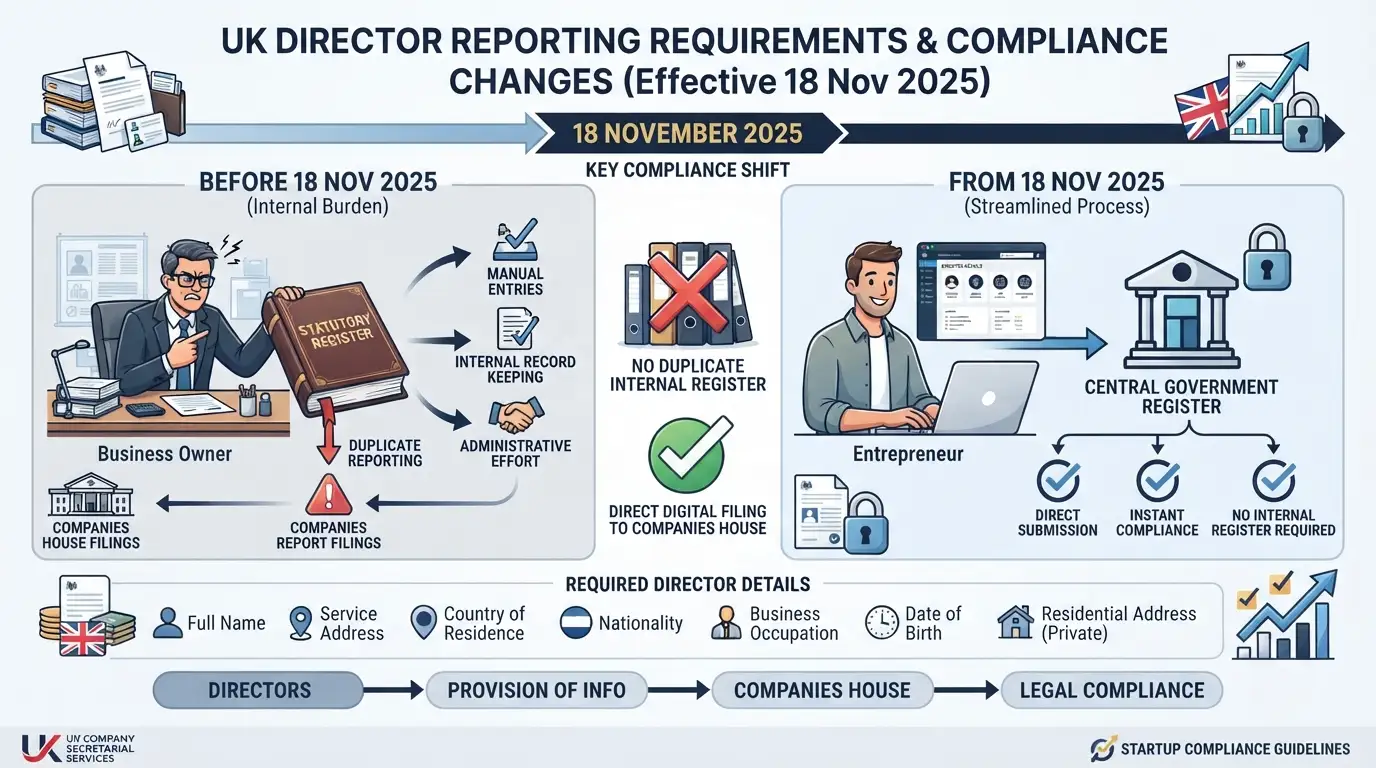
Director information remains important for company administration and public record accuracy. Companies should ensure that appointment, resignation and relevant personal-detail changes are submitted through the appropriate Companies House filing process.
Information reported for an individual director includes relevant identity and appointment particulars, such as their name, date of birth, nationality, country of residence and service address. Companies House displays only the month and year of an individual’s date of birth on the public register.
The separate internal Register of Directors and Register of Directors’ Residential Addresses are no longer required. This change does not remove the obligation to report director information to Companies House or comply with identity verification requirements.
What Information Must Be Reported for Persons with Significant Control?
Companies must identify their Persons with Significant Control and report the required information to Companies House. However, maintaining a separate internal statutory PSC register is no longer required from 18 November 2025.
A PSC is generally an individual who meets one or more of the statutory conditions of significant control. These include:
- Holding more than 25% of a company’s shares.
- Holding more than 25% of its voting rights.
- Having the right to appoint or remove a majority of the board.
- Otherwise exercising significant influence or control over the company.
- Exercising significant influence or control over a trust or firm that meets relevant control conditions.
Companies must assess their ownership and control arrangements to identify the correct PSCs. They must then submit the required information and keep the Companies House record accurate.
For a fuller explanation of the legal definition and reporting requirements, read our guide to What Is a PSC Register and Why Do You Need It?.
Businesses that need help managing PSC-related administration can also explore the PSC Register service from Form My Company. This provides a commercial next step for companies reviewing their PSC information and related records.
PSC Identity Verification Requirements
PSC reporting now also involves identity verification. Since 18 November 2025, individuals who are PSCs have been required to verify their identity with Companies House and provide their personal code and verification statement within their applicable 14-day period.
The exact deadline depends on the individual’s circumstances, including whether they were already registered as a PSC before the requirement began and whether they are also a director of the company.
Read our guide to PSC Identity Verification in the UK for further information about the process and requirements.
Companies and individuals who need assistance with the verification process can review Form My Company’s Identity Verification Service for Directors and PSCs.
How Do You Maintain and Update the Register of Members?
Companies should update the register whenever a person becomes or ceases to be a member or when information about an existing member or their shares changes. Accurate entries, supporting documents and clear historical records help maintain reliable ownership information.
Important events that may require an update include:
- Allotment of new shares
- Transfer of existing shares
- Admission of a new member
- A member ceasing to hold shares
- Changes to a member’s name or service address
- Changes to the number or class of shares held
- Changes to the amount paid or agreed to be paid on shares
Updating Shareholder Information
When a new shareholder joins the company, the register should include the required name and service address, membership date and relevant share details.
If an existing member changes their service address, the company should update the record while retaining the information required to preserve the membership history.
Recording Share Transfers
Share transfers require appropriate supporting documentation and company administration. Once a transfer has been properly processed and the new member is entered in the register, the company should ensure that the former and new ownership details are accurately recorded.
The register should also reflect any relevant changes to share numbers, classes and payment information.
Correcting Errors in the Register
Companies should not casually delete or overwrite historical entries when correcting an error. They should follow the appropriate legal process, retain supporting documentation and obtain professional advice where a disputed or complex ownership entry requires rectification.
For guidance on keeping company records accurate, read How to Keep Your Statutory Books Compliant With the Companies Act.
Where Must a Register of Members Be Kept?
A company must keep its register of members available for inspection at its registered office or another permitted location, such as a Single Alternative Inspection Location. The company must comply with the applicable Companies House notification requirements when the location changes.
Companies can maintain the register in a physical or electronic format, provided the record satisfies the legal requirements and remains available for inspection. A digital system should preserve accurate entries, historical information and appropriate access controls.
Companies House removed the option for companies to keep their register of members on its central register from 26 January 2026. Companies must therefore maintain their own register at the registered office or an appropriate alternative inspection location.
The register is an important company record and should be protected against loss, unauthorised changes and accidental deletion. Directors should ensure that the company can retrieve the information when required.
What Is the Difference Between the Register of Members and Companies House Records?
The register of members is the company’s internal statutory record of membership and shareholding. Companies House maintains public company information and filings, but its public record does not replace the company’s obligation to maintain its own register of members.
The two records serve related but different purposes:
| Register of Members | Companies House records |
|---|---|
| Maintained by the company | Maintained by Companies House |
| Records members and shareholdings | Displays information submitted through statutory filings |
| Includes membership dates | Records relevant filing and notification information |
| Must be kept available at the registered office or permitted alternative location | Provides public access to company information, subject to disclosure rules |
| Must be updated by the company | Must be updated through the relevant Companies House filing process |
Companies should check that their internal register and public filings are consistent. However, submitting information to Companies House does not remove the separate duty to maintain the register of members.
What Happens If a Company Fails to Maintain Its Register of Members?
Failing to maintain an accurate register of members can create legal and administrative problems for the company and its officers. Section 113 of the Companies Act 2006 places a statutory duty on companies to keep this register, and non-compliance without reasonable excuse can constitute an offence.
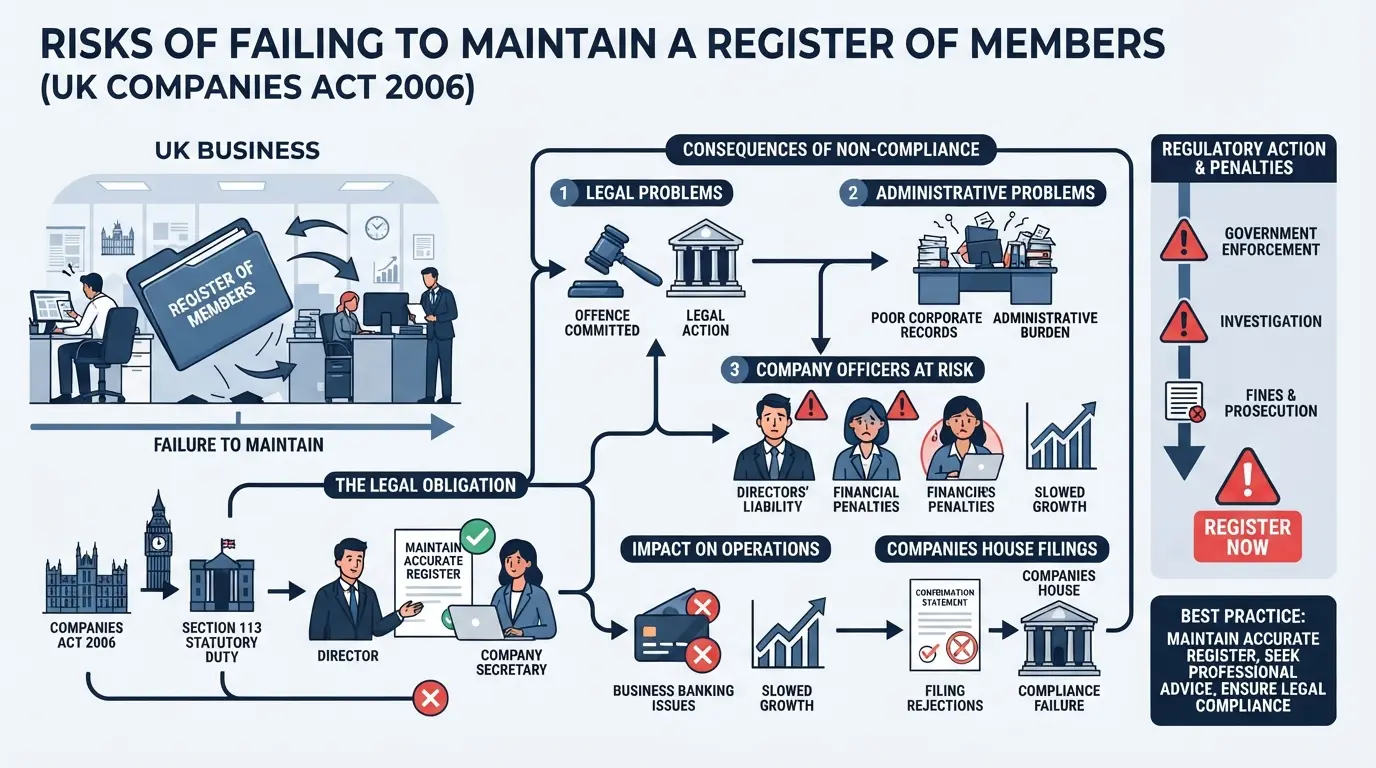
For further information about the consequences of poor statutory recordkeeping, read our guide on What Happens If You Fail to Keep a Statutory Register?.
Poor recordkeeping can also create practical difficulties when a company:
- Transfers shares to new investors.
- Changes its ownership structure.
- Prepares for a business sale or investment.
- Responds to a legal ownership dispute.
- Completes financial or corporate due diligence.
- Needs to confirm its membership history.
Missing or inconsistent entries can make it harder to establish who holds shares and when membership changed. Companies should review their records regularly and correct gaps through the appropriate process.
For additional support with statutory documentation, read Secure Your Statutory Books With Form My Company. It explains how organised company records support ongoing administration and compliance.
How Can a Company Pack Help Maintain Statutory Records?
A Company Pack provides organised company documentation and statutory record materials that help businesses maintain their corporate records. It can be particularly useful when setting up a new company or replacing incomplete or outdated documentation.
Form My Company’s Company Pack guide explains how a company pack supports business administration and statutory recordkeeping.
Companies looking for the relevant products can also explore the Company Pack service. Before purchasing, check the package contents and confirm that the documents meet the company’s current requirements, particularly following the changes to internal company registers in November 2025.
Information for Overseas Founders and Shareholders
Overseas founders may need to understand UK company formation, ownership and ongoing compliance before establishing a UK business. Our guides to launching a UK company from Chile and what Chinese residents need to consider when setting up a UK company provide additional information for international entrepreneurs.
These guides focus on company formation for overseas residents rather than the detailed legal fields in a register of members. They are included as supplementary resources for international founders who may also need to understand UK shareholder and company administration requirements.
Frequently Asked Questions
What information must be included in a register of members?
A register of members must include each member’s name, service address, date of registration and date of cessation, where applicable. For companies with share capital, it must also show the shares held by each member, relevant share numbers and classes, and the amount paid or agreed to be paid on those shares.
Is a register of members compulsory for UK companies?
Yes. Section 113 of the Companies Act 2006 requires every UK company to keep a register of members. The company must maintain accurate membership information and keep the register available for inspection at its registered office or another permitted location.
Does a register of members include shareholders’ dates of birth?
A member’s date of birth is not a standard required field under sections 113A and 113B of the Companies Act 2006. For an individual member, the required information includes their name and service address.
Do companies still need an internal register of directors and PSCs?
No. From 18 November 2025, companies no longer need to maintain separate internal statutory registers of directors, directors’ residential addresses, secretaries or PSCs. However, they must still submit the required information to Companies House and keep the public records up to date.
Where should a register of members be kept?
A company must keep its register of members available for inspection at its registered office or another permitted location, such as a Single Alternative Inspection Location. The company must comply with the applicable notification requirements when the location changes.
Can a register of members be maintained digitally?
Yes. Companies can maintain their register of members electronically or in physical form, provided the record meets the statutory requirements and remains available for inspection. Digital records should be secure, accurate and supported by reliable backups.
When should a company update its register of members?
A company should update the register when membership changes, shares are allotted or transferred, or required member information changes. It should record the relevant dates and retain the information needed to establish the company’s membership history.
What is the difference between a register of members and a PSC register?
The register of members records the company’s legal members and their shareholdings. PSC information identifies individuals or entities that exercise significant control over the company and must be reported to Companies House. Since 18 November 2025, companies no longer need to maintain a separate internal statutory PSC register.
Maintain Accurate Company Ownership Records
The register of members remains a fundamental statutory record for every UK company. It must identify members, record their service addresses and membership dates, and document relevant shareholding and payment details where the company has share capital.
Companies should also understand the distinction between internal statutory records and information filed with Companies House. Although separate internal registers of directors and PSCs are no longer required, the relevant reporting and identity verification obligations remain in force.
Form My Company provides company documentation and compliance services to support business administration. Review the Company Pack service and the PSC Register service to explore the available support for your company’s recordkeeping requirements.