
Choosing the right company seal requires assessing your corporate structure, legal requirements, and operational workflows. Select a traditional brass embossing seal for formal wet-ink impressions, an electronic seal for secure PDF execution, or a pre-inked stamp for rapid paperwork handling.
What Is a Company Seal and Why Do Businesses Need One?
A company seal is a physical or electronic authentication tool used to execute binding corporate documents and validate official resolutions. UK registered companies utilize seals to secure share certificates, deeds, and cross-border agreements.
A company seal acts as the ultimate mark of corporate authenticity. Historically, UK corporate legislation required a physical impression on all formal deeds. Modern legislation provides flexibility, yet many commercial institutions still expect a formal seal. Operating without one can delay international transactions or complicate banking compliance verifications.
Corporate officers apply seals to eliminate forgery risks. Each impression embeds unique organizational data into the paper fibers. This structural permanence prevents unauthorized document alterations. Directors protect their stakeholder liability by enforcing strict physical security over the stamping device.
Institutions across global markets recognize registered corporate seals as proof of executive authority. When overseas partners review contracts, an embossed impression signals legitimacy. Form My Company ensures every UK corporate entity establishes proper document execution workflows from incorporation onward.
Which Types of Company Seals Are Available for UK Businesses?
UK businesses can choose between three primary seal types: traditional embossing presses, self-inking stamps, and electronic digital seals. Each variant serves distinct document verification workflows across different administrative environments.
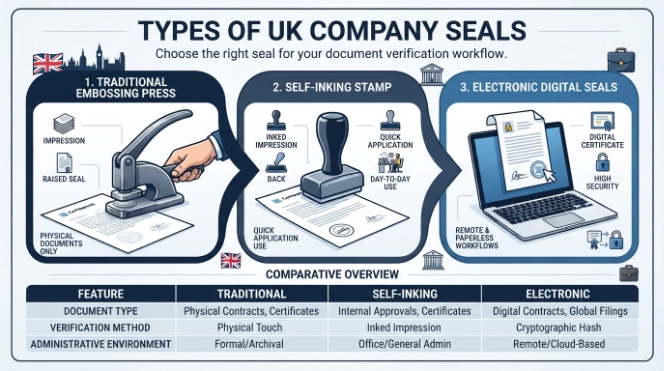
Traditional brass embossing presses create a raised, tactile impression on heavy stock paper. These heavy-duty devices suit permanent certificates and physical deeds. Self-inking stamps deliver rapid, clear ink impressions for high-volume invoice processing. Digital electronic seals embed cryptographic hashes into portable document formats for secure remote execution.
Selecting the right physical format depends on daily document volume. An embossing press requires manual pressure to deform paper fibers. This mechanism suits low-frequency, high-value executions like share transfers. In contrast, self-inking mechanisms optimize administrative throughput for routine compliance filings.
Digital security protocols govern electronic seal implementations across modern corporate networks. Software algorithms encrypt signer metadata directly into PDF deliverables. Form My Company provides guidance on integrating these digital mechanisms into standard operational structures.
How Does UK Corporate Law Regulate the Use of Company Seals?
UK corporate law dictates that companies may execute documents using a formal seal witnessed by two authorized officers. Modern companies operate under flexible governance rules where signatures alone suffice unless articles of association mandate a seal.
Section 45 of the Companies Act 2006 establishes the statutory framework for company seals in the United Kingdom. Directors must engrave the official company name legibly on the metallic die. Failing to include exact registration details breaches statutory compliance standards.
Articles of association dictate specific internal protocols for seal custody. Companies must store embossing dies in secure vaults accessible only by designated corporate secretaries. Document execution logs track every single impression stamped during a fiscal year.
Statutory compliance demands exact adherence to execution protocols. When executing a deed under seal, two directors or one director and the company secretary must sign alongside the impression. Reviewing the complete registration process helps founders understand compliance obligations. Explore our guide on how to register a company in the UK to establish proper foundational governance.
What Factors Should You Consider When Selecting a Seal?
Selecting a company seal requires evaluating document volume, material durability, legal jurisdiction, and remote working requirements. Businesses must balance traditional stakeholder expectations against modern digital efficiency.
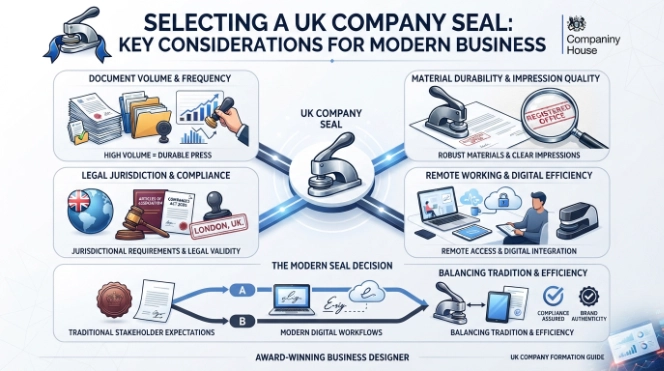
Material composition dictates the longevity of physical embossing presses. Solid brass dies resist wear during high-volume document execution cycles. Steel-reinforced frames prevent mechanical slippage during heavy paper compression.
Operational geography influences format selection significantly. Remote teams require digital execution tools rather than desktop embossing presses. Conversely, businesses managing international trade agreements often need physical impressions to satisfy foreign notarization rules.
Evaluating these operational requirements ensures seamless administrative workflows. Companies can review the What Is a Company Seal and Do You Still Need One? overview to assess specific compliance needs before purchasing hardware.
How Can Businesses Implement and Maintain Their Company Seal?
Businesses implement company seals by updating internal governance policies, registering authorized custodians, and establishing secure physical storage protocols. Regular maintenance ensures clear, legally compliant impressions over decades of corporate operations.
Implementing a seal begins with board approval and registration in company minutes. Directors designate specific operational custodians responsible for daily tool access. Maintenance schedules require cleaning brass dies periodically to remove paper dust and ink residue.
| Operational Step | Action Item | Compliance Standard |
| Custody Assignment | Appoint authorized officers | Restrict vault access |
| Impression Testing | Verify die clarity | Ensure legible text |
| Execution Logging | Record stamped documents | Maintain audit trails |
Proper maintenance prevents blurred impressions that could invalidate formal agreements. Administrative teams must inspect mechanical presses quarterly for alignment wear. When updating corporate governance, founders can seamlessly Order an Official Company Seal From Form My Company to maintain flawless compliance.
Choosing the right company seal protects corporate integrity and streamlines document execution. Form My Company delivers comprehensive corporate services, ensuring every UK business operates with verified administrative authority.
Explore our Company Pack guide,
DIY vs Assisted PSC Identity Verification: Which Is Safer?
How to Avoid Delays With PSC Identity Verification
Frequently Asked Questions
What is included in a Form My Company company pack?
A company pack typically includes digital and printed corporate documents such as the certificate of incorporation, memorandum and articles of association, and share certificates. These bundled assets provide UK business founders with all essential governance items needed immediately after incorporation.
Do UK companies legally require a company seal?
Modern UK corporate legislation does not make a physical company seal legally mandatory for standard operations. However, many international institutions and traditional financial partners still request a sealed physical impression to execute formal deeds and cross-border agreements securely.
How long does it take to receive official corporate documents?
Digital incorporation documents are generally delivered via email within hours of approval by Companies House. Physical items like printed certificates and company seals ordered through Form My Company ship within standard 1 to 3 business days.
Can I update my company register after incorporation?
Directors can update company registers whenever corporate details change, including director appointments, share allocations, or registered office addresses. Maintaining accurate statutory registers ensures ongoing compliance with the Companies Act 2006.
Why should I choose Form My Company for incorporation services?
Form My Company streamlines corporate setup by bundling compliance essentials, digital registers, and official seals into a single package. Business owners rely on these services to establish robust administrative foundations without navigating complex regulatory filings manually.