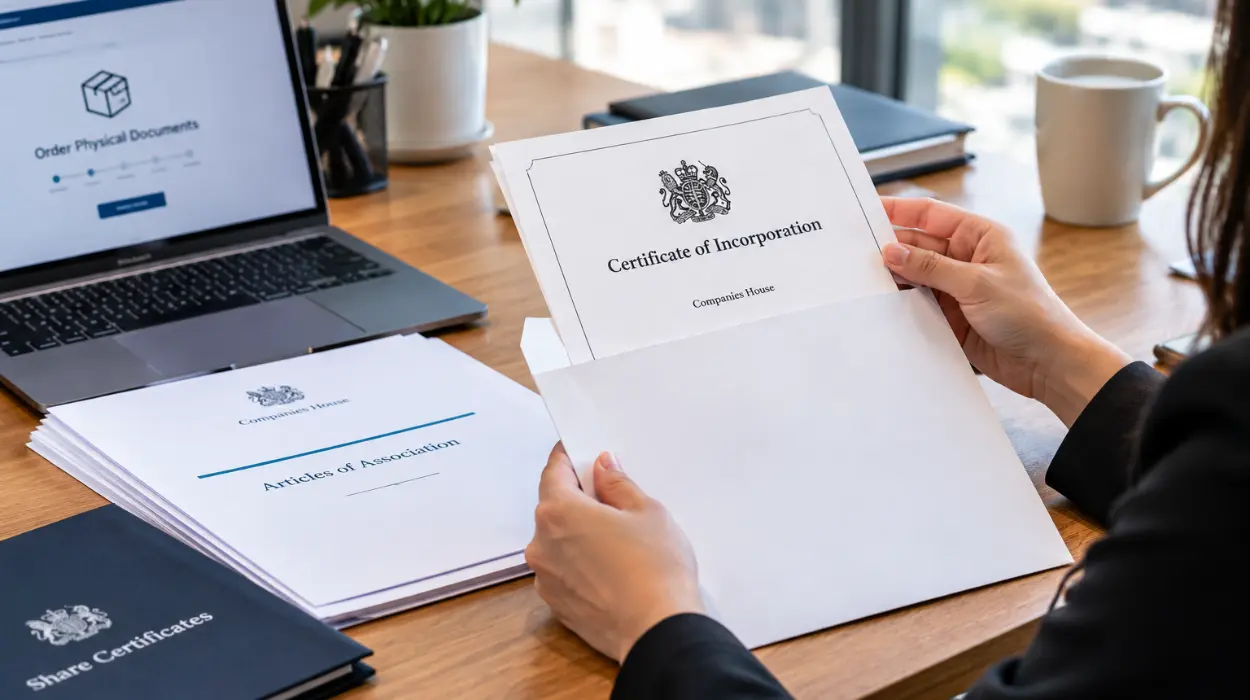
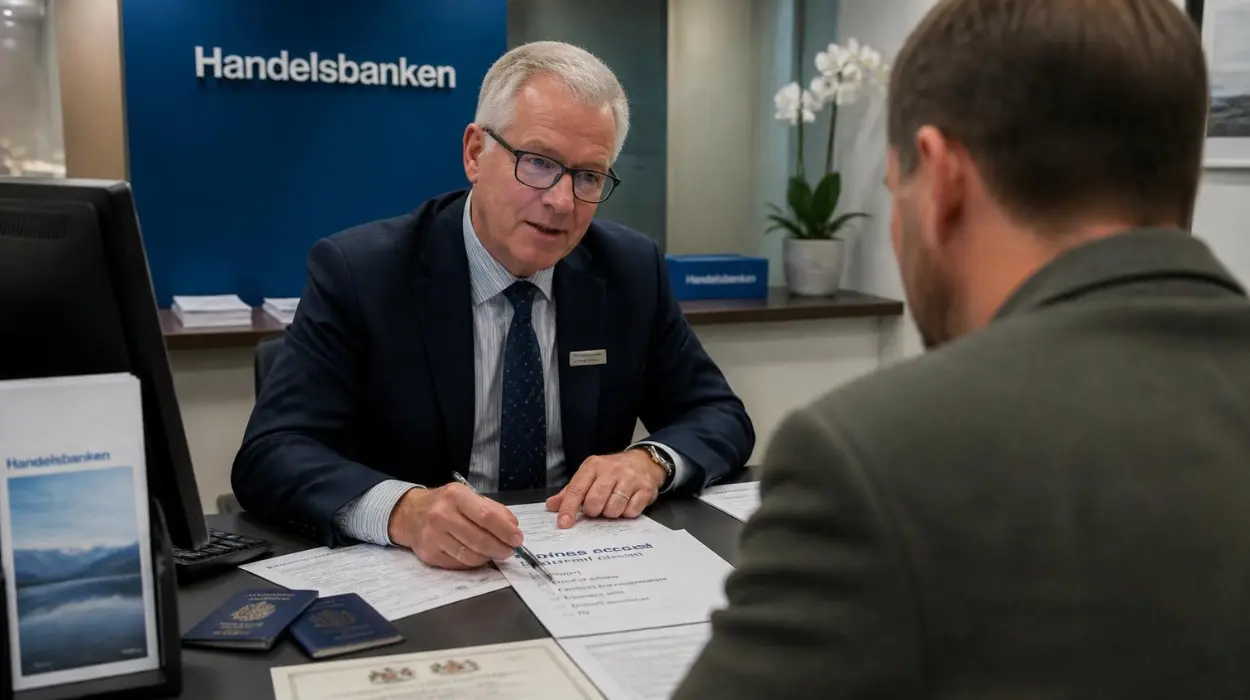
UK banks require corporate statutory documents, proof of business operations, and verified identity records for all directors and significant shareholders. This mandatory documentation satisfies strict regulatory compliance standards established by the Financial Conduct Authority.
What Statutory Corporate Documents Must You Provide?
UK banks require your certificate of incorporation, memorandum and articles of association, and official register entries to prove legal entity formation. Financial institutions review these constitutional records to validate your corporate structure before issuing sort codes or account numbers.
Every corporate application starts with your certificate of incorporation. This official registrar document confirms your limited company exists on the Companies House register. Banks verify the registration number and company name against official government databases.
Your articles of association outline internal management rules. Financial institutions read these constitutional bylaws to understand voting rights and director authority limits. Companies formed with standard model articles streamline this administrative review process significantly.
You must supply a certified copy of your memorandum of association. This founding document lists initial shareholders and their agreement to form the corporate entity. Compliance officers inspect these names to trace early capital contributions.
Recent confirmation statements prove active business status on public registers. Banks examine filing histories to confirm your corporate details remain current and accurate.
What Personal Identification Records Do Directors Need?
UK banks mandate government-issued photo identification and recent residential address proof for every company director and 25% shareholder. Compliance teams check these personal credentials against international watchlists and credit reference agencies to satisfy anti-money laundering laws.
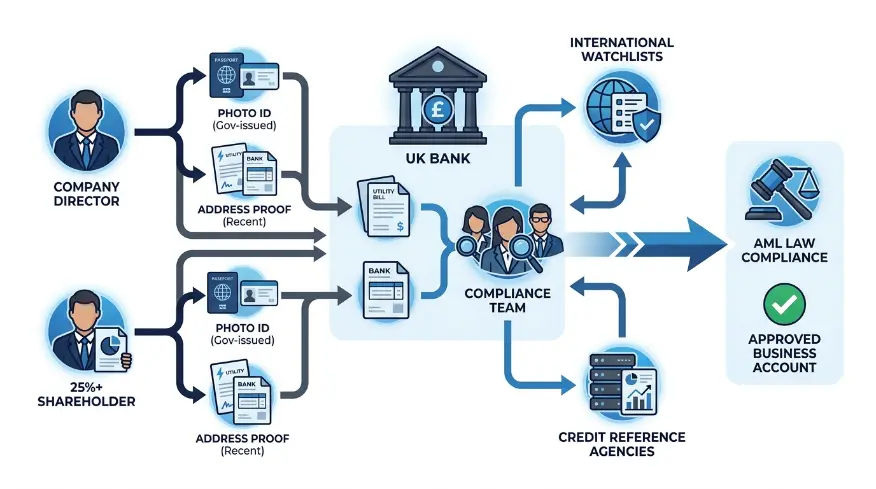
Acceptable photo identification includes valid passport booklets or biometric driving licences. Identity Verification Services validate director credentials using official UK compliance frameworks to prevent fraudulent applications. Digital uploads require high-resolution images showing clear facial features and visible expiration dates.
Proof of address requires utility bills or council tax statements dated within the last 90 days. Bank statements also serve as valid residency verification if issued by regulated financial institutions. Mobile phone bills and digital-only statements often face rejection by traditional high-street lenders.
Non-resident directors must provide notarised translations of foreign identity documents. International applicants face extended onboarding schedules while compliance departments authenticate overseas credentials manually.
What Proof of Business Operations Is Essential?
UK banks demand comprehensive business plans, cash flow forecasts, and anticipated transaction volumes to assess commercial viability. Commercial underwriters evaluate these operational projections to understand your revenue sources and mitigate financial crime risks.
Detailed business plans explain your commercial model, target audience, and competitive advantages. Underwriters read these proposals to evaluate whether your revenue projections align with standard industry benchmarks.
Cash flow forecasts outline expected income and operational expenditures across twelve months. Financial analysts review these financial models to verify sufficient operating capital exists before account activation.
Contracts with suppliers and clients validate legitimate trade activities. Providing signed commercial agreements proves that genuine economic transactions drive your revenue generation.
Businesses operating in regulated sectors require additional trade licenses or professional accreditations. Lenders reject applications instantly if mandatory industry permits remain missing from the submission package.
How Does Proper Documentation Speed Up Account Approval?
Proper document preparation reduces corporate account approval times from several weeks down to five business days. Organised compliance submissions prevent administrative delays and eliminate requests for additional information from bank underwriters.
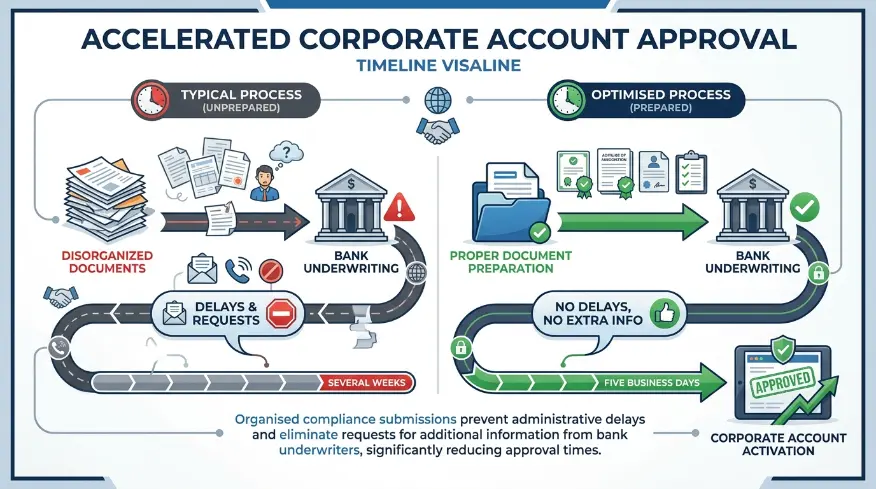
Submitting complete statutory records allows compliance teams to initiate verification checks immediately. Disorganised applications trigger automatic freezes and prompt requests for missing certified copies.
Using professional incorporation assistance ensures your foundational paperwork meets strict banking standards. Business owners streamline this administrative burden by ordering a comprehensive Company Pack containing all legally mandated formation documents.
Matching director details across all corporate filings prevents verification mismatches. Discrepancies between shareholder registers and passport names cause severe compliance bottlenecks during manual reviews.
Clear financial projections demonstrate commercial competence to reviewing underwriters. Well-structured business plans answer compliance questions proactively before bank officers issue formal inquiries.
What Are the Most Common Reasons for Bank Account Rejections?
UK banks reject corporate applications due to incomplete director identification, high-risk business sectors, or opaque ownership structures. Compliance officers deny account access automatically when applicant credentials fail automated anti-money laundering screenings.
Opaque ownership structures involving complex offshore holding companies trigger immediate rejections. Banks require clear visibility over ultimate beneficial owners holding more than 25% voting rights.
High-risk industries face strict operational scrutiny during the onboarding process. Businesses involved in cryptocurrency, adult entertainment, or cash-intensive retail often struggle to secure traditional high-street accounts.
Unresolved county court judgments on director credit files lead to commercial account denials. Lenders view poor personal credit histories as a direct indicator of elevated financial risk.
Incomplete application forms cause unnecessary delays and subsequent rejections. Providing inaccurate contact details or mismatched addresses prevents verification systems from validating your corporate identity.
UK banks enforce rigorous documentation standards to comply with anti-money laundering regulations and prevent financial crime. Successful applicants provide complete statutory records, verified personal identification, and transparent proof of business operations. Preparing these mandatory files accurately eliminates administrative friction during the banking onboarding process. Business founders seeking reliable incorporation paperwork can explore what UK banks look for when verifying a new company to align their corporate records with institutional requirements. Entrusting your initial setup to established corporate services ensures your startup remains fully prepared for commercial banking. Entrepreneurs ready to secure verified corporate paperwork can explore our guide on how to order AML-ready company paperwork with Form My Company to streamline their upcoming account application.
Explore our Company Pack guide,
Why Does ESG Reporting Now Include Corporate Events?
How to Get Printed Certificate of Incorporation and Share Certificates?
Frequently Asked Questions
What is included in a standard company formation pack?
A standard formation pack typically contains your certificate of incorporation, memorandum and articles of association, and share certificates. When you order through Form My Company, our comprehensive Company Pack includes all these legally required statutory registers and digital onboarding documents to simplify your business launch.
How long does it take to receive corporate documents after incorporation?
Digital corporate documents are usually delivered via email within hours of successful registration at Companies House. Hard copy portfolios and printed statutory registers arrive within two to three working days depending on postal selection.
Are digital company documents accepted by UK banks for account opening?
UK banks accept digital certificates of incorporation and electronic articles of association during initial online applications. Form My Company ensures all digital corporate files are officially formatted to meet compliance standards required by major financial institutions.
Can non-UK residents order a company formation pack?
Non-UK residents can establish a British limited company and purchase formation packs without holding local residency status. International founders simply provide valid overseas passport identification and a registered office service address to satisfy compliance mandates.
Why do I need physical statutory registers for my business?
UK company law mandates that every limited company maintains up-to-date physical or digital statutory registers containing director, secretary, and shareholder details. Form My Company supplies pre-formatted registers within your Company Pack to ensure complete legal compliance from day one.