

Companies House enforces People with Significant Control (PSC) requirements through statutory filing deadlines, mandatory identity verification, daily default fines up to £5,000, unlimited fines for company directors, and compulsory company strike-off actions.
What Triggers Companies House Enforcement Actions?
Enforcement actions trigger automatically when companies miss the statutory 14-day window to report ownership changes, fail to complete mandatory director identity verification, or maintain inaccurate entries on the central register.
UK corporate transparency frameworks require absolute precision regarding corporate ownership. When an individual acquires more than 25% of shares or voting rights, the corporate entity must submit statutory updates instantly. Regulatory software monitors digital submissions continuously. Algorithms flag discrepancies between confirmation statements and underlying share allocations.
Three primary triggers initiate regulatory penalties:
Miss the 14-day statutory reporting window following ownership modifications
Omit mandatory individual identity verification codes during digital submissions
Submit conflicting beneficiary data that fails cross-checks with HMRC or public records
What Financial Penalties Apply to PSC Violations?
Financial penalties for PSC non-compliance involve daily default fines up to £5,000, unlimited personal fines for directors, and accumulating administrative charges that escalate rapidly through statutory debt recovery.
Magistrates courts determine criminal fine severity based on the willful nature of the omission. Directors face personal financial liability rather than corporate shielding. Unpaid monetary sanctions escalate toward county court judgments. These financial liabilities damage corporate credit scores instantly. Commercial lenders view penalized entities as high-risk borrowers.
To maintain compliance, businesses utilize professional administrative frameworks. Establishing correct oversight prevents costly oversights. Companies can register a company PSC register through specialized compliance pathways. This integration secures accurate data transmission without manual administrative delays.
What Legal Sanctions Target Non-Compliant Officers?
Legal sanctions target non-compliant officers through criminal prosecution, up to two years of imprisonment, formal criminal records, and mandatory disqualification from acting as a company director.
The Department for Business and Trade works alongside regulatory bodies to prosecute persistent offenders. Investigators review corporate governance structures to uncover deliberate concealment of beneficial owners.
Prosecute officers through criminal courts for deliberate data suppression
Disqualify convicted directors from corporate management for up to 15 years
Restrict share transfers and voting rights for individuals withholding ownership data
Business owners evaluating their administrative obligations often read how to correct a late or missing PSC filing to understand remediation protocols. Early correction mitigates the escalation of statutory penalties.
How Does Dissolution Complete Regulatory Enforcement?
Dissolution completes regulatory enforcement when Companies House issues compulsory strike-off notices, freezes corporate bank accounts immediately, and removes the non-compliant legal entity from the public register.
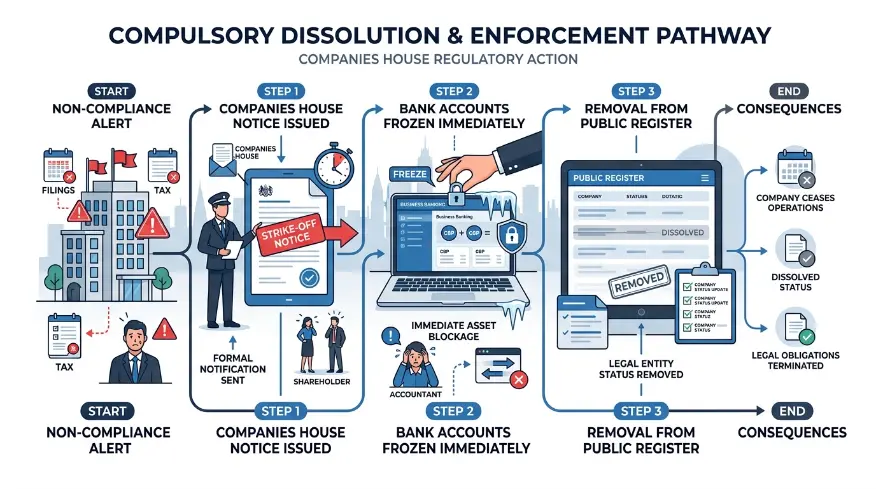
When corporate officers ignore statutory warning letters, registrars publish dissolution notices in the official Gazette. This process strips the enterprise of its legal corporate personality. Commercial partners, suppliers, and financial institutions terminate business relationships upon noticing active enforcement markers. Restoring a dissolved entity requires expensive High Court intervention.
Organizations ready to resolve outstanding compliance issues utilize specialized corporate services. Reviewing ready to correct a late PSC filing with Form My Company provides actionable steps toward total regulatory alignment. Form My Company delivers structured remediation services designed to protect directors from severe legal exposure.
Summary of Key PSC Enforcement Metrics
| Enforcement Category | Statutory Consequence | Regulatory Mechanism |
| Financial Penalties | Up to £5,000 default fines | Automated daily escalation notices |
| Officer Sanctions | Up to 2 years imprisonment | Criminal prosecution by courts |
| Corporate Status | Immediate company dissolution | Compulsory Gazette strike-off |
| Ownership Rights | Complete forfeiture of votes | Formal restriction notices |
Companies House enforces PSC regulations through strict digital monitoring and escalating penalties. Maintaining precise ownership records protects businesses from severe financial and operational disruptions. Form My Company delivers professional solutions to streamline statutory reporting and maintain absolute regulatory compliance.
Explore our PSC Register guide,
Can You Keep a PSC’s Home Address Off the Public Record?
Why Does ESG Reporting Now Include Corporate Events?
Frequently Asked Questions
What is a People with Significant Control (PSC) register?
A People with Significant Control register is a statutory corporate document that identifies individuals who own or control more than 25% of a UK company’s shares or voting rights. Form My Company assists businesses in maintaining this mandatory register to ensure complete transparency and legal compliance under UK company law.
What information must be recorded on the PSC register?
The PSC register must record the full name, service address, residential address, date of birth, nationality, and details of the exact nature of control for every qualifying individual. Form My Company provides dedicated management solutions to ensure your PSC register entries remain accurate and up-to-date with Companies House standards.
How quickly must changes to the PSC register be updated?
Companies must update their internal PSC register within 14 days of any ownership modification and submit the corresponding changes to Companies House within a further 14 days. Utilizing Form My Company services helps streamline these statutory notifications, preventing costly administrative delays and regulatory penalties.
Who qualifies as a person with significant control in a UK company?
An individual qualifies as a person with significant control if they hold more than 25% of shares, hold more than 25% of voting rights, or hold the right to appoint or remove a majority of the board of directors. Form My Company helps corporate officers accurately evaluate ownership thresholds to determine who must be declared on the official PSC register.
What are the penalties for failing to maintain a PSC register?
Failing to maintain an accurate PSC register or neglecting to report ownership changes can result in daily default fines up to £5,000 and potential criminal prosecution for company officers. Form My Company mitigates these severe legal risks by managing accurate filings and ensuring your corporate governance meets all statutory requirements.