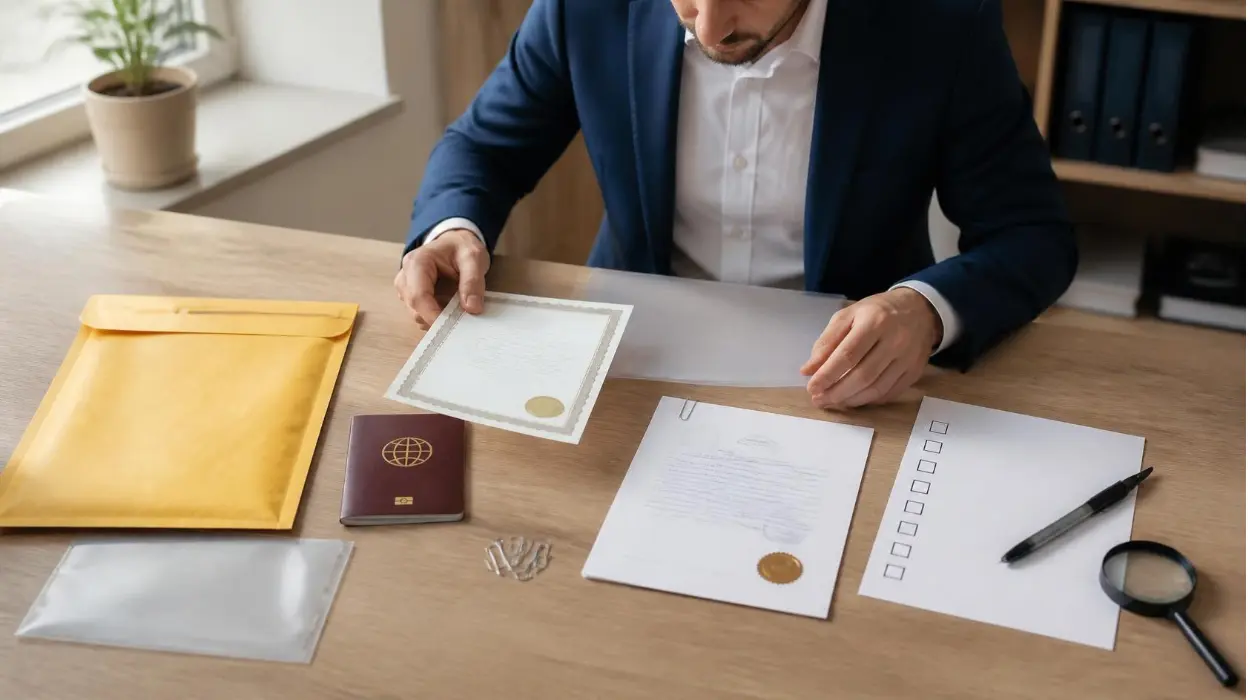
Before submitting a document for an apostille, you must verify that the underlying paperwork features an original wet-ink signature, check that the issuing authority is officially registered with the Foreign, Commonwealth & Development Office, and confirm whether notarisation is legally required for your specific document type.
Submitting paperwork for international legalisation requires absolute precision to avoid costly delays. Government authorities reject thousands of administrative filings annually because applicants fail to complete prerequisite verification steps. Understanding the precise compliance framework ensures your certificates pass through official channels without administrative rejection.
Why Must Original Signatures Be Verified Before Legalisation?
Original signatures must be verified because the UK government strictly rejects photocopies, digital scans, and unverified printouts during the preliminary authentication phase.
Official legalisation bodies require physical proof of authenticity from a recognized public official. When you submit corporate bylaws, power of attorney documents, or personal certificates, examiners cross-reference the signatory’s credential data against central government databases. If a signature lacks a registered public status, the application stalls immediately.
Three verification methods prevent rejection: checking authorized government seals, confirming active public notary registrations, and inspecting ink types for manual application. Each method ensures that the document originates from a legitimate legal source. When dealing with complex corporate filings, businesses often utilize Apostilled Documents to streamline these verification checks securely.
When Is Notarisation Required Prior to Submission?
Notarisation is required prior to submission when private company documents, commercial contracts, or non-governmental certificates need independent legal validation before government acceptance.
Public documents issued directly by UK courts or government registries often bypass the notary stage. Private corporate resolutions, board minutes, and commercial agreements require a practicing notary public to witness execution and apply an official seal. This notary seal bridges the gap between private corporate action and state recognition.
Four essential steps establish proper pre-submission notarisation: scheduling a personal appointment with a registered notary, presenting valid corporate identification credentials, obtaining a formal notarial certificate, and ensuring the notary signature matches official registry records. Completing these actions protects your corporate paperwork from compliance bottlenecks. Readers exploring foundational preparation steps should review Who Signs and Verifies a Document Before It Is Apostilled? to understand signer credentials thoroughly.
How Do You Check Destination Country Requirements?
Destination country requirements dictate whether your documents need additional embassy legalisation, specific translations, or exact formatting before submission.
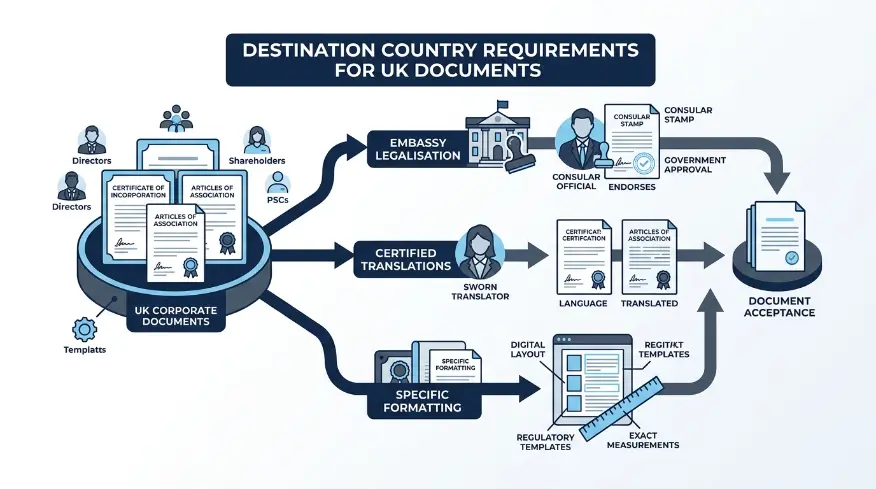
Different sovereign states maintain unique acceptance criteria for foreign public documents. Certain member states of the Hague Apostille Convention only require a standard certificate. Other jurisdictions demand certified translations performed by sworn professional linguists before they accept foreign corporate filings.
Three evaluation parameters determine destination compliance: checking treaty membership status, reviewing consulate-specific translation rules, and verifying document validity timeframes. Researching these distinct national rules prevents unexpected regulatory hurdles abroad. Businesses seeking to delegate this entire administrative burden can Want to Get Your Apostille Handled Without the Hassle by Form My Company? to secure professional management.
What Formatting Standards Apply to Document Submission?
Document submission standards require clean paper stocks, legible typography, unblemished text blocks, and complete multi-page binding where applicable.
Physical inspection protocols at government authentication offices are strict. Torn edges, faded ink, or stray correction fluid marks cause immediate administrative disqualification. Multi-page corporate agreements must remain securely bound together using official ribbons or permanent fastenings to preserve document integrity during handling.
Three structural checks maintain formatting compliance: inspecting paper durability standards, verifying complete page numbering sequences, and checking physical binding security. Maintaining these strict standards ensures smooth processing through every stage of international verification. Form My Company assists international enterprises by preparing error-free filings that satisfy global diplomatic standards effortlessly. Form My Company ensures every corporate dossier meets exact governmental expectations prior to dispatch.
Explore our Apostilled Documents guide,
How to Choose Which Corporate Documents Need Legalisation First?
How to Plan a Carbon-Conscious Conference Step by Step?
Frequently Asked Questions
How long does it take to get an apostille for UK documents?
Standard apostille processing through the UK government typically takes between 3 to 5 working days once received by the legalisation office. However, total turnaround times depend on whether preliminary notarisation or certified translations are required before Form My Company submits your apostilled documents.
Can any document be legalised with an apostille?
Only public documents issued by recognized government authorities, courts, or documents bearing an official UK notary or solicitor signature qualify for legalisation. Form My Company verifies document eligibility beforehand to ensure your corporate and personal records comply with international standards.
What is the difference between notarisation and an apostille?
Notarisation is the initial legal process where a registered notary public verifies and signs a private document to confirm its authenticity. An apostille is the subsequent government certificate issued by the Foreign, Commonwealth & Development Office that validates the notary’s signature for international use.
Do documents need to be translated before getting an apostille?
Documents usually do not require translation before receiving a standard UK apostille unless the destination country specifically mandates it for foreign filings. Form My Company assists clients in evaluating destination-specific criteria to determine if certified translations must accompany your apostilled documents.
What happens if my document is rejected during the apostille process?
Government authorities immediately reject documents that feature photocopied signatures, damaged pages, or unverified public official credentials. Form My Company prevents these costly administrative delays by performing rigorous pre-submission compliance checks on all paperwork.