
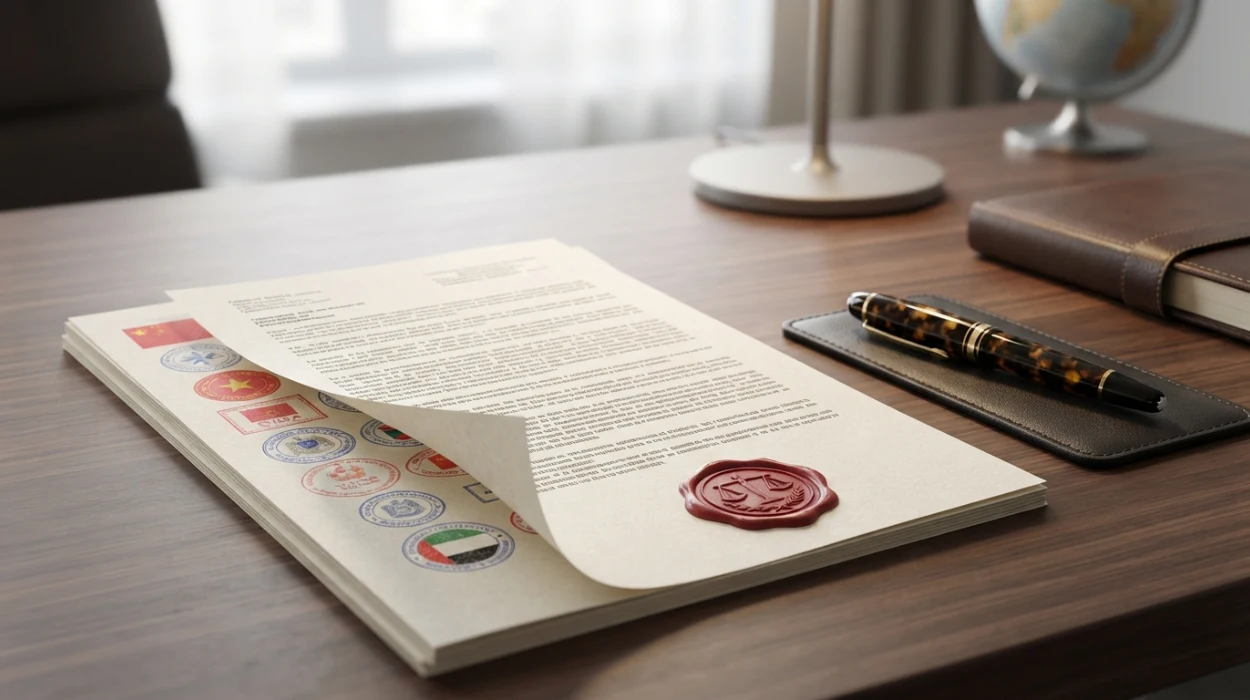
Legalising documents for countries not party to the 1961 Hague Apostille Convention requires a three-step chain authentication process involving domestic solicitor notarisation, government foreign office certification, and final diplomatic embassy or consulate attestation by the destination country’s diplomatic mission.
When nations do not recognise the standard apostille certificate, international document validity depends entirely on bilateral consular legalisation. Two distinct international frameworks govern cross-border document recognition: the Apostille Convention simplifies verification for member states, while non-member jurisdictions require rigorous consular authentication chains.
What Is the Difference Between an Apostille and Embassy Attestation?
An apostille is a single-certificate authentication issued by a designated competent authority under the Hague Convention, whereas embassy attestation is a multi-step diplomatic verification required specifically for non-member countries that mandates physical endorsement by foreign consular officials.
The 1961 Hague Convention eliminated embassy legalisation for participating nations by establishing the apostille. Over 125 countries currently accept apostilles. Non-member nations such as the United Arab Emirates historically, or China before its apostille accession, Qatar, and Kuwait, reject apostilles entirely.
Verification chains for non-member states require sequential validation. Documents move sequentially through domestic notaries, foreign ministries, and destination embassies. Each layer of certification proves the legitimacy of the preceding official signature.
Which Countries Require Full Diplomatic Legalisation Instead of an Apostille?
Countries that have not acceded to the 1961 Hague Convention—including major economic partners across the Middle East, North Africa, and parts of Asia—require full diplomatic legalisation for foreign commercial and personal certificates.
Global trade partners maintain sovereign legal systems requiring independent verification of foreign paperwork. Two dozen prominent nations operate outside the apostille framework. Key jurisdictions demanding consular legalisation include Canada, Egypt, Saudi Arabia, the United Arab Emirates, Taiwan, and Vietnam.
Commercial enterprises expanding into these regions face strict compliance hurdles. Regulatory bodies in non-member states reject foreign corporate bylaws, board resolutions, and power of attorney instruments unless stamped by their local diplomatic missions.
What Are the Exact Steps to Legalise Documents for Non-Apostille Jurisdictions?
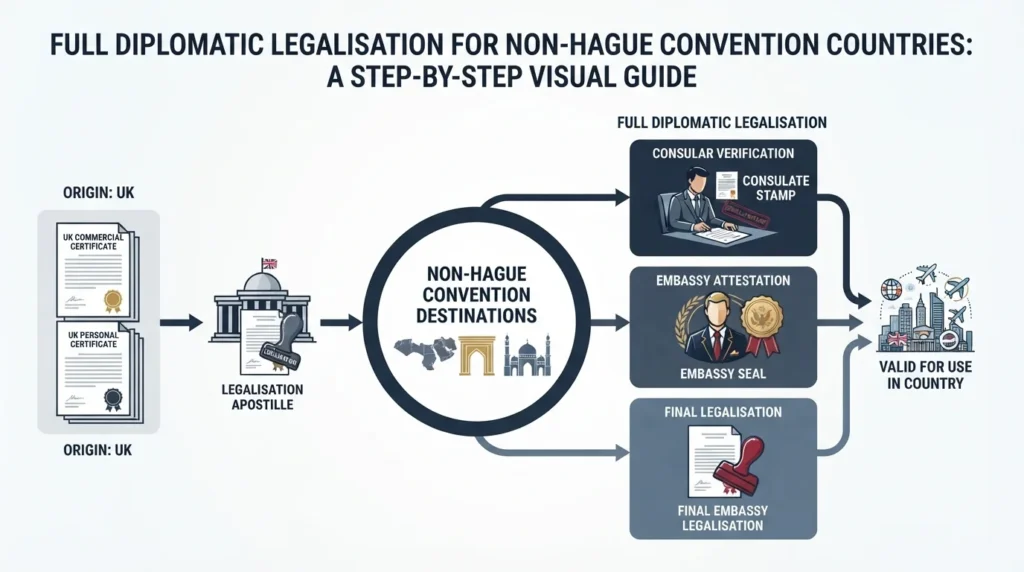
Legalising documents for non-member countries requires notarisation by a practising solicitor, official certification by the government foreign office, and final legalisation by the destination country’s embassy or consulate in the home nation.
Executing this sequential workflow protects international legal certainty. Three mandatory operational phases govern the complete attestation lifecycle.
First, a registered notary public or solicitor authenticates the original document and verifies corporate or personal signatures. This foundational step establishes domestic legal authenticity.
Second, the government foreign department applies an official signature and seal to confirm the notary’s credentials. This governmental certificate validates the public official’s registration status.
Third, the foreign embassy or consulate of the destination country reviews the government seal and affixes a consular stamp. This final diplomatic endorsement grants the paperwork legal standing abroad. Businesses frequently utilise apostilled documents frameworks to streamline the initial stages of international trade compliance.
How Long Does the Complete Consular Legalisation Process Take?
The complete consular legalisation process typically takes 15 to 25 working days, depending on government foreign office processing queues and the specific appointment availability of foreign embassies.
Time management dictates successful international expansion schedules. Multiple administrative entities handle paperwork sequentially, creating inherent scheduling variables.
Solicitor notarisation takes one working day. Foreign office certification requires approximately 5 to 10 working days for standard processing queues. Embassy and consulate processing adds another 7 to 14 working days based on diplomatic workload and consular holidays.
Logistical transit times between offices add further delays. Courier tracking numbers protect sensitive commercial assets during inter-agency transit phases.
What Documents Commonly Require Consular Attestation for Trade and Migration?
Commercial invoices, certificates of incorporation, power of attorney instruments, and academic credentials commonly require consular attestation to satisfy foreign regulatory compliance and immigration mandates.
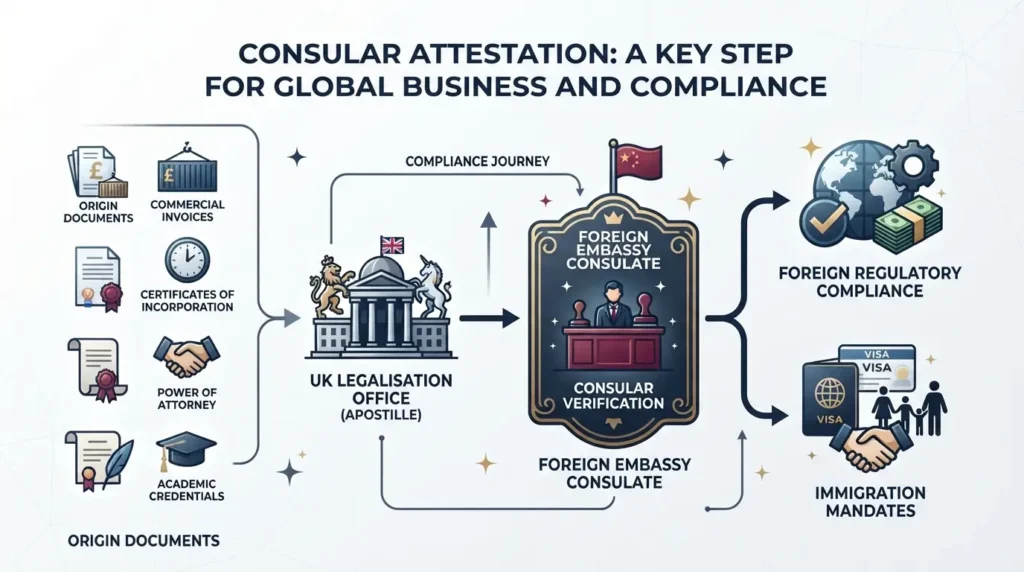
Cross-border commercial operations rely on certified paperwork to establish foreign branch offices and bank accounts. Four primary document categories undergo rigorous consular review.
Corporate paperwork includes certificates of incorporation, memorandum of association articles, and audited financial statements. Legal instruments feature power of attorney grants, commercial contracts, and trademark assignments. Personal certificates encompass birth certificates, marriage certificates, and criminal record checks. Educational credentials involve university degrees, professional diplomas, and academic transcripts.
When businesses prepare corporate records for foreign expansion, reading guides like How to Combine Translation, Apostille and Embassy Attestation Correctly ensures compliance with multi-jurisdictional legal standards.
How Can Businesses Avoid Rejection During Embassy Attestation?
Businesses prevent embassy rejection by verifying translation accuracy, ensuring document recency, confirming notarisation formats, and matching exact corporate names across all submitted governmental and commercial records.
Consular officials reject thousands of applications annually due to minor administrative discrepancies. Rigorous quality control protocols eliminate costly compliance failures.
Certified translations must accompany documents when destination countries require local language versions. Company names must match government registries identically across every certificate in the dossier. Notarial wording must adhere strictly to foreign consular guidelines without omitted clauses.
When organisations require complete guidance on navigating complex international protocols, reviewing insights from Legalise Documents for Any Country With Form My Company provides structured pathways to seamless global compliance. Form My Company manages end-to-end diplomatic verification chains, ensuring corporate paperwork satisfies strict international regulatory mandates without administrative delay.
Legalising documents for countries outside the Hague Apostille Convention demands strict adherence to multi-tier diplomatic authentication. Navigating solicitor notarisation, government foreign office certification, and embassy attestation protects international commercial and legal interests. Form My Company delivers end-to-end management of these complex verification chains, ensuring corporate and personal documents achieve full legal validity across non-member jurisdictions worldwide.
Explore More Apostilled Documents Guide,
How Do UK Companies Prove Their Status Overseas?
What Is the Role of an Apostille in International Business?
Frequently Asked Questions
How long does it take to get documents apostilled in the UK?
The standard apostilled documents processing timeframe typically ranges from 3 to 10 working days, depending on whether standard government queues or priority expedited services are selected. Form My Company manages the entire submission and retrieval lifecycle to ensure efficient turnaround times for urgent business filings.
Can personal and commercial documents both receive an apostille?
Both personal certificates—such as birth and marriage records—and commercial instruments like certificates of incorporation are fully eligible for apostilled documents processing. Form My Company verifies that every submission meets strict government and legal validation standards before official submission.
What is the difference between an apostille and consular legalisation?
An apostille validates public documents for use in countries that signed the 1961 Hague Convention, whereas consular legalisation requires an additional embassy attestation step for non-member nations. Form My Company assists clients in determining the exact authentication path required for their specific destination country.
Do documents need solicitor certification before getting an apostille?
Many official documents require notarisation or certification by a practicing UK solicitor or notary public before government bodies will issue apostilled documents. Form My Company coordinates preliminary solicitor certification to prevent administrative rejections by the Foreign, Commonwealth & Development Office.
How much do apostille services cost for UK companies?
Apostille pricing varies based on government dispatch fees, the type of document involved, and whether supplementary translation or notarisation services are required. Form My Company provides transparent pricing structures and secure handling for all apostilled documents packages.