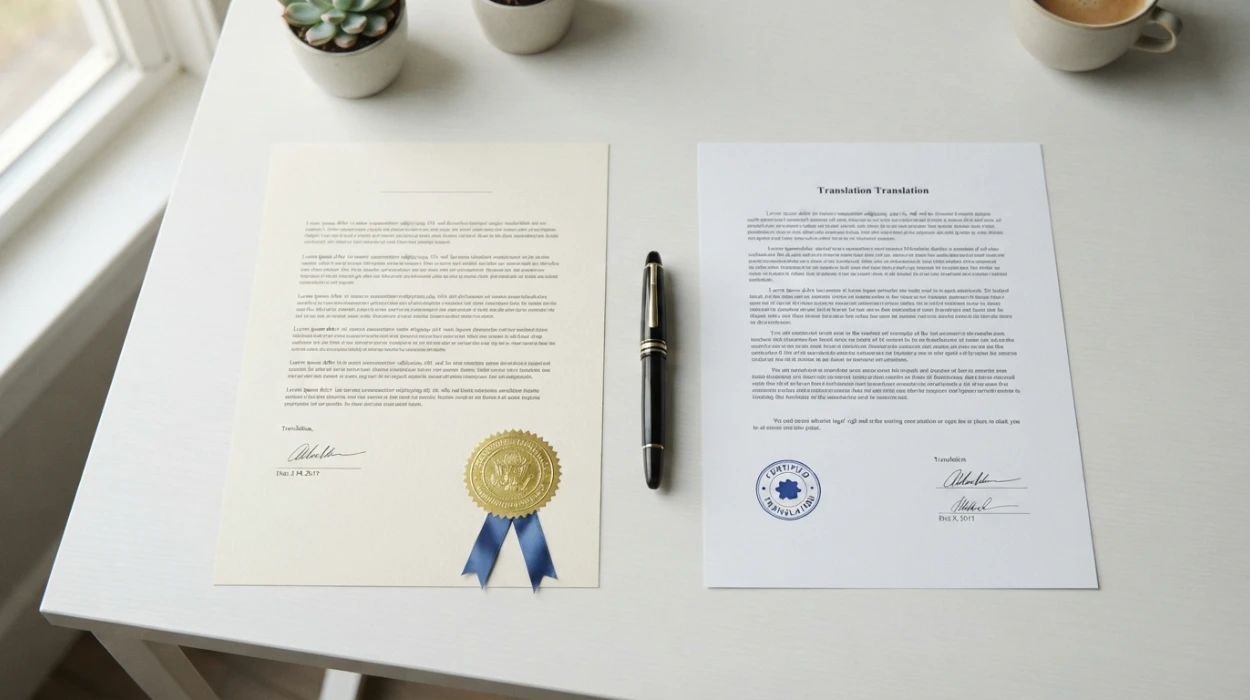
When you submit UK corporate documents to foreign authorities, you need both a certified translation and an apostille because international institutions require legal verification of document authenticity alongside an official translation into their local language, ensuring complete compliance with foreign regulatory frameworks.
What Is an Apostille and How Does It Validate UK Documents?
An apostille is an official government certificate issued by the Foreign, Commonwealth & Development Office that validates the signatures and seals on UK public documents, guaranteeing their legal recognition in 125 member countries under the Hague Convention.
Global business expansion requires absolute document validity across international borders. Foreign registries reject unverified certificates immediately. The UK government issues official stamps through designated competent authorities. This certification confirms that the issuing official held proper authority.
Without this official verification stamp, foreign institutions treat corporate records as unverified paper. Cross-border commercial transactions depend on undisputed document integrity. Legal authorities demand proof that corporate filings originate from genuine government databases. The validation process eliminates fraudulent submissions entirely.
Why Do Foreign Authorities Require Certified Translations for Corporate Documents?
Foreign institutions mandate certified translations because legal reviewers and corporate registries abroad cannot legally process documents written in English, requiring word-for-word accuracy delivered by certified translators to ensure complete linguistic comprehension.
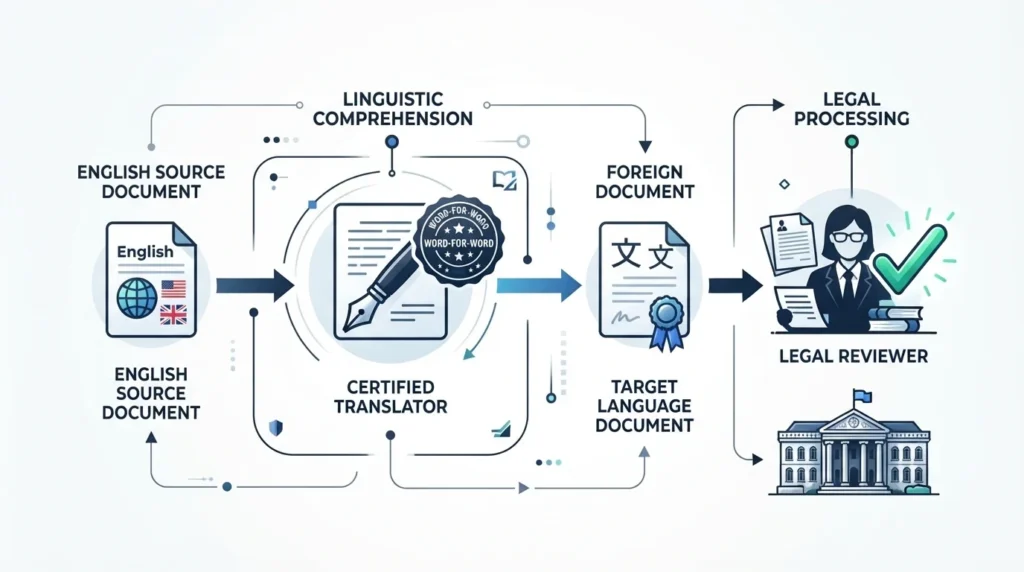
Language barriers disrupt international trade operations instantly. Foreign compliance officers examine every word of incoming articles of incorporation and board resolutions. Professional translators convert complex legal terminology with absolute precision. Certified translation agencies attach formal statements confirming document accuracy.
Incomplete or inaccurate translations trigger immediate application rejections. Local courts and government bodies operate strictly in their native languages. Regulatory compliance demands official translation seals from recognized linguistic associations. Every translated clause must match the original UK source text line by line.
How Do Translation and Apostille Requirements Intersect in International Transactions?
Translation and apostille requirements intersect because foreign legal systems mandate that both the original document authentication and its corresponding translation bear official verification before accepting them for foreign corporate registration or legal proceedings.
Document workflows follow a strict sequence during international submissions. Legal experts attach the apostille certificate directly to the original UK document first. Professional linguists then translate both the primary document and the attached apostille certificate. Foreign authorities check both components simultaneously before approving foreign business operations.
Skipping either requirement halts cross-border expansion projects permanently. International legal frameworks treat unverified translations as inadmissible evidence. Foreign bank account openings and subsidiary registrations stall without dual compliance. Document processing speeds accelerate when businesses prepare both validations concurrently.
What Specific Documents Commonly Require Both Validations?
Corporate expansion demands dual validation for three essential document types: certificates of incorporation, memorandum and articles of association, and board resolutions submitted to foreign regulatory bodies and international financial institutions.
Certificates of incorporation prove a company maintains active legal status in the UK. Foreign tax authorities inspect these foundational records during branch office setups. Memorandum and articles of association outline internal governance structures for overseas regulators.
Board resolutions authorize specific company directors to sign foreign contracts. International commercial banks review these authenticated resolutions before opening corporate accounts. Regulatory compliance officers verify every signatory using certified translations and apostille stamps.
How Does Form My Company Streamline Global Document Legalisation?
Form My Company manages complex international compliance by providing expert document legalisation services, ensuring your UK business records receive precise apostilles and certified translations for seamless overseas deployment.
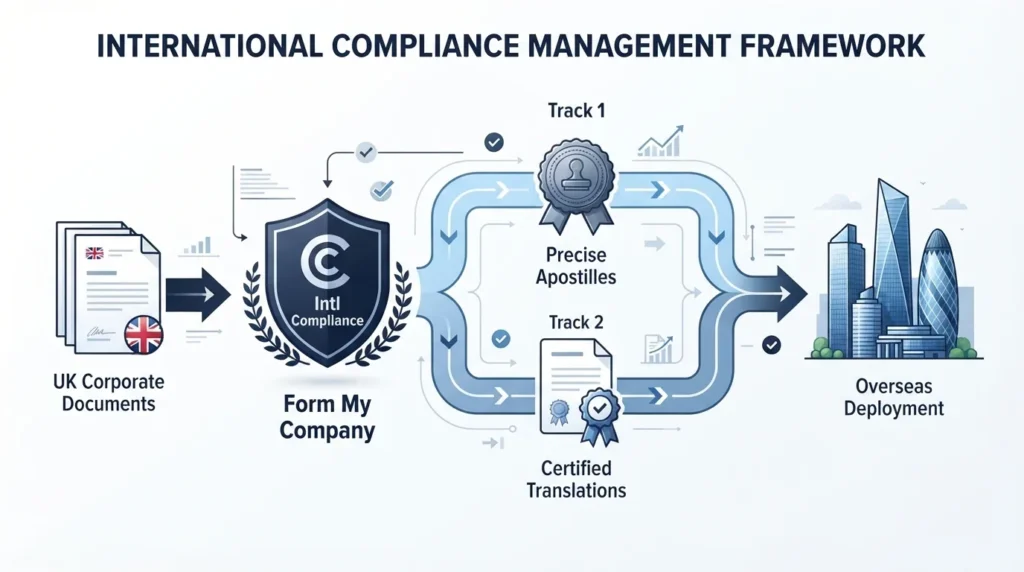
Navigating foreign bureaucratic requirements consumes valuable corporate time. Professional service providers coordinate directly with government departments and accredited linguists. Experienced specialists review every page for compliance before submission to foreign authorities.
Businesses avoid costly administrative delays by outsourcing complex multi-step legalisation workflows. Accurate document preparation guarantees successful international submissions on the first attempt. Form My Company delivers comprehensive Apostilled Documents to satisfy strict global regulatory standards.
What Steps Define the Complete Document Preparation Process?
The complete document preparation process involves three distinct operational phases: verifying original UK registry records, securing official government apostille certification, and executing professional certified translation.
Verify original UK records against official Companies House databases
Secure official government apostille certification from the Foreign Office
Execute professional certified translation matching foreign legal standards
Strategic preparation minimizes administrative friction during international expansion. Corporate legal teams track each phase carefully to prevent compliance oversights. Professional oversight ensures total adherence to foreign jurisdictional mandates.
International business operations require absolute adherence to foreign legal standards. Combining certified translations with official apostilles ensures that UK corporate records satisfy every regulatory demand abroad. Form My Company delivers reliable solutions through structured Get Complete Document Legalisation Done Right With Form My Company frameworks and informative evaluations detailed in How to Choose Between Apostille and Full Consular Legalisation. Professional legalisation secures your global corporate footprint.
Explore More Apostilled Documents Guide,
How Do You Legalise Documents for Countries Not in the Apostille Convention?
How Do UK Companies Prove Their Status Overseas?
Frequently Asked Questions
What is an apostille and when is it required for UK documents?
An apostille is an official government certificate issued by the UK government that authenticates the seals and signatures on public documents for use abroad. Businesses and individuals typically require apostilled documents when expanding overseas, opening foreign bank accounts, or establishing international branches. Form My Company assists clients in securing this official verification to ensure international legal compliance.
How long does it take to get an apostille for corporate documents?
The processing time for document legalisation depends on the specific government department workloads and whether standard or expedited services are selected. Standard processing through Form My Company typically takes a few working days from the moment the physical UK corporate records are received and verified. Expedited options are often available for time-sensitive international business transactions.
Can Form My Company handle documents issued outside the United Kingdom?
UK-based apostille authorities can only legalise documents originating from within the United Kingdom, such as Companies House certificates or UK notarised paperwork. Form My Company specialises in processing UK corporate records, ensuring they meet the stringent authentication requirements of foreign registries. Documents from other jurisdictions must be legalised through their respective home country authorities.
Do apostilled documents require a certified translation for overseas use?
Many foreign authorities require both an apostille and a certified translation if the destination country does not recognise English as an official language. Form My Company coordinates comprehensive document legalisation services that cover both governmental authentication and accurate linguistic translation. This dual preparation prevents application rejections by international regulatory bodies.
What types of business documents can be apostilled through Form My Company?
Virtually all official UK corporate documents can receive an apostille stamp, including certificates of incorporation, memorandum and articles of association, and board resolutions. Form My Company processes these essential business filings to validate their authenticity for foreign trade partners and overseas government agencies. Proper authentication ensures seamless cross-border business operations.