
Comparing Certificate of Good Standing prices requires checking baseline government registry fees, administrative agent markups, expedited dispatch charges, and apostille add-ons to prevent unexpected extra costs.
What causes unexpected price differences when ordering a Certificate of Good Standing?
Variations in pricing stem from hidden courier fees, variable official filing speeds, mandatory agent handling surcharges, and optional translation upgrades that transform a low baseline cost into an expensive corporate expense.
Companies often encounter discrepancies because corporate service providers separate official registrar fees from private processing overhead. When a business registry sets a standard statutory filing tariff, private incorporation agents frequently add optional service tiers. These tiers cover handling time, digital document delivery, and paper certification management. Understanding these distinct components prevents unexpected invoicing surprises during company expansion or international banking verification.
Transparent pricing frameworks separate statutory fees from administrative fees clearly. Businesses evaluate cost structures by requesting itemized invoices before authorization. Companies examine whether digital copies incur additional download fees or if physical postal delivery requires international courier surcharges. Clear itemization protects corporate budgets from surprise add-on charges.
How do official government fees compare to private agent service charges?
Official government fees cover basic registrar database retrieval, while private agent service charges cover expedited document handling, digital portal access, compliance checks, and customer support infrastructure.
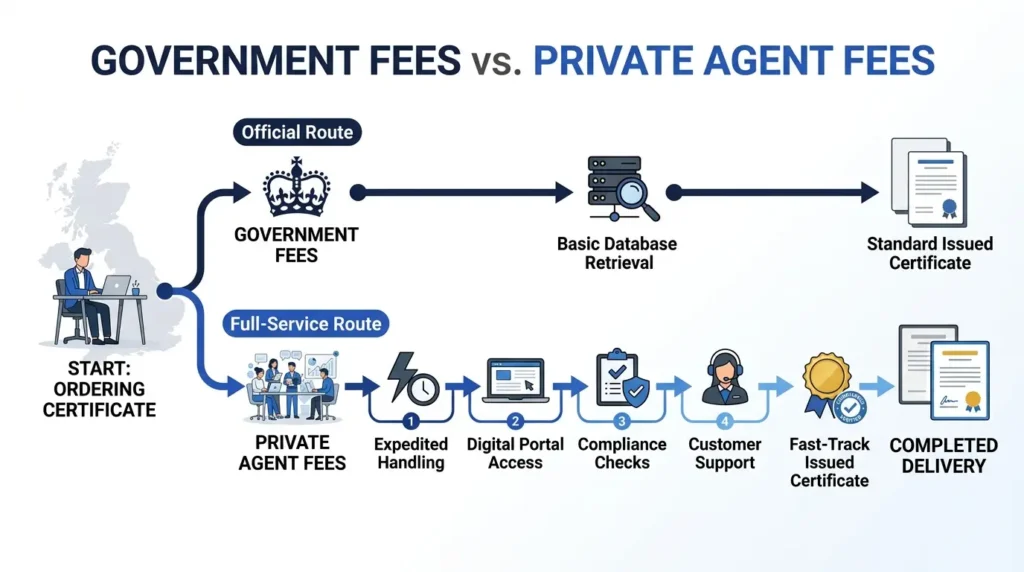
The Companies House statutory database maintains official corporate status records for all registered UK entities. Requesting a basic status confirmation directly from public infrastructure involves minimal base transaction costs. Private corporate service providers streamline this retrieval process by offering dedicated client portals, automated compliance verification, and fast-tracked dispatch systems. These operational efficiencies justify the addition of agency handling fees.
Evaluating these options requires balancing internal administrative time against external agency costs. When internal staff spend hours navigating government portals, the operational expense exceeds the convenience fee charged by corporate service providers. Businesses calculate total cost by factoring in staff hourly rates alongside official registry tariffs. Efficient delegation preserves internal resources while securing required corporate documentation promptly.
How can businesses identify hidden fees in certificate pricing structures?
Businesses identify hidden fees by reviewing checkout summaries for mandatory document delivery charges, unrequested notarization fees, automated subscription renewals, and high-cost priority processing tiers.
Corporate procurement teams scrutinize pricing tables line by line before submitting purchase orders. Service providers occasionally display low headline prices while embedding mandatory courier fees or digital archiving charges inside the final payment screen. Identifying these practices involves testing the checkout flow up to the final payment authorization stage. Clear providers display all mandatory fees transparently upfront without unexpected additions at checkout.
Reviewing terms of service agreements reveals recurring subscription traps or automated document renewal charges. Companies operating across international jurisdictions require specific validation formats that alter baseline pricing. Knowing exact jurisdictional requirements prevents purchasing unnecessary add-ons such as redundant notarizations or unauthorized legalizations. Accurate requirement mapping secures transparent pricing every time.
Which delivery speeds and expedited options affect total certificate costs?
Expedited delivery speeds increase total certificate costs by applying priority registry processing surcharges, same-day dispatch handling fees, and international courier tracking tariffs.
Standard processing timelines suit companies planning corporate restructuring weeks in advance. Urgent international banking applications or legal proceedings require immediate document acquisition through expedited priority channels. Registries and corporate agents allocate dedicated staff resources to fast-tracked applications, which incurs higher service tariffs. Balancing speed against budget constraints determines the most cost-effective dispatch option.
Calculating urgency value involves assessing potential financial losses caused by corporate transaction delays. When a delayed status document halts a commercial property acquisition or a foreign bank account opening, priority dispatch costs become a minor operational necessity. Companies weigh expedition premiums against timeline flexibility to optimize resource allocation without overspending on unnecessary priority tiers.
How do international shipping and apostille requirements alter final pricing?
International shipping and apostille requirements increase final pricing through Foreign, Commonwealth and Development Office legalization fees, consular attestation charges, and secure overseas courier delivery costs.
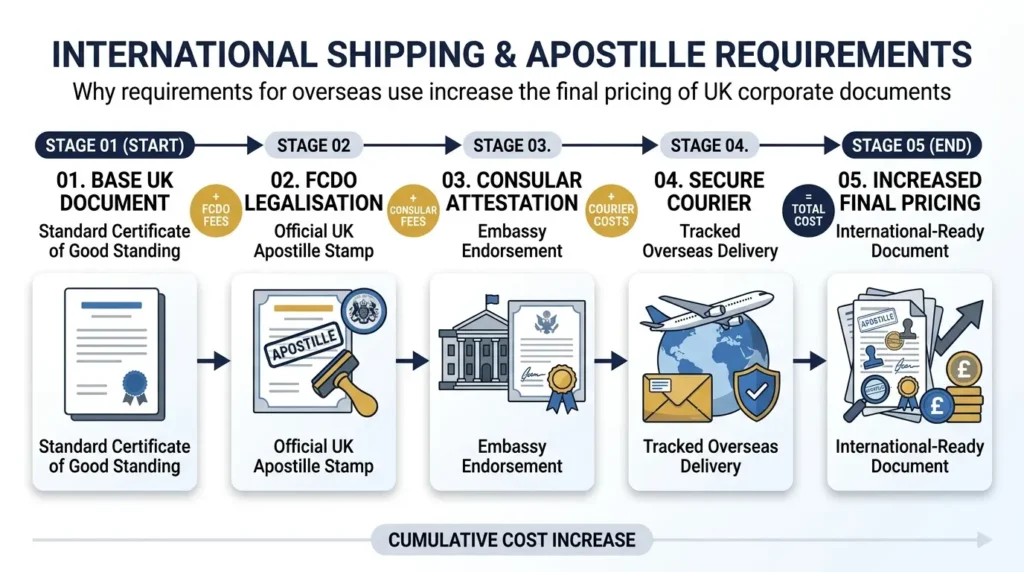
Using a status document outside the United Kingdom frequently requires an official apostille stamp to verify authenticity under international law. The Department of Foreign Affairs applies statutory legalization fees that apply independently of standard registry charges. Additionally, dispatching physical parchment certificates to overseas destinations involves specialized courier tracking to prevent document loss. These specialized steps expand the baseline price significantly.
Foreign entities must confirm whether destination authorities accept digital certificates or require physical paper versions. Digital PDF documents eliminate international shipping expenses and physical apostille requirements entirely in jurisdictions accepting electronic verification. Verifying local regulatory acceptance before ordering prevents purchasing expensive physical authentication services that provide no added utility. Strategic selection aligns document format directly with international compliance mandates.
How does Form My Company provide transparent pricing for your corporate needs?
Form My Company delivers clear pricing by eliminating hidden administrative markups, detailing official statutory fees upfront, and providing transparent service tiers for every order.
Selecting a reliable partner ensures your corporate compliance tasks proceed without budgetary surprises. Form My Company structures service offerings with clear itemization, allowing organizations to review official registry costs alongside professional handling fees before initiating requests. To secure your corporate status documentation transparently, explore the Certificate of Good Standing service page today.
Organizations managing multi-jurisdictional compliance benefit from straightforward guidance and fixed pricing models. For a comprehensive overview of statutory cost variations, read our foundational guide on How Much Does a UK Certificate of Good Standing Cost?. When ready to complete your procurement securely, Order Your Certificate of Good Standing at a Clear Price From Form My Company to finalize your corporate documentation efficiently.
Explore More Certificate of Good Standing Guide,
How to Keep Your Company Continuously Eligible for Good Standing
How to Avoid Rejection From Submitting an Expired Certificate of Good Standing
Frequently Asked Questions
What is a Certificate of Good Standing and who issues it?
A Certificate of Good Standing is an official corporate document that verifies a registered company is active, compliant with statutory filing requirements, and legally authorized to conduct business. In the United Kingdom, Companies House issues this official confirmation for limited companies and LLPs upon request.
How long does it take to get a Certificate of Good Standing?
Standard processing through Companies House typically takes between three to five working days, though expedited dispatch services can deliver the document much faster. Businesses partnering with Form My Company can choose priority handling tiers to receive digital or physical copies on the same day.
Can a dissolved company obtain a Certificate of Good Standing?
Dissolved or inactive companies cannot obtain a Certificate of Good Standing because the registry only maintains active status records for currently operating corporate entities. To secure documentation, a business must maintain active status by filing up-to-date annual accounts and confirmation statements with Companies House.
Do international banks require an apostille on a Certificate of Good Standing?
Overseas financial institutions and foreign regulatory authorities frequently require an apostille stamp attached to a Certificate of Good Standing to authenticate the document under international law. This legalization process confirms the authenticity of the official UK registrar signature through the Foreign, Commonwealth and Development Office.
How much does Form My Company charge for a Certificate of Good Standing?
Pricing for a Certificate of Good Standing through Form My Company combines standard statutory registry filing tariffs with transparent administrative processing fees. Itemized pricing options allow organizations to select specific delivery speeds and international authentication add-ons without encountering unexpected checkout costs.