
Official UK company ownership and management are proven through a Certificate of Incorporation, Articles of Association, Statements of Capital, share certificates, and updated statutory registers. Combined with recent Confirmation Statements filed with Companies House, these official records provide legally binding authentication of shareholders and active directors.
What Are the Core Legal Documents That Establish UK Company Ownership?
UK company ownership is legally established through the Certificate of Incorporation, Articles of Association, and official Share Certificates. These primary statutory documents confirm the creation of the legal entity, define shareholding rights, and verify individual share allocations to registered company members.
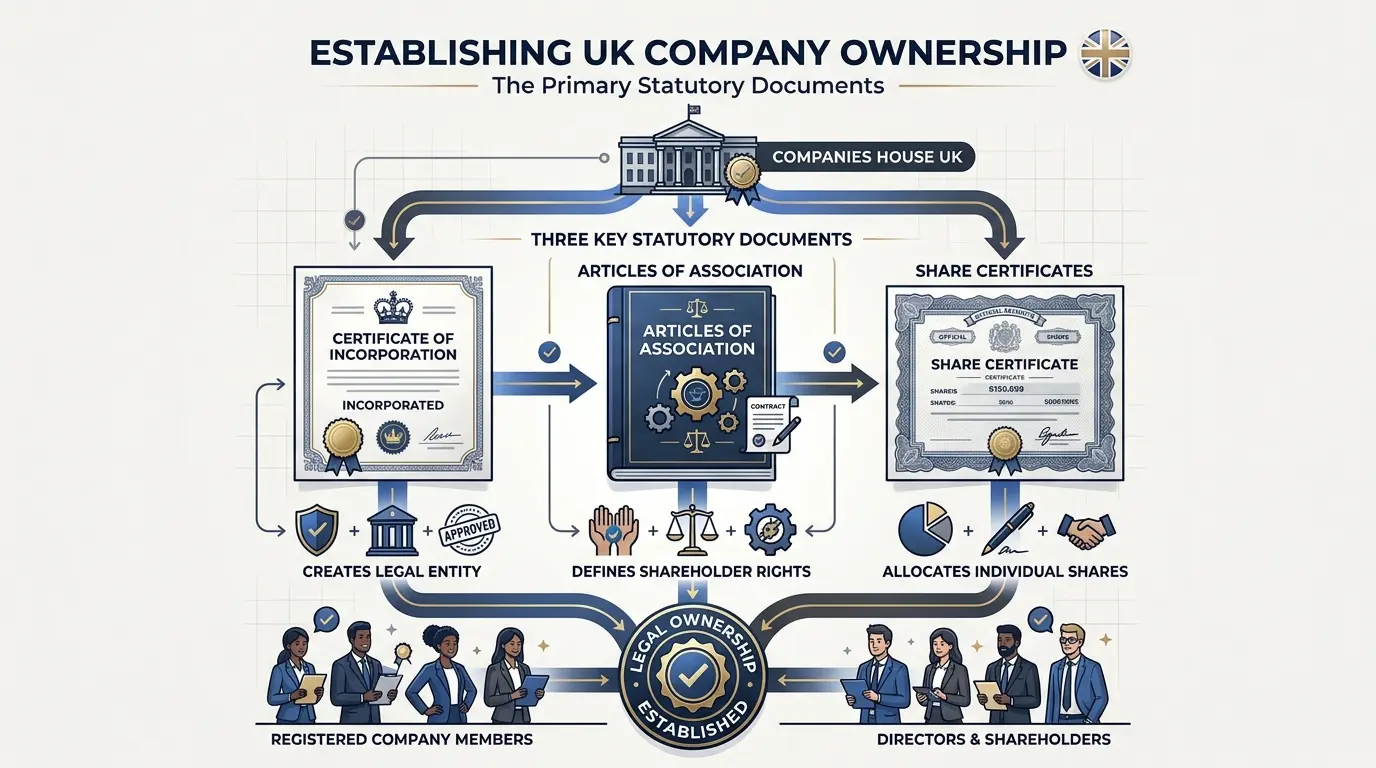
When a business incorporates in the United Kingdom, Companies House issues a Certificate of Incorporation. This document serves as the foundational birth certificate of the business entity. It displays the unique company number, official corporate name, and formal date of registration. It proves the legal existence of the corporate structure under UK company law.
The Articles of Association act as the internal constitutional rules governing company operations. This legal document details the voting rights, dividend entitlements, and administrative powers linked to every class of share issued. Prospective investors, financial institutions, and regulatory bodies review these articles to determine how equity distributions and structural decisions are executed within the firm.
Share Certificates provide direct proof of equity held by individual shareholders within the entity. Each certificate states the shareholder name, total number of shares held, share class, and exact monetary value. Issuing accurate share certificates ensures that every equity holder possesses tangible, legally binding evidence of their proportional ownership stake in the UK business.
How Do Official Statutory Registers Authenticate Active Directors and Shareholders?
Statutory registers authenticate company leaders by maintaining real-time records of active directors, company secretaries, Persons with Significant Control, and shareholders. UK law requires every limited company to hold and update these internal ledgers continuously to remain fully compliant.
The Register of Directors details the full legal names, service addresses, nationalities, dates of birth, and formal appointment dates of all active company officers. Regulatory authorities and commercial lenders inspect this register to confirm who possesses legal authority to sign contracts, manage operations, and bind the business to contractual obligations.
The Register of Members lists every shareholder, their recorded address, and the exact date their equity was acquired or transferred. Under the Companies Act 2006, legal title to shares passes only when an entry is formally written into this register. A share certificate alone remains incomplete without corresponding entries inside the official Register of Members.
The Register of Persons with Significant Control identifies ultimate beneficial owners holding more than 25 percent of shares or voting rights. Maintaining this statutory book ensures full compliance with UK anti-money-laundering regulations and corporate transparency mandates. Businesses simplify compliance by securing professional supplementary company documents to maintain verified statutory records and corporate registers.
What Filings with Companies House Confirm Current Management Structure?
Companies House confirmation statements, annual accounts, and officer appointment filings confirm current management structures on the public register. These statutory submissions validate that internal corporate records match the official public database accessed by banks, regulators, and legal entities.
The Confirmation Statement, previously known as the Annual Return, provides a snapshot of company information filed annually with the Registrar of Companies. This public record verifies the active registered office address, current principal business activities through Standard Industrial Classification codes, total capital structure, and an accurate list of active shareholders.
Officer notification forms, specifically Form AP01 for director appointments and Form TM01 for resignations, update the public database when executive management changes occur. Filing these forms within 14 days of any corporate alteration ensures that prospective commercial partners can verify active management authority through public searches.
Financial institutions cross-reference internal statutory ledgers against public Companies House records before approving corporate accounts or credit lines. Discrepancies between private company records and public filings stall commercial transactions. Executives often review strategies on how to combine formation documents and registers to prove ownership when undergoing formal due diligence audits.
Which Financial and Share Documents Validate Corporate Capital and Control?
Statements of Capital, stock transfer forms, and official dividend vouchers validate corporate capital structure and financial control. These specialized financial instruments record equity values, track changes in share allocations, and document the legitimate distribution of corporate earnings to registered owners.
The Statement of Capital provides an itemized breakdown of total corporate equity at any given moment. This financial schedule details the total number of issued shares, aggregate nominal value, total unpaid amounts, and specific rights attached to each class. Corporate transactions require an up-to-date Statement of Capital to verify equity dilution and current valuation parameters.
Stock Transfer Forms, designated officially as Form J30, document the legal purchase, sale, or transfer of existing shares between parties. When shares move from an existing holder to an incoming investor, executing this form validates the transaction, calculates applicable stamp duty, and authorizes updates to the statutory Register of Members.
Dividend vouchers provide formal proof of profit distributions allocated to shareholders in proportion to their equity holdings. Auditors and tax authorities review these vouchers to separate legitimate owner equity returns from executive director remuneration. Companies streamline their legal verification procedures when they prove company ownership with documents from Form My Company to satisfy international compliance audits.
How Do Banks and Regulatory Bodies Verify UK Company Ownership Status?
Banks and regulatory bodies verify UK company ownership by conducting Know Your Customer compliance checks, checking government databases, and requiring certified statutory documents. These rigorous verification protocols protect the financial ecosystem by validating beneficial ownership structures before granting access to services.
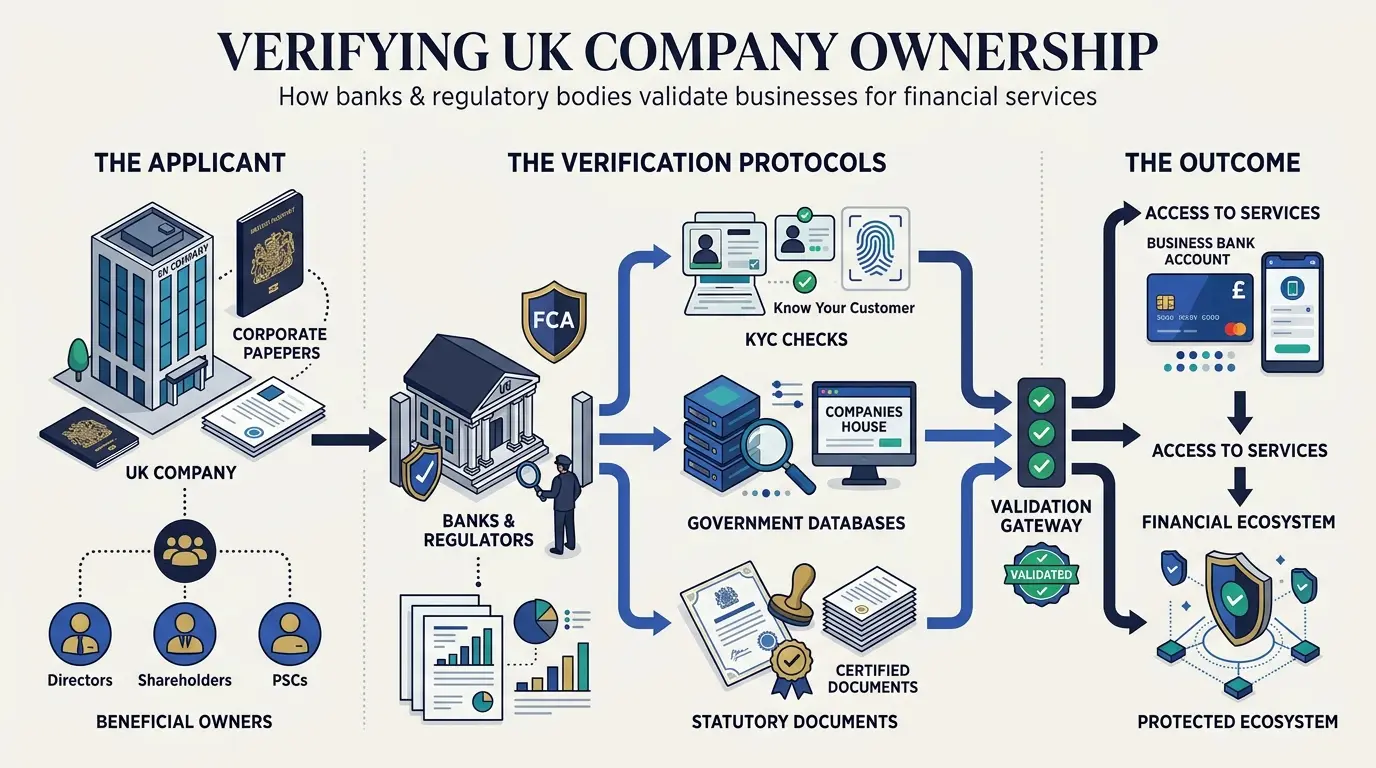
Financial institutions apply strict Know Your Customer frameworks to verify corporate identity, prevent money laundering, and comply with international sanctions regimes. Compliance officers inspect original or certified true copies of incorporation certificates, governance articles, and statutory books to establish a complete audit trail of corporate ownership.
Identity verification protocols require all individual directors and major beneficial owners to submit government-issued identification documents. Compliance teams cross-reference passport details, utility bills, and biometric data against information listed in the corporate Register of Persons with Significant Control to eliminate undisclosed corporate control.
International trade partners, government procurement teams, and commercial landlords frequently require official Apostille certification on corporate ownership documents. This legal legalization process, completed by the UK Foreign, Commonwealth & Development Office, confirms that official signatures and seals on UK business records are genuine for international recognition.
How Do You Ensure Statutory Company Documents Remain Legally Compliant?
Ensuring statutory company documents remain legally compliant requires conducting routine internal audits, filing timely statutory updates, and maintaining accurate legal registers. Proactive corporate administration prevents regulatory penalties, legal disputes, and delays during commercial transactions.
Conducting bi-annual reviews of statutory registers identifies administrative oversights before they cause compliance failures. Management teams must verify that address changes, share transfers, director appointments, and resignation dates are logged immediately within internal ledgers and reported accurately to Companies House.
Updating legal governance documents ensures corporate policies align with evolving statutory requirements. When companies expand operations, issue new share classes, or onboard institutional investors, amending the Articles of Association preserves clear operating guidelines and protects founder voting rights.
Utilizing dedicated corporate administration services simplifies legal record-keeping for growing enterprises. Form My Company assists business owners by providing compliant statutory documents, professional corporate registers, and structured legal records tailored to meet UK regulatory standards.
Explore More Supplementary Company Documents Guide,
Why Do Accountants Ask for Your Company Formation Documents?
What Company Records Do Buyers Ask for When You Sell a Business?
Frequently Asked Questions
What are supplementary company documents and why are they required?
Supplementary company documents are official legal records—such as statutory registers, share certificates, and governance agreements—that complement a standard Certificate of Incorporation. Banks, lenders, and regulatory bodies require these records to verify ownership structure, legal compliance, and director authority during due diligence checks. Form My Company provides these essential legal documents to ensure your UK enterprise remains fully transparent and audit-ready.
How do official supplementary company documents prove UK business ownership?
Supplementary company documents establish clear proof of ownership by detailing share allocations, voting rights, and legal titles within the official Register of Members and Statements of Capital. While a basic formation certificate proves entity registration, financial institutions rely on these statutory registers to authenticate current shareholders and ultimate beneficial owners. Form My Company prepares tailored corporate registers that validate your equity distribution for commercial compliance.
Which supplementary documents are needed to open a UK corporate bank account?
UK banks typically require an updated Certificate of Incorporation, Articles of Association, share certificates, and verified statutory registers listing active directors and Persons with Significant Control (PSC). Meeting strict Know Your Customer (KYC) requirements depends on submitting complete and legally aligned company records. Utilizing supplementary company documents from Form My Company ensures your corporate paperwork matches Companies House records, preventing account setup delays.
How often should statutory company records and registers be updated?
Under the UK Companies Act 2006, statutory company registers must be updated immediately whenever changes occur in directorship, shareholder status, registered addresses, or share allocations. Failing to maintain accurate corporate books can result in compliance penalties and legal disputes during commercial transactions. Form My Company assists business owners by generating compliant supplementary company documents to keep internal records up to date.
Can I request missing or updated supplementary company documents after incorporation?
Yes, business owners can issue or replace missing statutory documents, share certificates, and formal registers at any point after company formation. Restructuring equity, onboarding investors, or preparing for an audit often requires updating governance paperwork to reflect the current corporate structure. Form My Company delivers professional supplementary company documents to restore missing company registers and satisfy legal verification demands.