
You prove UK company ownership by presenting official incorporation certificates, articles of association, share certificates, and updated statutory registers. Form My Company provides certified copies of these official document packages to validate director identity, shareholder equity, and person with significant control (PSC) status.
Why Do Third Parties Require Official Proof of UK Company Ownership?
Banks, investors, and legal authorities require official proof of ownership to comply with UK anti-money laundering regulations, prevent fraud, and verify legal authority. Presenting validated incorporation documents ensures your business meets regulatory standards and secures essential commercial contracts without friction.
Financial institutions must verify beneficial ownership before opening corporate bank accounts. Regulators enforce 2017 Anti-Money Laundering Regulations across all UK business sectors. Lenders inspect company records to identify individuals holding 25% or more of voting rights. Property leases and major supplier agreements also depend on verified corporate structure.
Failure to produce official documentation delays commercial deals and contract executions. Third parties cross-reference submitted documents against the Companies House public register. Inconsistencies between internal records and public filings raise compliance red flags immediately. Utilizing Supplementary Company Documents ensures your corporate documentation aligns perfectly with official statutory filings.
Corporate transactions require transparent proof of control to mitigate financial liability. Investors review statutory registers during legal due diligence to confirm equity ownership. Foreign jurisdictions often require apostilled documents to validate UK corporate entities overseas. Maintaining authenticated documents protects your enterprise against identity theft and unauthorized corporate alterations.
Which Key Documents Establish Legal Ownership and Corporate Control?
The primary documents proving corporate ownership include the Certificate of Incorporation, Articles of Association, Share Certificates, and Statutory Registers. Together, these legal files confirm incorporation status, governance rules, member shareholdings, and persons exercising significant control over company decisions.
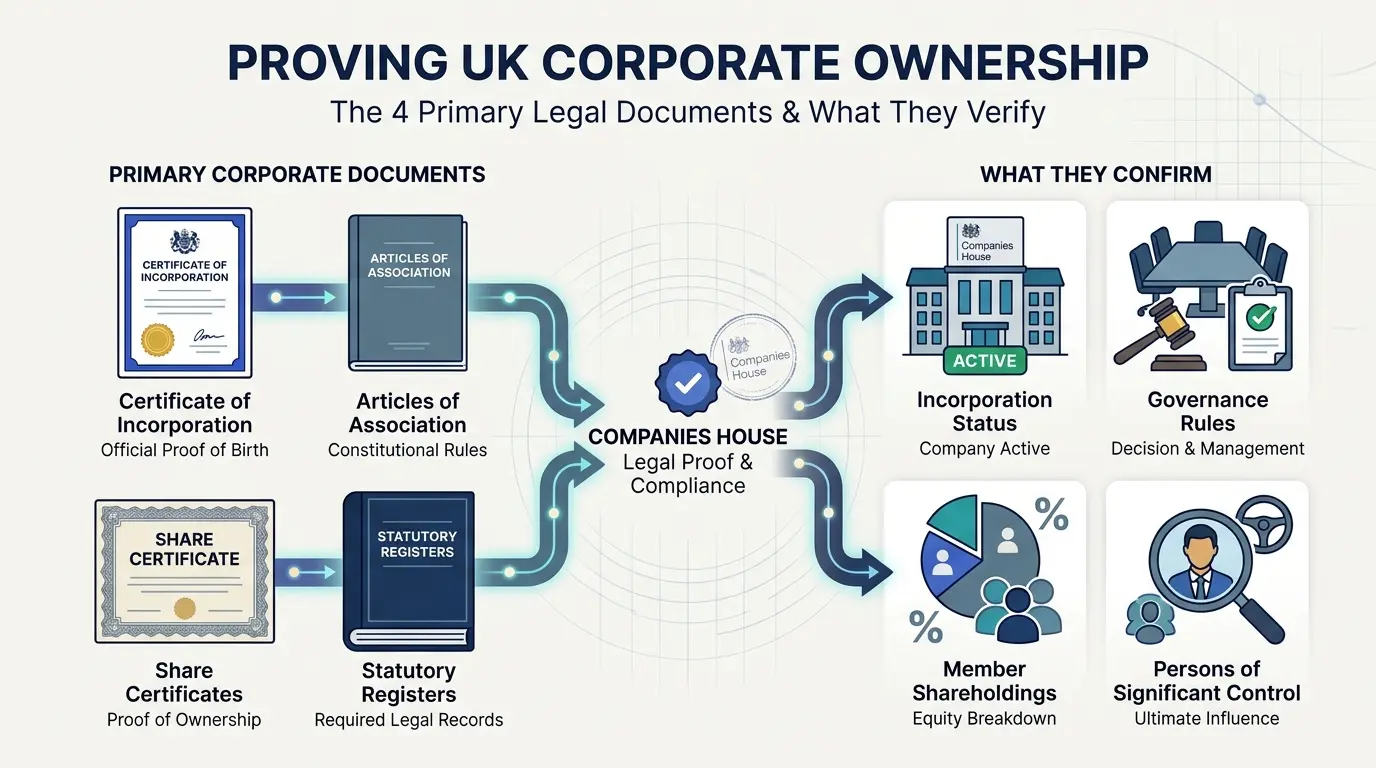
The Certificate of Incorporation acts as the legal birth certificate of a UK company. It contains the official company name, registration number, and exact date of formation. The Articles of Association define internal governance rules, director powers, and voting rights. These charter documents establish the legal foundation upon which ownership rights exist.
Share certificates document individual ownership stakes within a company limited by shares. Each certificate details the shareholder name, number of shares held, and share class. When evaluating corporate structures, financial institutions review share allocations alongside statutory registers. You can learn how to combine formation documents and registers to prove ownership to satisfy stringent banking checks.
Statutory registers provide the definitive legal record of corporate ownership under the Companies Act 2006. The Register of Members records official legal title to shares in a company. The Register of People with Significant Control (PSC) identifies individuals owning over 25% shares or voting rights. Official statutory registers take precedence over share certificates during legal disputes.
How Do Formation Documents Differ From Ongoing Statutory Registers?
Formation documents establish initial legal existence at registration, whereas statutory registers provide continuous, updated records of corporate ownership. Third parties inspect both sets of files to confirm historic formation details alongside current director and shareholder positions.
Formation documents represent a snapshot of the business at its official launch date. The initial Memorandum of Association lists founding subscribers who agreed to form the company. The Statement of Capital records original share allocations issued upon incorporation. These static records remain unchanged in the historical archive of Companies House.
Statutory registers change constantly throughout the operational lifecycle of a business. Directors must update registers within 14 days of any corporate alterations. Changes in share ownership, director appointments, or PSC details require immediate statutory entry. Keeping updated registers ensures continuous legal compliance and audit readiness.
Discrepancies often arise when companies issue new shares without updating internal registers. Third-party auditors inspect both historical formation files and current statutory books during financial reviews. Unaligned records can halt corporate sales, loan approvals, and partnership contracts. Maintaining accurate registers protects corporate integrity across all operational stages.
What Steps Are Required to Validate Your Company Documents for Banks?
Validating company documents requires collating statutory registers, requesting certified copies, matching Companies House records, and securing notary apostilles for international use. Following this systematic process guarantees your documentation satisfies corporate compliance checks.
Assemble your Certificate of Incorporation, Articles of Association, and current Register of Members.
Cross-reference internal register entries with active public filings at Companies House.
Issue stamped Share Certificates signed by active company directors.
Obtain official certified copies from Companies House or an authorized corporate service provider.
Apply a Solicitor Certification or Hague Apostille if presenting documents to international banks.
Banks reject documents containing incomplete dates, missing officer signatures, or unverified share classes. When compliance officers review corporate applications, they verify every entry against public database filings. Utilizing professional document preparation services removes administrative errors and prevents application rejections.
International institutions require extra authentication through Foreign, Commonwealth & Development Office (FCDO) apostille services. This extra step verifies seal authenticity for cross-border operations. Preparing validated document packets in advance accelerates corporate account setup and funding rounds.
How Does Form My Company Provide Verified Proof of Business Ownership?
Form My Company delivers official company document packages, certified register updates, and statutory compliance files tailored for legal verification. Business owners receive fully compliant documentation structured to satisfy bank compliance departments and legal auditors.
Form My Company simplifies corporate proof by issuing authenticated statutory registers and official document sets. When business owners update corporate structures, Form My Company updates public and private records accurately. This service ensures your corporate files remain compliant with UK company law standards.
Navigating corporate documentation requires precision and attention to statutory formatting. You can order documents from Form My Company to prove company ownership and instantly secure official proof for third-party verification. Professional handling guarantees all corporate filings match regulatory expectations.
| Document Type | Primary Purpose | Key Information Included |
| Certificate of Incorporation | Legal Existence | Company Name, CRN, Formation Date |
| Share Certificate | Equity Evidence | Shareholder Name, Quantity, Share Class |
| Register of Members | Legal Ownership | Entry Dates, Allotments, Current Holders |
| PSC Register | Ultimate Control | Beneficial Owners (>25% shares/votes) |
Using professional formation services prevents compliance delays caused by missing statutory books. Form My Company maintains full alignment between your internal registers and Companies House. Secure documentation allows business directors to focus on scaling operations without administrative friction.
How Do You Maintain Compliant Ownership Records Over Time?
Maintaining compliant ownership records requires updating statutory registers within 14 days of changes, filing annual confirmation statements, and logging share transfers immediately. Consistent record management prevents regulatory fines and protects corporate legal standing.
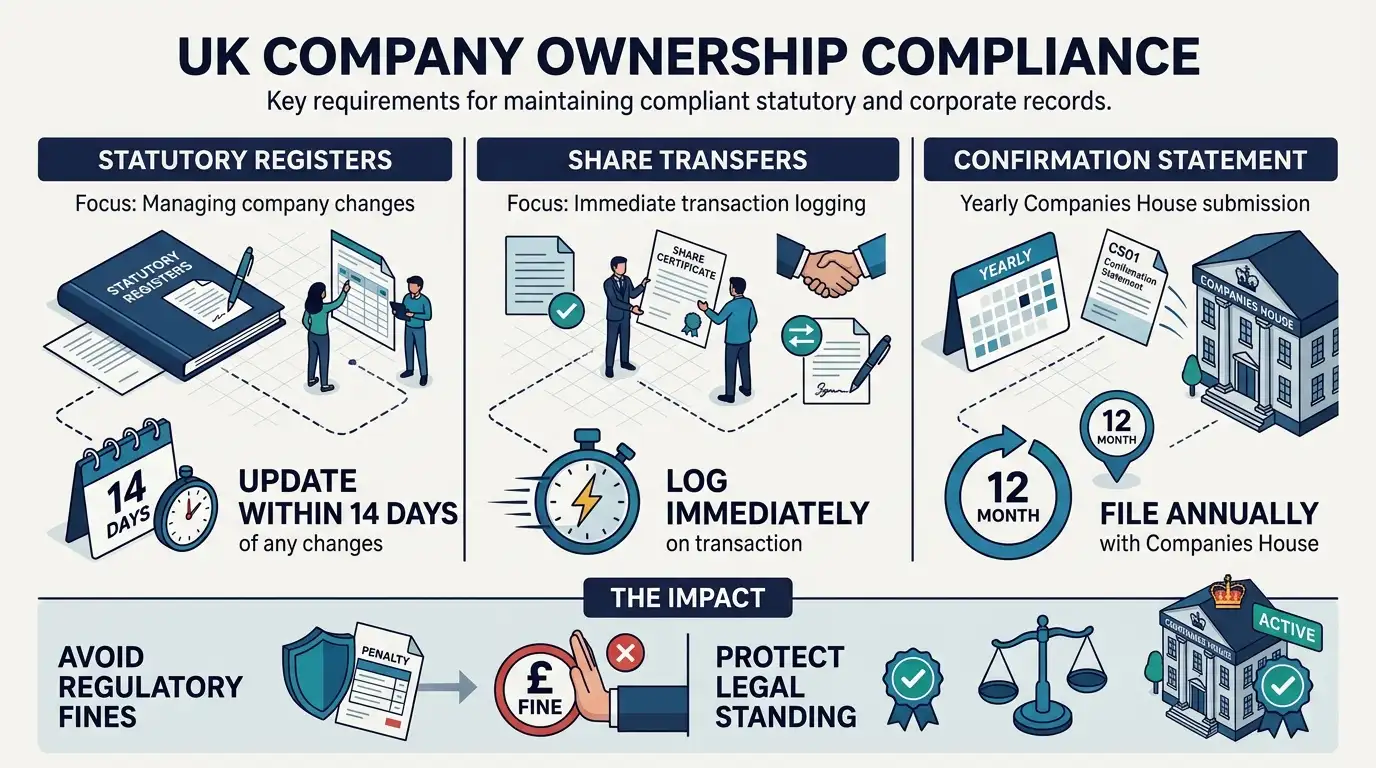
UK company law mandates immediate updates following any alteration in company structure. Transferring shares requires a signed Stock Transfer Form and corresponding board approval. Directors must record stamp duty payments and update the Register of Members promptly. Delaying register updates invalidates new share issuance claims during legal challenges.
Annual Confirmation Statements confirm current director, shareholder, and PSC details with Companies House. Filing accurate annual statements ensures public records match internal company registers. Inconsistent filings trigger regulatory scrutiny and delay corporate financing approvals.
Digital record management keeps compliance audit-ready for unexpected legal or financial inspections. Storing digital backup copies of share certificates and articles prevents record loss. Proactive documentation maintenance protects shareholder rights and preserves seamless business operations.
Proving UK company ownership requires clear, accurate, and statutory-compliant documentation. Combining historic formation files with updated statutory registers delivers complete verification for banks, investors, and legal authorities. Form My Company provides professional document solutions to ensure your business maintains full regulatory compliance and seamless commercial operations.
Explore More Supplementary Company Documents Guide,
Get Grant-Ready Company Documents From Form My Company
Get Sponsor Licence-Ready Company Documents From Form My Company
Frequently Asked Questions
What Supplementary Company Documents do you need to prove UK business ownership?
To prove UK business ownership, third parties typically require a Certificate of Incorporation, Articles of Association, Share Certificates, and an updated Register of Members. Supplementary Company Documents provided by Form My Company help business owners consolidate these statutory files into an official verification package for banks and legal authorities. Obtaining certified copies ensures your corporate ownership structure aligns fully with Companies House records.
How do Supplementary Company Documents help open a UK business bank account?
UK banks require official verification of directors, beneficial owners, and shareholders before opening a corporate account to meet anti-money laundering compliance standards. Supplementary Company Documents from Form My Company provide the certified registers, share allocations, and charter documents necessary to clear financial due diligence. Presenting these validated legal files prevents administrative delays during the corporate onboarding process.
Where can I get official copies of my company’s Articles of Association and Certificate of Incorporation?
Official copies of formation records can be retrieved through Companies House filings or requested directly through corporate service providers. Form My Company offers Supplementary Company Documents to supply business owners with certified, audit-ready versions of their Certificate of Incorporation, Articles of Association, and statutory registers. These official files serve as legal proof of legal existence and corporate governance rules.
Why are statutory registers required alongside initial formation documents?
While initial formation documents prove a company’s legal registration at launch, statutory registers detail current shareholdings, active directors, and persons with significant control (PSCs). Third parties inspect updated statutory registers alongside Supplementary Company Documents from Form My Company to confirm present-day ownership status. Maintaining accurate registers ensures compliance with the UK Companies Act 2006.
How do I get company documents certified for international or legal use?
Company documents are certified by comparing internal statutory registers against Companies House records and adding legal verification statements or solicitor certification. Business owners can order Supplementary Company Documents through Form My Company to receive official corporate files structured for legal, banking, and international verification. For foreign transactions, these certified documents can also undergo Hague Apostille authentication.