

To prepare company documents for commercial insurance cover, gather your Certificate of Incorporation, Articles of Association, register of directors, and share certificates. Verify that all corporate details match Companies House records exactly, ensure filings are current, and submit certified copies to your insurer.
Commercial insurance underwriters assess risk based on verified legal structures. Submitting accurate corporate documentation speeds up policy underwriting and prevents coverage voidance during claims.
Why Do Insurers Require Official Company Documentation?
Commercial insurers require official company documentation to establish legal entity status, identify beneficial owners, assess corporate liability, and satisfy anti-money laundering regulations. Validated records confirm that your business legally exists and possesses the authority to enter into binding insurance contracts.
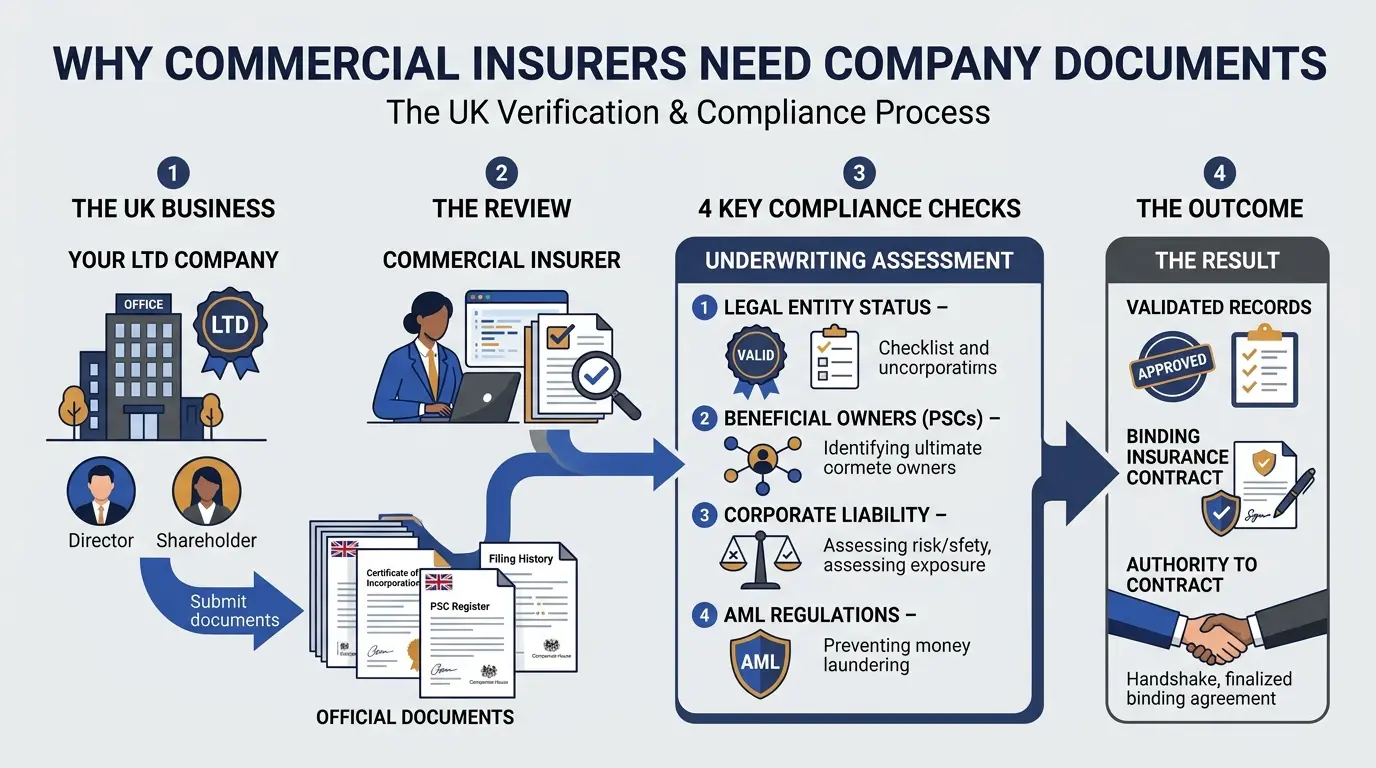
Underwriters evaluate corporate filings to determine ownership hierarchy and operational scope. Discrepancies between your insurance application and official registry records raise fraud flags and delay policy issuance.
Insurance underwriters verify beneficial ownership to satisfy UK Customer Due Diligence (CDD) standards. Providing official proof of incorporation eliminates ambiguity regarding entity structure, ensuring underwriters assess the correct legal entity.
Correct documentation prevents future claim repudiations. If a claim arises and corporate details do not match registry records, insurers can void coverage for non-disclosure.
Which Company Documents Are Needed for Commercial Insurance?
Insurers require four primary company documents: the Certificate of Incorporation, Articles of Association, Confirmation Statement (CS01), and Register of Directors. Certain specialized commercial policies also demand share certificates, trade licenses, and audited financial statements to confirm operational limits.
Each document serves a specific verification purpose during underwriting:
Submit the Certificate of Incorporation to prove legal entity registration date and company number.
Supply the Articles of Association to define director powers and corporate governance rules.
Provide the latest Confirmation Statement to verify current shareholder structures and registered office addresses.
Share the Register of Directors to validate the identity of individuals managing legal liability.
Insurers cross-reference these filings directly against public registries. Missing or outdated documents halt the compliance review phase.
When underwriters review high-risk commercial policies, they require supplementary legal records to verify secondary operational details. Obtaining supplementary company documents ensures your business can supply official certificates of good standing, change of name certificates, and customized governance filings without delay.
How Do You Audit Documents Before Submitting to Insurers?
Audit company documents by cross-referencing legal names, registered addresses, director details, and officer appointments against your current Companies House record. Correct any typos, outdated director lists, or overdue filings prior to sending paperwork to your insurance broker.
Data inconsistencies cause 42% of commercial insurance application delays in the UK. Performing an internal document audit prevents administrative rejections.
Verify that the exact legal entity name—including suffixes like “Limited” or “LTD”—matches across all forms. Insurers reject applications where registered names differ from trading names without clear documentation.
Check director appointments and resignations. If a former director remains on your public record, insurers consider them a legal party to corporate liability. File form AP01 for new appointments or form TM01 for resignations before applying for cover.
Ensure your registered office address is up to date. Insurers evaluate risk geographically; an incorrect address skews underwriting risk assessments and alters premium calculations.
If you want to understand the foundational requirements underwriters look for, review why do business insurers need proof of incorporation to streamline your initial risk assessment.
What Are the Steps to Prepare Documents for Underwriters?
Prepare documents by downloading digital copies from Companies House, ordering certified physical duplicates if required, redacting sensitive non-essential data, organizing files chronologically, and uploading them through secure insurer portals alongside your completed application form.
Follow an organized preparation process to streamline compliance reviews:
Retrieve official PDF records directly from Companies House or your corporate secretarial provider.
Verify that digital files contain official watermarks, incorporation numbers, and submission timestamps.
Obtain certified true copies from a solicitor or chartered accountant if your insurer specifies hard-copy authentication.
Group documents into labeled folders corresponding to legal status, financial standings, and governance structures.
Transmit files securely using encrypted document portals rather than unencrypted email attachments.
Organized submissions reduce underwriting processing time from weeks to days. Insurers prioritize clear, complete document packets.
How Do Document Errors Impact Insurance Claims?
Document errors lead to delayed policy approvals, increased premium quotes, denied indemnity claims, or immediate policy cancellation. Incorrect corporate records invalidate the duty of fair presentation required under the UK Insurance Act 2015.
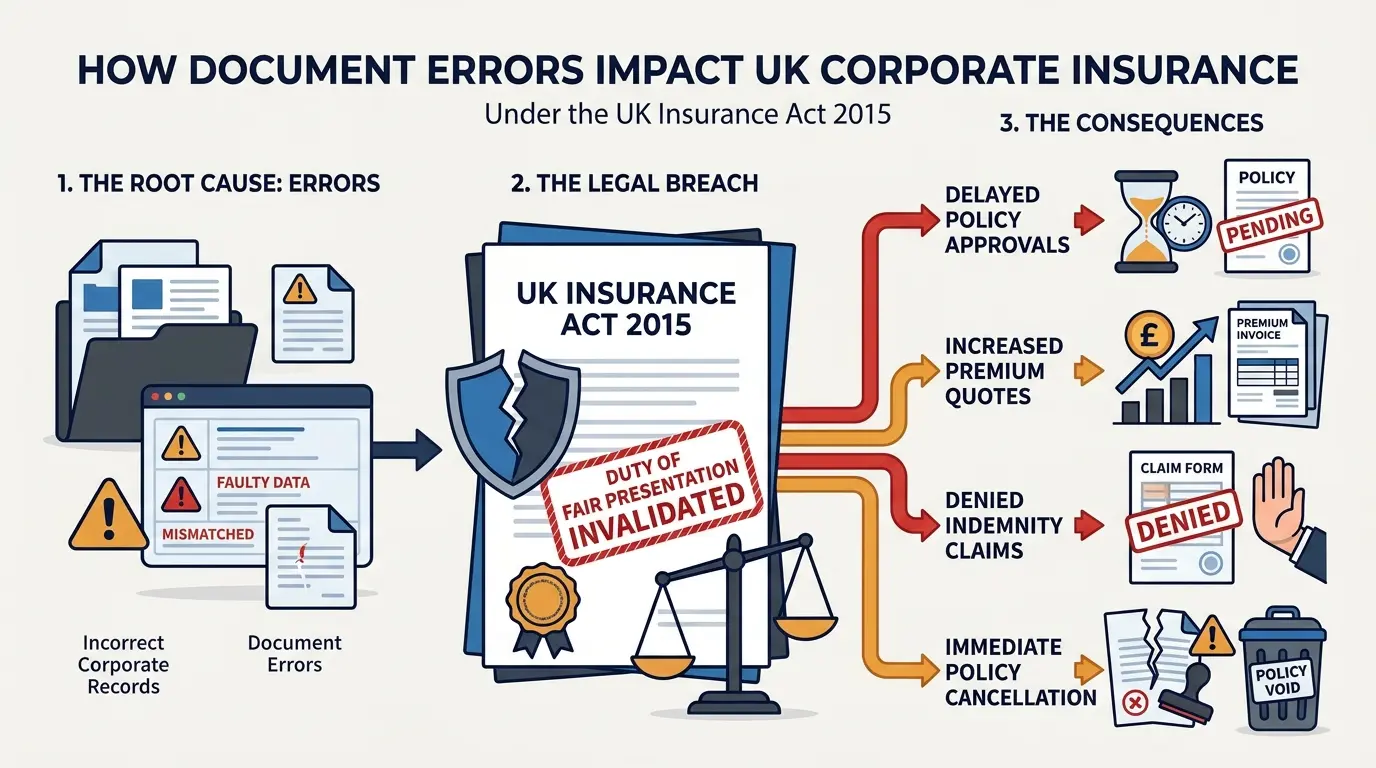
Under the Insurance Act 2015, policyholders must disclose material circumstances fully and accurately. Presenting outdated or inaccurate company filings breaches this statutory requirement.
When an insurer identifies incorrect director names or unrecorded business activities during a claim investigation, they re-evaluate the policy. If the insurer would have charged a higher premium had they known the true facts, they reduce claim payouts proportionally.
In cases of deliberate or reckless misrepresentation, underwriters void the policy entirely. Retaining premiums paid, the insurer refuses to pay outstanding claims, leaving directors personally exposed to third-party liabilities.
Maintaining updated corporate filings ensures continuous coverage validity throughout the policy term.
How Does Form My Company Simplify Insurance Document Preparation?
Form My Company simplifies document preparation by retrieving official register records, auditing corporate filings for errors, issuing certified supplementary documentation, and delivering underwriter-ready corporate packages directly to business owners.
Navigating corporate registries and compliance requirements requires time and regulatory precision. Form My Company manages the entire administrative process, ensuring your documentation meets strict insurer criteria.
Professional secretarial services eliminate discrepancies between your application data and official filings. If your business requires missing registers or certified proof of legal status, get insurer-ready company documents from Form My Company to expedite your commercial insurance approval.
Form My Company verifies corporate registers against current statutory standards, keeping your business compliant and fully insurable.
Explore More Supplementary Company Documents Guide,
How to Combine Formation Documents and Registers to Prove Ownership
How to Hand Over Company Documents When Switching Accountants
Frequently Asked Questions
What are supplementary company documents?
Supplementary company documents are official legal and corporate records issued alongside standard incorporation paperwork to confirm specific business details. Services like Form My Company provide these documents—such as Certificates of Good Standing, change of name certificates, and certified register extracts—to help UK businesses satisfy bank compliance, commercial insurance underwriting, and legal verification requirements.
How do I get official supplementary company documents for my UK business?
You can order official supplementary company documents directly through Companies House or via a corporate secretarial provider such as Form My Company. These providers retrieve, audit, and certify statutory filings, ensuring all corporate records match public registers before delivery.
Why do banks and insurers require supplementary company documents?
Financial institutions and commercial insurers request supplementary company documents to satisfy anti-money laundering (AML) and Customer Due Diligence (CDD) regulations. Providing verified corporate records validates legal entity status, establishes beneficial ownership hierarchies, and prevents policy delays or account application rejections.
How quickly can supplementary company documents be issued?
Standard processing for supplementary company documents through Companies House takes two to five business days, while expedited digital services can issue certified records within 24 hours. Services provided by Form My Company streamline retrieval to ensure fast turnaround times for urgent legal or financial compliance checks.
What is the difference between statutory registers and supplementary company documents?
Statutory registers are internal governance files—such as the register of directors and register of members—that a business is legally required to maintain by law. Supplementary company documents are official certificates or legal extracts derived from those records to provide third-party proof of corporate standing, ownership structure, or statutory compliance.


