

Voluntary VAT registration allows early-stage startups below the 90,000 GBP taxable turnover threshold to register for Value Added Tax early. This grants the right to reclaim input tax on business expenses, boost commercial credibility, and establish seamless accounting frameworks before mandatory thresholds apply.
Early-stage startups face critical financial decisions regarding tax compliance. Founders often operate below the mandatory UK threshold set by HM Revenue and Customs. Deciding to register early introduces distinct financial obligations and administrative workflows. Understanding these dynamics helps founders protect cash flow while scaling operations.
Why Should Early-Stage Startups Consider Voluntary VAT Registration?
Voluntary registration grants startups the legal right to recover input VAT on business purchases, build immediate corporate credibility with enterprise clients, and prepare accounting systems for future growth phases before mandatory registration limits take effect.
Startups purchase software licenses, equipment, and professional services before generating revenue. These initial operational costs accumulate standard-rate VAT charges. Registering early enables founders to recover these costs through regular quarterly returns submitted to HM Revenue and Customs. This mechanism preserves essential working capital during the initial development phase.
Enterprise buyers often evaluate supplier credentials closely. Operating without a VAT number signals a micro-business status to potential corporate partners. Registered entities present an established market presence that commands greater trust. This professional positioning secures B2B contracts more effectively.
Accounting infrastructure requires adaptation as businesses grow. Adopting digital tax workflows early prevents messy administrative overhauls later. Founders integrate compliance software into their daily routines seamlessly. This proactive stance eliminates sudden friction when taxable turnover approaches mandatory limits.
What Are the Financial Advantages of Registering Before the Threshold?
Early registration enables businesses to reclaim input tax on capital investments, eliminates the stigma of micro-business status, and positions the company for smooth transitions into standard tax compliance without disruptive operational shifts.
Capital expenditure drains startup cash reserves quickly. Purchasing heavy machinery, office fit-outs, or proprietary software incurs significant tax charges. Reclaiming these amounts reduces total startup capital expenditure by 20 percent. This tax recovery directly lowers the cost of initial setup.
Business-to-business transactions operate smoothly under registered frameworks. Corporate clients expect standard invoices displaying proper tax identification numbers. Suppliers deal with registered entities through established institutional channels. These streamlined interactions accelerate procurement cycles significantly.
Future growth planning benefits from early tax integration. Scaling past mandatory limits happens rapidly for high-growth tech ventures. Founders who master digital reporting early avoid compliance penalties. This preparation ensures continuous operational stability during rapid expansion phases.
What Are the Primary Financial Risks of Voluntary VAT Registration?
Voluntary registration creates quarterly filing obligations, increases accounting overhead costs, and introduces cash flow pressure if sales transactions involve non-VAT-registered consumers who cannot absorb standard pricing increases.
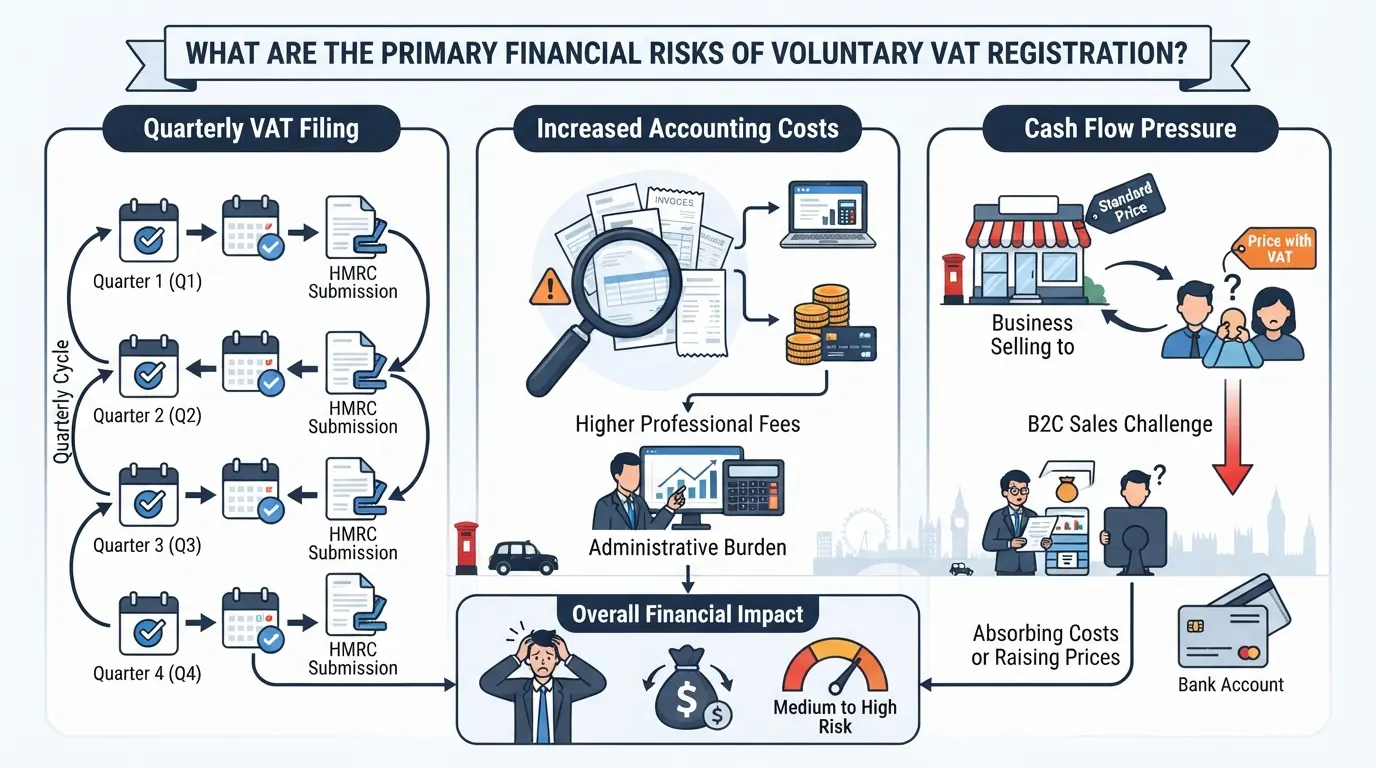
Administrative burdens multiply upon entering the tax system. Companies must submit four digital returns annually alongside digital record-keeping compliance. Missing deadlines triggers automatic financial penalties from HM Revenue and Customs. These compliance requirements demand dedicated time or paid professional support.
Target audience characteristics dictate registration viability. Selling directly to retail consumers restricts pricing flexibility. Adding 20 percent to retail prices drives customers toward unregistered competitors. Startups must absorb this cost difference if consumer demand proves price-sensitive.
Cash flow dynamics shift for registered enterprises. Collecting standard tax on sales requires holding those funds securely until submission deadlines arrive. Mixing operational funds with tax liabilities causes severe accounting errors. Founders must manage these temporary tax holdings with strict discipline.
How Does Voluntary Registration Affect B2B Versus B2C Startups Differently?
B2B startups benefit from seamless tax neutrality across corporate supply chains, whereas B2C ventures face pricing disadvantages because retail consumers cannot recover standard tax charges on personal purchases.
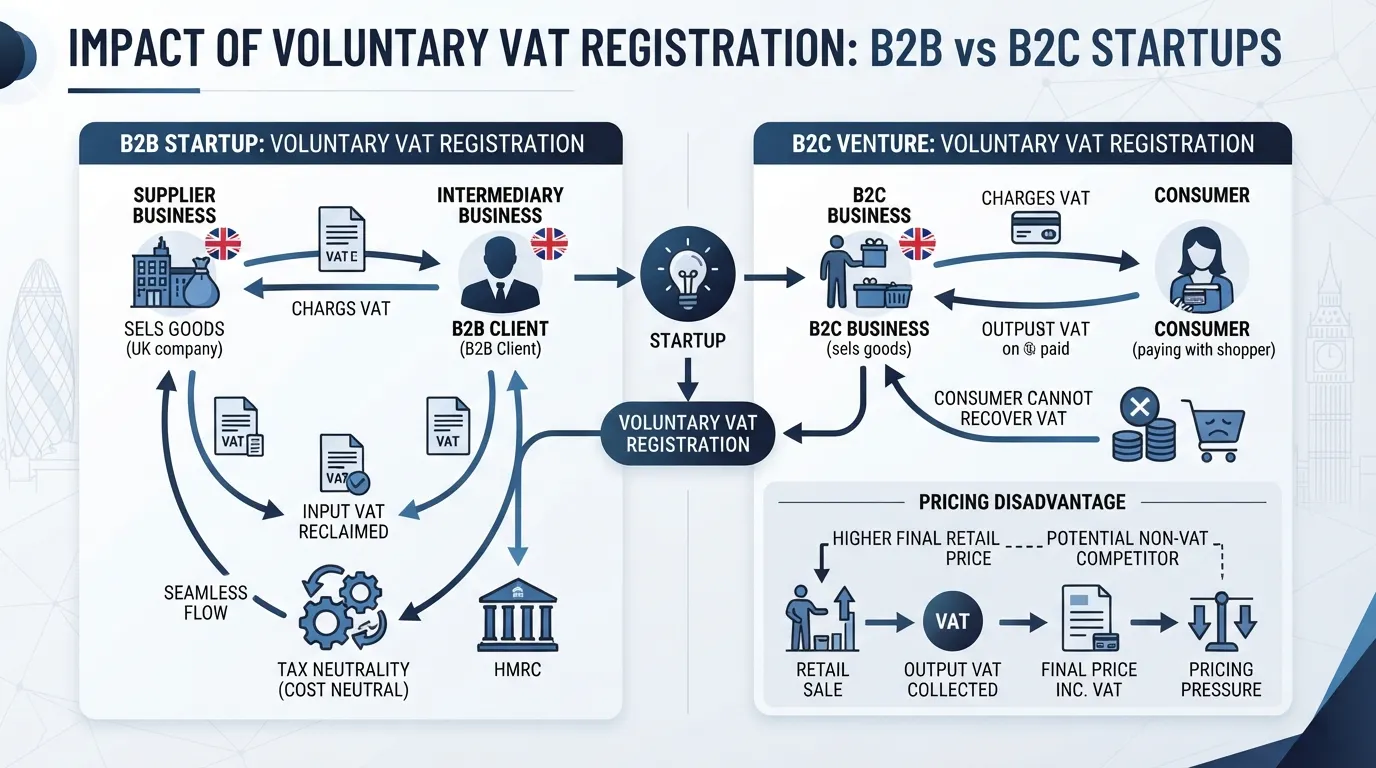
Corporate buyers operate as registered entities themselves. They recover the tax charged on supplies through their own periodic returns. Adding standard tax to B2B invoices creates zero financial friction for enterprise customers. Business buyers focus exclusively on net pricing values.
Retail markets function under entirely different commercial rules. Individual consumers absorb retail prices as final end costs. Raising prices by 20 percent alienates budget-conscious buyers immediately. B2C startups must calculate whether input recovery outweighs lost retail sales volume.
Strategic evaluation requires mapping customer demographics accurately. Founders examine customer composition before submitting applications to HM Revenue and Customs. Aligning tax status with market realities protects revenue streams against unexpected contraction.
Explore More VAT Registration Assistance Guide,
Supplementary Company Document Packages Compared: Which Fits You?
How to Determine the Exact Moment Your Business Must Register for VAT
How Does Form My Company Streamline the Registration Process?
Professional guidance simplifies complex application procedures, ensures accurate alignment with HM Revenue and Customs regulations, and accelerates operational readiness through expert administrative execution.
Navigating official portals requires precise data entry and document authentication. Errors delay approvals and disrupt initial business launch timelines. Expert support eliminates guesswork during form completion. Founders utilize specialized VAT Registration Assistance to ensure accurate submissions on the first attempt.
Understanding complex tax regulations demands specialized knowledge. Professional advisors evaluate specific business models against regulatory frameworks. This guidance prevents costly misclassifications during early operational phases. Founders gain clarity regarding quarterly filing obligations instantly.
Transitioning from setup to active trading requires structured administrative workflows. Professional teams establish digital accounts and compliance protocols efficiently. Reviewing our What Is the Current UK VAT Registration Threshold for Small Businesses? guide helps founders understand baseline mandatory limits before deciding. Exploring Fast and Accurate: How Form My Company Helps You Navigate Voluntary VAT Registration reveals how expert intervention secures rapid approval for early-stage ventures.
Voluntary tax registration presents distinct strategic choices for emerging enterprises. Balancing input recovery against administrative overhead determines long-term viability. Form My Company delivers the necessary expertise to navigate these complex regulatory decisions securely and efficiently.
Frequently Asked Questions
What is VAT registration assistance and how does it work?
VAT registration assistance involves professional support services that help businesses prepare, verify, and submit their Value Added Tax applications to HM Revenue and Customs. Experts at Form My Company manage the digital documentation, review company turnover data, and ensure accurate submissions to prevent costly administrative delays. This structured guidance streamlines compliance so directors can focus entirely on core business operations.
How long does it take to get a VAT number in the UK?
The standard processing time for a UK Value Added Tax application typically ranges from two to four weeks following digital submission to HM Revenue and Customs. Complex corporate structures or requests requiring manual compliance checks by tax authorities may extend this review window. Utilizing professional VAT Registration Assistance ensures that applications are completed correctly on the first attempt, minimizing avoidable review bottlenecks.
Is voluntary VAT registration beneficial for a new startup?
Voluntary registration allows early-stage enterprises trading below the statutory taxable turnover limit to reclaim input tax on initial business expenses and capital equipment. This proactive setup builds corporate credibility with B2B enterprise clients and establishes digital accounting workflows early. However, founders must weigh these recovery benefits against the administrative requirement of submitting quarterly digital tax returns.
What information is required to apply for a VAT number?
Applying for a tax identification number requires official company registration details, bank account credentials, estimated turnover figures, and descriptions of primary business activities. HM Revenue and Customs also requires proof of trading identity and director verification documents to prevent fraudulent registrations. Form My Company assists startups in compiling and authenticating these exact records to meet stringent UK compliance standards.
When is mandatory VAT registration required for small businesses?
Mandatory registration is legally required when a company’s taxable turnover exceeds the statutory registration threshold within any rolling 12-month period. Businesses must notify HM Revenue and Customs within 30 days of the end of the month in which they breached this limit to avoid financial penalties. Monitoring monthly revenue closely ensures timely compliance before statutory enforcement deadlines arrive.


