

Compulsory VAT registration is a mandatory legal requirement for UK businesses whose taxable turnover exceeds the 90,000 GBP threshold within a rolling 12-month period, whereas voluntary VAT registration allows businesses trading below this limit to register by choice to reclaim input tax on business expenses.
What Is Compulsory VAT Registration and When Does It Apply?
Compulsory VAT registration is a mandatory HMRC compliance requirement enforcing businesses to register for Value Added Tax within 30 days of the end of any month where cumulative taxable turnover exceeds the 90,000 GBP statutory threshold.
HM Revenue and Customs enforces this legal mandate to capture tax revenue from commercial entities operating above the micro-business threshold. Three distinct triggers initiate compulsory registration: exceeding 90,000 GBP in a rolling 12-month period, anticipating taxable turnover to exceed 90,000 GBP within the next 30 days alone, or taking over a going concern that was already VAT-registered. Business directors must monitor financial records continuously because failure to notify HMRC within the 30-day statutory window incurs severe financial penalties.
Calculating taxable turnover requires tracking all standard-rated, reduced-rated, and zero-rated supplies of goods and services provided within the United Kingdom. Exempt supplies and sales of capital assets do not count toward this statutory threshold. When business owners understand these specific calculations, they prevent accidental non-compliance. Business leaders evaluating their financial trajectory often read How to Calculate Your Taxable Turnover Accurately to Avoid HMRC Fines to ensure their internal accounting practices align with official UK statutory guidelines.
Why Would a Business Choose Voluntary VAT Registration?
Voluntary VAT registration permits commercial enterprises trading below the 90,000 GBP statutory threshold to register with HMRC proactively to recover input tax on business-related purchases and project professional credibility.
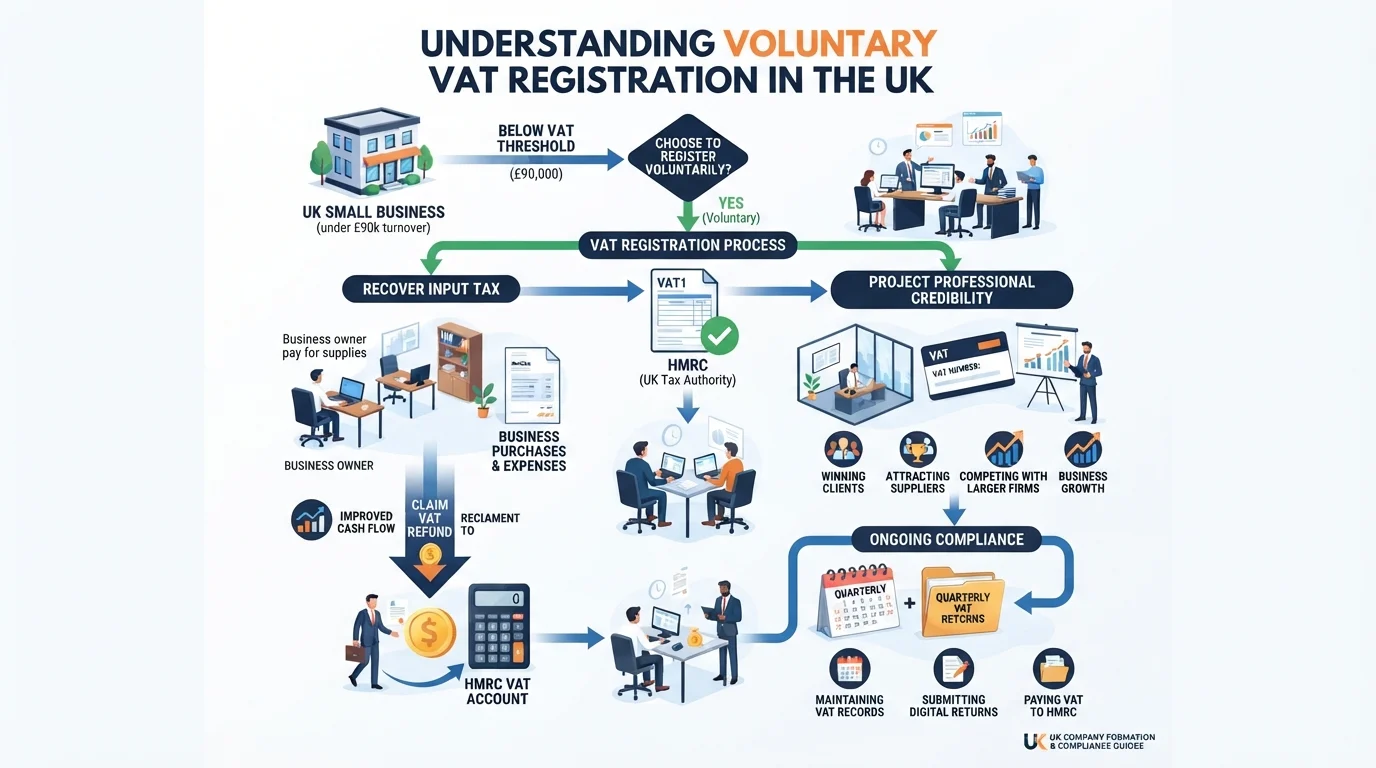
Small businesses with turnover under 90,000 GBP often find financial advantages in registering before crossing the statutory limit. Two primary financial benefits drive voluntary registration: recovering VAT paid on business expenses and establishing trust with corporate clients who prefer working with VAT-registered suppliers. When registered businesses purchase raw materials, software licenses, or commercial equipment, they reclaim the incurred VAT through regular quarterly returns. This mechanism reduces operational overhead for startups investing heavily in initial inventory or infrastructure.
Startups and sole traders must weigh administrative burdens against financial recovery before choosing this path. Registered entities must submit digital returns using Making Tax Digital compliant software and maintain meticulous sales and purchase invoices for six years. Businesses that primarily supply VAT-registered corporate clients face minimal friction because their customers recover the charged tax. Conversely, businesses selling directly to the general public must absorb the 20% standard VAT rate into their retail prices, which can reduce profit margins or decrease consumer competitiveness. Strategic planning ensures voluntary registration supports commercial growth rather than creating unnecessary accounting complexity.
What Are the Core Operational Differences Between Compulsory and Voluntary VAT Schemes?
Compulsory VAT registration enforces strict 30-day statutory deadlines and mandatory penalties for late notification, whereas voluntary VAT registration removes time-pressure thresholds while still demanding identical quarterly digital return submissions.
The legal framework governing both registration types shares identical compliance obligations once active, but entry criteria and operational risks differ significantly. Compulsory registration leaves no room for delay because missing the 30-day notification window triggers automatic HMRC surcharges based on understated tax liabilities. Voluntary registration permits business owners to choose their exact launch date, allowing them to time their registration with peak purchasing cycles or corporate restructuring phases. Both systems require strict adherence to Making Tax Digital regulations, demanding digital record-keeping and direct software integration with HMRC portals.
Operational differences also manifest in flat-rate scheme eligibility and cash flow management. Businesses with taxable turnover below 150,000 GBP can opt for the VAT Flat Rate Scheme to simplify accounting by paying a fixed percentage of turnover to HMRC while retaining the difference. Compulsory registrants often manage complex partial exemption calculations if they make both taxable and exempt supplies. Utilizing professional VAT Registration Assistance ensures accurate scheme selection, correct tax point calculations, and seamless electronic submission setup without risking administrative errors.
Explore More VAT Registration Assistance Guide,
What Is the Current UK VAT Registration Threshold for Small Businesses?
What Is VAT and How Does the UK Value Added Tax System Work?
How Does Form My Company Streamline the VAT Registration Process?
Form My Company manages the entire VAT registration lifecycle by validating financial data, preparing HMRC documentation, and submitting applications through direct digital channels to secure valid registration numbers efficiently.
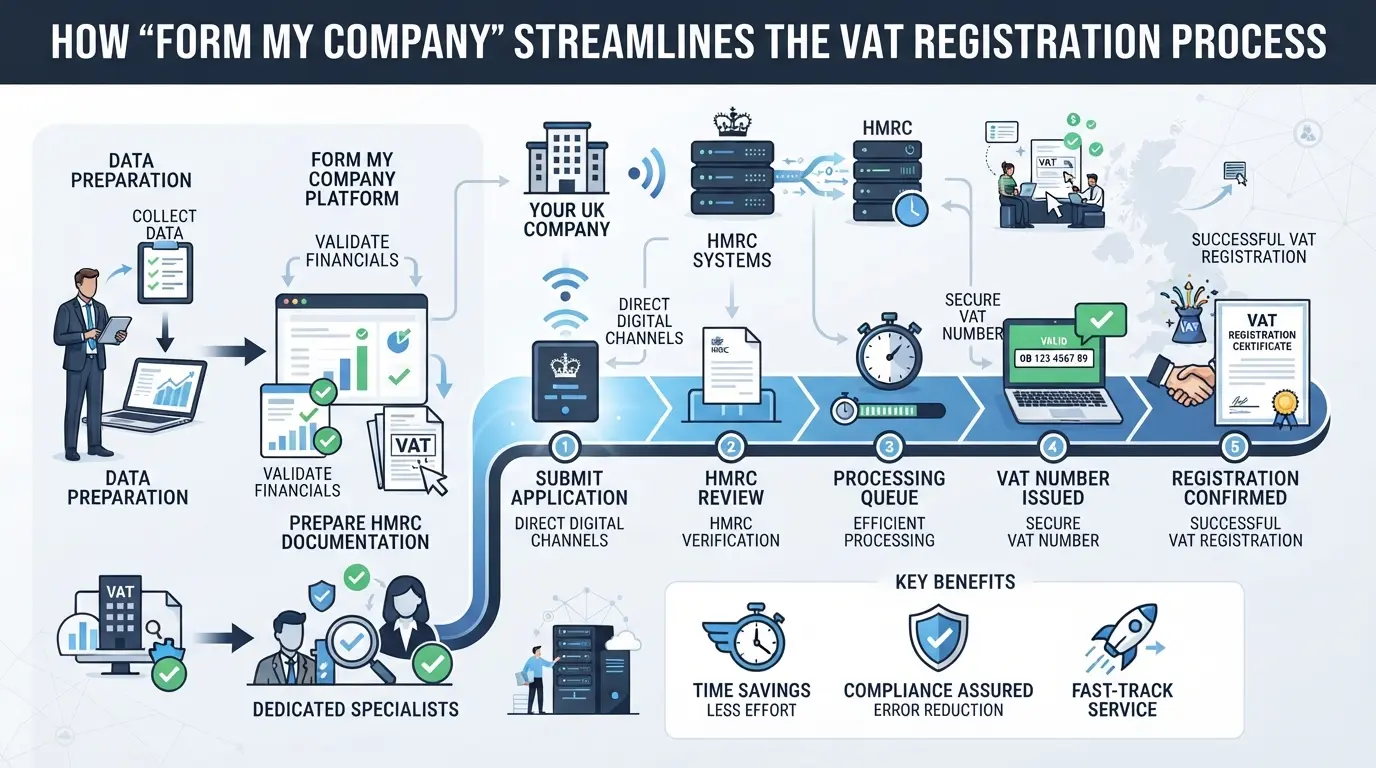
Navigating HMRC registration portals requires precise data entry and comprehensive knowledge of UK tax classifications. Two operational challenges frequently delay applications: inconsistent turnover records and incorrect Standard Industrial Classification code assignments. Form My Company eliminates these bottlenecks by conducting thorough financial reviews, compiling required director identification credentials, and communicating directly with tax authorities on behalf of the corporate entity. This structured approach prevents common application rejections caused by missing documentation or mismatched company house data.
Commercial entities requiring dedicated oversight for mandatory compliance leverage structured advisory services. Directors managing complex multi-stream revenues benefit from Never Miss the Threshold: How Form My Company Manages Compulsory VAT Registration for You to protect their operations from regulatory penalties. Form My Company delivers accurate statutory filings, ongoing threshold monitoring, and expert guidance on digital tax compliance, allowing business owners to focus entirely on core commercial growth.
Frequently Asked Questions
What is included in VAT registration assistance for UK businesses?
VAT registration assistance from Form My Company includes a complete review of your taxable turnover, preparation of HMRC documentation, and electronic submission through Making Tax Digital channels. Dedicated specialists handle communications with tax authorities to secure your official VAT number efficiently and accurately.
When is a business legally required to register for VAT in the UK?
A business must register for VAT compulsorily when its cumulative taxable turnover exceeds the 90,000 GBP threshold within any rolling 12-month period. Business directors must notify HMRC within 30 days of the end of the month the threshold was breached to avoid statutory financial penalties.
Can a business register for VAT voluntarily if turnover is below the threshold?
Businesses trading below the 90,000 GBP statutory threshold can register for VAT voluntarily to recover input tax on business expenses and build commercial credibility. Form My Company provides expert guidance on whether voluntary registration aligns with your specific cash flow and customer base.
How long does it take HMRC to process a VAT registration application?
HMRC typically processes online VAT registration applications within 14 to 30 days, though complex cases or applications requiring manual verification take longer. Utilizing professional VAT Registration Assistance ensures all required director credentials and financial data are submitted correctly to prevent unnecessary delays.
What documents are required to apply for a UK VAT number?
Applying for a UK VAT number requires company registration details, Unique Taxpayer Reference numbers, bank account information, and turnover projections. Form My Company collects and verifies these mandatory documents to streamline your submission and ensure complete HMRC compliance.


