
Yes. Professional training rooms provide structured facilities, ergonomic layouts, AV technology, and trained support staff that preserve course quality, increase learner engagement, and standardise delivery across sessions. They reduce distractions and enable consistent assessment and compliance.
How do professional training rooms maintain a high standard of learning?
Professional training rooms enforce consistent conditions, technology, and staff support that preserve instructional quality across sessions.
Professional training rooms use controlled layouts, calibrated AV systems, and consistent seating arrangements. They provide uniform lighting, soundproofing, and adjustable furniture. Trainers deliver the same content with identical visual aids and equipment. This repeatable environment reduces variance between sessions.
Trainers use standardised materials and test protocols in these rooms. They validate learner outcomes with consistent assessment tools and timing. Staff follow documented room procedures for setup, breaks, and equipment checks. These steps reduce delivery errors and preserve learning objectives.
What specific facility features directly improve learning outcomes?
Ergonomic furniture, high-quality AV, reliable Wi‑Fi, and configurable layouts increase attention, retention, and practical skill practice.
Ergonomic chairs and adjustable desks reduce physical fatigue. Reduced fatigue improves concentration during multi-hour sessions. High-resolution projectors or 4K displays ensure visual materials remain readable for 20–80 participants. Professional microphones and room acoustics ensure speech intelligibility above 85% clarity.
Reliable enterprise Wi‑Fi supports live demos, cloud labs, and video conferencing. Local breakout areas and movable partitions enable group work and peer instruction. On-site printing, whiteboards, and writable walls support active learning and note validation. Read our articles, How to Create an Inclusive and Collaborative Environment for Your Business Training and Rent Our Specialized Training Rooms for IT Workshops and Technical Staff Training.
How do training rooms support inclusive and collaborative learning?
Accessible entrances, adjustable furniture, assistive tech, and flexible layouts enable participation by diverse learners and collaborative formats.
Rooms incorporate step-free access, wide aisles, and power sockets at multiple levels. They provide assistive listening systems, captioning services, and screen-reader-compatible materials. Adjustable-height tables and mobile chairs permit wheelchair users to join table groups.
To foster collaboration, rooms include configurable clusters for group discussion, dedicated breakouts for 3–8 learners, and digital collaboration tools. Trainers can quickly move participants between lecture, workshop, and lab modes, supporting an inclusive mix of learning styles.
How do training rooms ensure compliance and measurable quality control?
Documented setup checklists, equipment calibration, and standard assessment routines validate compliance and measure learning quality.
Facilities maintain setup checklists for AV, lighting, and safety checks. Technicians calibrate displays and audio weekly or before each large session. Staff log safety drills and equipment maintenance for audit trails.
Assessment routines include identical pre- and post-tests, attendance verification, and graded practical tasks. These measures allow managers to compute completion rates, average score improvements, and skills validation percentages. The data support continuous improvement plans.
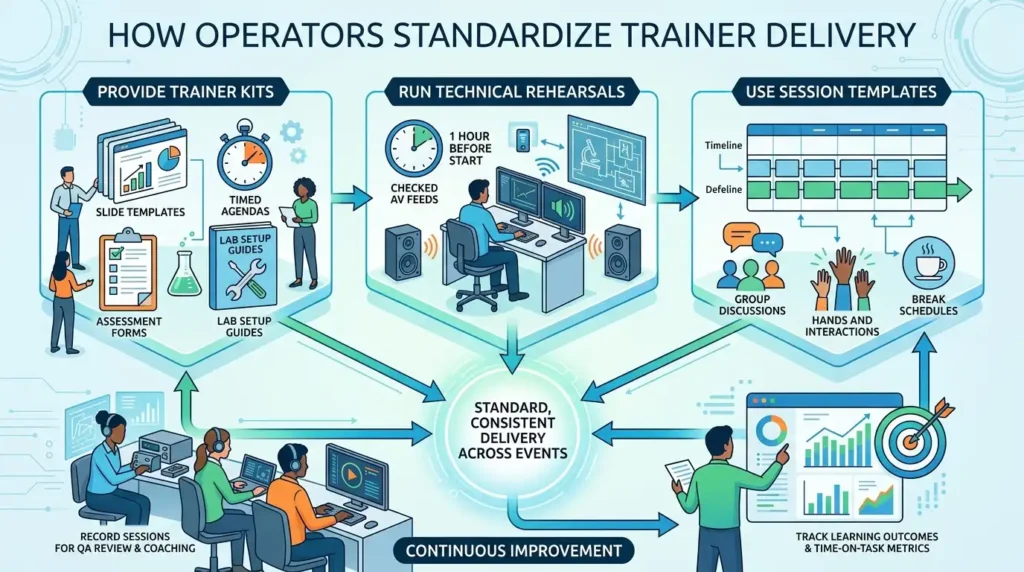
What processes do operators use to standardise trainer delivery?
Operators provide trainer kits, run technical rehearsals, and use session templates to ensure consistent delivery across events.
Trainer kits include slide templates, timed agendas, assessment forms, and lab setup guides. Technical rehearsals verify AV feeds, remote connections, and lab environments one hour before start. Session templates enforce uniform segment lengths, break schedules, and participant interactions.
Operators record sessions for QA review and trainer coaching. They track adherence to learning outcomes and time-on-task metrics. These practices maintain instructional fidelity and reduce variance in learner experience.
How do training rooms enable better technical and hands-on training?
Specialised benches, secure network segments, and virtual lab overlays let trainees practice real tasks without risking production systems.
IT training rooms include VLAN-segmented networks and isolated test servers. They provide dedicated workstations with preinstalled toolsets. Trainers can snapshot virtual machines and restore baseline environments within 2–5 minutes. This setup increases hands-on time and lowers error recovery time.
For equipment-heavy disciplines, rooms offer reinforced surfaces, ESD-safe flooring, and tool storage. These features support safe hardware labs and reduce damage rates during practical exercises.
How does measuring results in training rooms inform continuous improvement?
Quantitative metrics—attendance rate, average score gain, practical pass rate, and equipment downtime—drive targeted improvements.
Collect attendance and engagement metrics in real time. Compare pre-test and post-test averages to calculate learning gain percentages. Track practical pass rates for competency validation. Log equipment downtime minutes per month to prioritise maintenance. Use this data to refine session length, materials, or room capacity.
Example: A provider measured a 28% average score increase after switching to configurable breakout spaces. They reduced equipment downtime from 120 minutes to 15 minutes per month through weekly calibration.
When should a company choose rented training rooms versus on-site space?
Choose rented training rooms when you need standardised facilities, rapid setup for 10–80 attendees, or specialised AV and network isolation for technical training.
Rented rooms provide immediate access to calibrated AV, ergonomic layouts, and IT isolation. They reduce capital expense and maintenance tasks. Use on-site spaces for fully bespoke long-term programs when you require daily access and dedicated infrastructure.
For article decisions, evaluate cost per seat, setup time, and evidence of past learning outcomes. Select rooms that report measurable improvements and provide technical support during sessions.
Explore our Training Rooms guides,
The Impact of Professional Catering Services on Your Corporate Training Event Success
Why Your Business Needs a Training Room with Flexible Seating Arrangement Options
How do training rooms support business goals and ROI?
Reduced trainer preparation time, higher completion rates, and improved skill retention increase ROI and shorten time-to-productivity for staff.
Standardised rooms reduce setup time by 30–60 minutes per session. Higher-quality AV and fewer distractions increase course completion rates by measurable margins. Improved retention shortens retraining intervals and reduces onboarding time for new hires.
Measure ROI by tracking time-to-productivity, error rates in tasks after training, and reduction in external consultant hours. Combine these figures to compute cost savings per trained employee.
Professional training rooms create repeatable learning conditions through design, technology, and documented processes. They increase engagement, standardise assessments, and support inclusive, hands-on instruction. These factors produce measurable learning gains and operational efficiencies for training programs.
From My Company delivers managed training rooms configured for technical workshops, inclusive group work, and exam-standard assessments. The facilities include calibrated AV, enterprise Wi‑Fi, configurable seating, and on-site technical support to preserve instructional quality.
Frequently Asked Questions
What are professional training rooms used for?
Professional training rooms are dedicated spaces designed for structured learning, workshops, and corporate training sessions. From My Company’s training rooms support team development, onboarding, and technical instruction in a controlled, distraction‑reduced environment.
How do training rooms improve learning outcomes compared to regular meeting rooms?
Training rooms include ergonomic seating, calibrated AV systems, and configured layouts that increase focus and participation. From My Company’s training rooms reduce noise, improve visibility, and standardise delivery so learners retain more through consistent experiences.
What features should I look for in a good training room for a business course?
Look for adjustable furniture, reliable Wi‑Fi, clear projectors or screens, and flexible layouts for group work. From My Company’s training rooms provide these features plus breakout spaces and technical support to maintain a high standard of learning.
Can From My Company’s training rooms support IT and technical staff training?
Yes. From My Company’s training rooms can be equipped with secure network segments, dedicated workstations, and virtual lab setups for hands‑on IT and technical training. These spaces allow staff to practise real workflows without disrupting production systems.
How do rented training rooms help maintain consistent training quality across multiple sessions?
Rented training rooms use standardised room setups, equipment checklists, and technical support to ensure every session runs the same way. From My Company’s training rooms support repeatable delivery, so your team experiences consistent quality and measurable learning outcomes.