
Businesses applying for VAT registration in the UK need to provide accurate business information, financial details and supporting evidence when HMRC requests it. Understanding what evidence is needed for VAT helps businesses prepare their applications correctly, demonstrate their trading activities and avoid unnecessary delays. The documents required depend on the business structure, registration circumstances and information requested by HMRC.
VAT registration involves more than completing an online application. Businesses must provide relevant details about their legal identity, taxable turnover, activities and financial position. This guide explains the documents and evidence needed for VAT registration, how HMRC assesses business information and how to prepare a complete application.
What Evidence Is Needed for VAT?
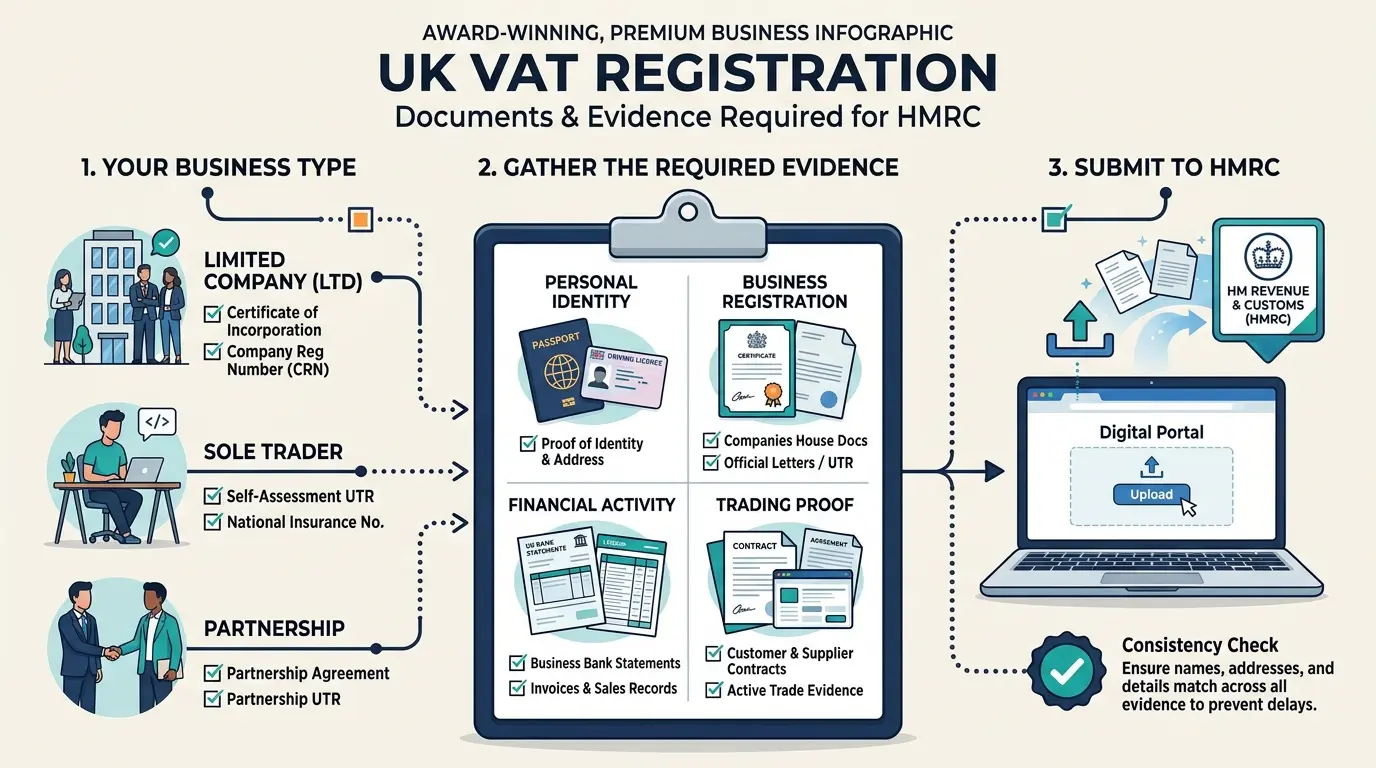
The evidence needed for VAT registration generally includes business identification details, financial records, information about taxable activities and supporting documents relevant to the applicant’s circumstances. Limited companies need details such as their Companies House registration number, business bank account information, Unique Taxpayer Reference and turnover estimates.
HMRC may also request additional documents to establish the nature of the business, verify its activities or clarify information supplied in the application. The exact evidence required depends on the applicant and the circumstances of registration.
Documents and Evidence Required for VAT Registration
Preparing the relevant documents before starting an application helps businesses provide consistent information to HMRC. The requirements differ between limited companies, sole traders and partnerships.
Business Registration and Identification Evidence
Limited companies should have their Companies House registration number and business details available. HMRC uses this information to identify the legal entity applying for VAT registration.
Other relevant information can include:
Company registration number.
Unique Taxpayer Reference.
Business name and registered address.
Business bank account details.
Details of directors and business ownership where relevant.
Information about Corporation Tax and PAYE arrangements.
Sole traders and partnerships have different information requirements, which can include National Insurance details, identity information and partnership records.
Businesses still completing their incorporation arrangements can explore the UK private limited company formation service to understand the company registration process.
Financial Records and Turnover Evidence
Financial information helps HMRC assess whether a business meets the conditions for mandatory or voluntary VAT registration. Applicants should prepare accurate records showing their taxable turnover and expected business income.
Useful financial records include:
Sales invoices and purchase invoices.
Business bank statements.
Accounting reports and bookkeeping records.
Sales summaries and turnover calculations.
Existing contracts and expected revenue information.
Forecasts of taxable turnover for the next 12 months.
Businesses must calculate taxable turnover correctly rather than relying on total income alone. Zero-rated, reduced-rated and standard-rated supplies generally count towards taxable turnover, while exempt and out-of-scope supplies are treated differently.
The standard UK VAT registration threshold is currently £90,000 of taxable turnover over a rolling 12-month period. Businesses must also consider the separate requirement to register if they expect their taxable turnover to exceed the threshold within the next 30 days.
For a detailed explanation of the relevant limits, read our guide to the current UK VAT registration threshold for growing small businesses.
Business Activity and Trading Evidence
HMRC may require evidence demonstrating that a business is already trading or genuinely preparing to start trading. This is particularly relevant when an organisation applies for voluntary VAT registration before generating significant sales.
Examples of supporting business evidence include:
Customer invoices and sales agreements.
Signed contracts for goods or services.
Supplier agreements and purchase documentation.
Business website and online service descriptions.
Marketing and advertising materials.
Evidence of business finance arrangements.
Business plans and relevant commercial correspondence.
For example, a consultancy preparing to trade may provide signed client agreements, marketing materials and evidence of expenditure on business services. A retailer may provide supplier invoices, purchase orders and information about its sales channels.
Not every applicant needs to provide every document listed above. HMRC considers the circumstances of each application and may request further information where necessary.
Why Does HMRC Require Financial Evidence During VAT Registration?
HMRC uses financial information to assess taxable turnover, establish the appropriate registration circumstances and check the accuracy of the information supplied by the applicant.
Businesses applying after exceeding the VAT threshold need accurate historical turnover calculations. Those applying voluntarily should be prepared to explain their business activities and provide relevant information supporting their application.
Financial records also help businesses establish the correct effective date of registration and understand their VAT responsibilities.
Records Supporting Mandatory VAT Registration
Businesses exceeding the £90,000 taxable turnover threshold should maintain reliable sales records covering the relevant rolling 12-month period.
These records help establish when the registration threshold was exceeded and when the business became liable to register. Accurate calculations are important because late registration can result in VAT liabilities and penalties.
Evidence Supporting Voluntary VAT Registration
Businesses can apply voluntarily when their taxable turnover is below the registration threshold, provided they meet the relevant eligibility requirements.
A new business preparing to trade may use commercial evidence such as supplier agreements, business expenditure invoices, finance arrangements and marketing plans to demonstrate that it is establishing a genuine business activity.
HMRC considers the available evidence rather than requiring a fixed number of invoices or a standard collection of documents for every voluntary application.
How Do You Prove Business Activity for VAT Registration?
Business activity can be demonstrated through documents showing actual trading or genuine preparations to supply taxable goods or services. HMRC may consider contracts, invoices, supplier arrangements, business plans and marketing activity when assessing whether an applicant is operating or establishing a business.
The most suitable evidence depends on the nature and stage of the business.
For established businesses, sales invoices and customer agreements can demonstrate commercial activity. For startups, purchase invoices, supplier correspondence, funding arrangements and planned marketing campaigns may provide relevant supporting evidence.
A business should ensure that the information across its documents is consistent. Its trading description, expected turnover, commercial activities and registration details should accurately reflect the nature of its operations.
What Identity and Address Information Is Required?
The identity information required during VAT registration depends on the type of applicant and the registration process. HMRC requests different information from limited companies, individuals and partnerships.
For individual applicants and sole traders, information can include a National Insurance number and an identity document such as a passport or driving licence.
Limited companies generally need their company registration details, UTR and business information. HMRC may request further documents where it needs to establish the identity or legal status of the applicant.
Businesses should ensure that names, addresses and registration details are consistent across their records. Where HMRC requests supporting identity or address evidence, applicants should follow the specific instructions provided rather than assuming that every document is required for every application.
How Can Documentation Errors Affect VAT Registration?
Incomplete or inconsistent information can lead HMRC to request clarification or additional supporting documents. This can extend the time required to process an application and create additional administrative work for the business.
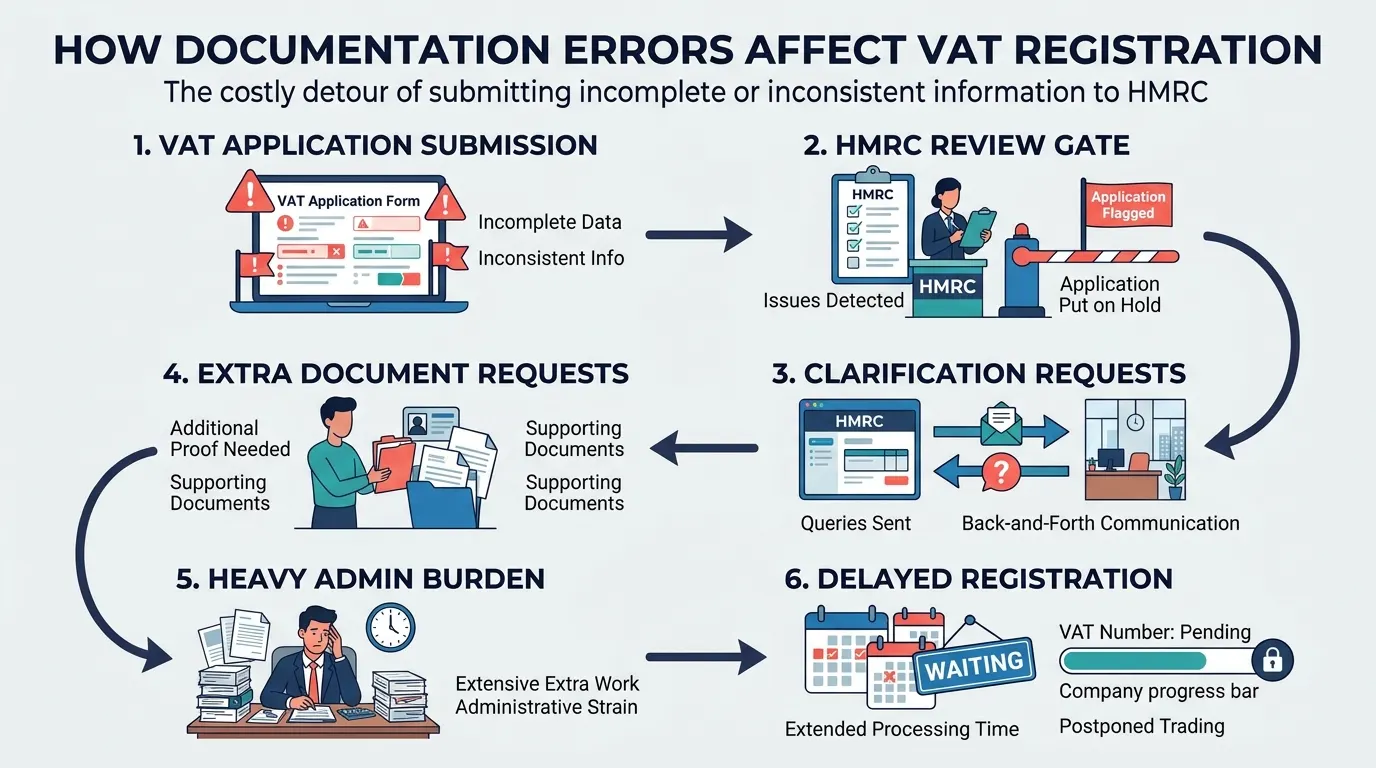
Common documentation problems include:
Incorrect company registration details.
Inconsistent business names or addresses.
Inaccurate taxable turnover calculations.
Missing financial records.
Unclear descriptions of business activities.
Outdated or incomplete supporting information.
Turnover forecasts that do not reflect the business’s actual circumstances.
Businesses should review their information before submission and ensure that all figures and descriptions are accurate.
Professional assistance can help organise the required information and identify inconsistencies before an application is submitted. Form My Company’s VAT registration assistance service provides support for businesses preparing their VAT registration applications.
When Should a Business Prepare VAT Registration Evidence?
Businesses should organise their VAT records before they become liable to register or when they decide to apply voluntarily. Early preparation makes it easier to monitor taxable turnover, maintain financial information and respond to HMRC requests.
A practical preparation process includes maintaining monthly sales records, reconciling business bank statements, organising purchase invoices and keeping commercial agreements accessible.
Businesses approaching the VAT threshold should monitor their rolling 12-month taxable turnover rather than waiting until the end of their financial year.
It is also important to understand the consequences of delayed registration. Read our article on why late VAT registration penalties are not worth the risk for startups.
How Does Professional VAT Registration Assistance Help?
Professional VAT registration assistance helps businesses organise their information, prepare relevant documentation and complete their applications accurately.
The process involves reviewing business details, checking turnover calculations, identifying relevant supporting evidence and ensuring that the application reflects the company’s actual activities.
Professional support can also help businesses understand which VAT registration information applies to their circumstances and respond to requests for additional documentation.
For businesses that need help with the application process, Form My Company’s VAT registration assistance service provides a practical route towards preparing and submitting the required information.
Also explore,
VAT Threshold 2026: UK Registration Rules Explained
How Professional VAT Specialists Help You Choose the Best VAT Accounting Scheme
Frequently Asked Questions
What evidence is needed for VAT registration?
VAT registration evidence can include company registration details, business bank account information, UTR, financial records, turnover calculations and information about business activities. HMRC may request additional supporting documents depending on the applicant’s circumstances.
What documents are needed for VAT registration in the UK?
Limited companies generally need their company registration number, business bank account details, UTR and taxable turnover information. Sole traders and partnerships have different requirements, which can include identity and National Insurance information.
Do I need invoices to register for VAT?
Invoices can help demonstrate business activity and support turnover calculations. However, they are not a universal requirement for every applicant. Businesses preparing to trade may use other relevant evidence, including supplier agreements, business expenditure and commercial plans.
Can I register for VAT before reaching £90,000?
Yes. Businesses making taxable supplies can generally apply for voluntary VAT registration below the £90,000 threshold. HMRC may require information supporting the business’s activities and registration circumstances.
Does HMRC require proof of business activity?
HMRC may request supporting evidence to establish that an applicant is already trading or preparing to start a business. Relevant evidence can include contracts, invoices, supplier agreements, business plans and marketing activity.
How long does HMRC take to process VAT registration?
Processing times can vary depending on the application and whether HMRC needs additional information. Businesses should avoid relying on a fixed approval timeframe and respond promptly to any requests for clarification or supporting documents.
Can a business apply for VAT registration without an accountant?
Yes. Businesses can generally apply directly through HMRC’s online VAT registration service. However, professional assistance can help with document preparation, turnover calculations and application accuracy.
Prepare Your VAT Registration Application with Form My Company
Preparing the correct evidence is an important part of a successful VAT registration application. Business identification details, financial records, turnover calculations and supporting information about trading activities help HMRC assess the application.
Form My Company provides VAT registration assistance to help businesses organise their information and navigate the application process. If you need support with your VAT registration, explore our service and take the next step towards meeting your business’s VAT obligations.