
Preparing company documents for a sponsor licence application requires gathering valid corporate records, authenticating operational evidence, certifying copies, and organizing files according to UK Visas and Immigration Appendix A standards to ensure full compliance.
What Documents Are Required for a UK Sponsor Licence Application?
The Home Office requires four specific supporting documents from Appendix A, including proof of corporate bank accounts, PAYE registration, employer’s liability insurance, and official business premises documentation.
UK Visas and Immigration (UKVI) enforces strict documentation requirements under Appendix A of the sponsorship guidance. Applicants select mandatory evidence based on corporate structure, trading history, and sector regulations. Standard private limited companies submit four primary pieces of evidence within 5 working days of online submission.
Failure to submit complete documentation within the deadline leads to immediate application rejection. UKVI cross-references submitted files against corporate databases, including Companies House and HM Revenue and Customs (HMRC).
Every document verifies physical presence, active trading, and financial viability within the UK economy. Businesses evaluate initial submission requirements by reviewing what documents the Home Office needs for a sponsor licence to prevent filing errors.
Key required document categories include:
Submit proof of active HMRC PAYE and National Insurance registration.
Provide corporate bank account statements from a Financial Conduct Authority (FCA) regulated institution.
Present lease agreements or proof of ownership for physical trading premises.
Include employer’s liability insurance covers of at least £5 million from an authorized insurer.
How Do You Audit Existing Corporate Records Before Submission?
Auditing existing corporate records requires cross-referencing Companies House filings, verifying active director registers, matching registered office details, and reconciling tax reference numbers for consistency.
Discrepancies between official public registers and application forms trigger automatic Home Office scrutiny. Compliance officers verify corporate records against the Companies House database prior to reviewing operational evidence.
Directors ensure all confirmation statements, annual accounts, and officer details remain completely up to date. Misaligned corporate names, outdated addresses, or unrecorded director resignations create compliance flags that slow processing times.
Internal compliance audits identify missing corporate filings and establish structural alignment before submission. Organizations review their corporate standing and secure necessary supplementary company documents to ensure public filings match submission criteria.
Standard audit steps include:
Check registered address details on Companies House against official utility bills.
Match active director listings with current passport data and appointment records.
Confirm corporate tax references, including VAT numbers and Unique Taxpayer References (UTR).
Reconcile statutory registers, including Person with Significant Control (PSC) registers.
How Do You Format and Certify Supporting Business Documents?
Certifying supporting business documents requires getting copies verified by a qualified solicitor or notary public who confirms authenticity, signs each page, and provides professional registration credentials.
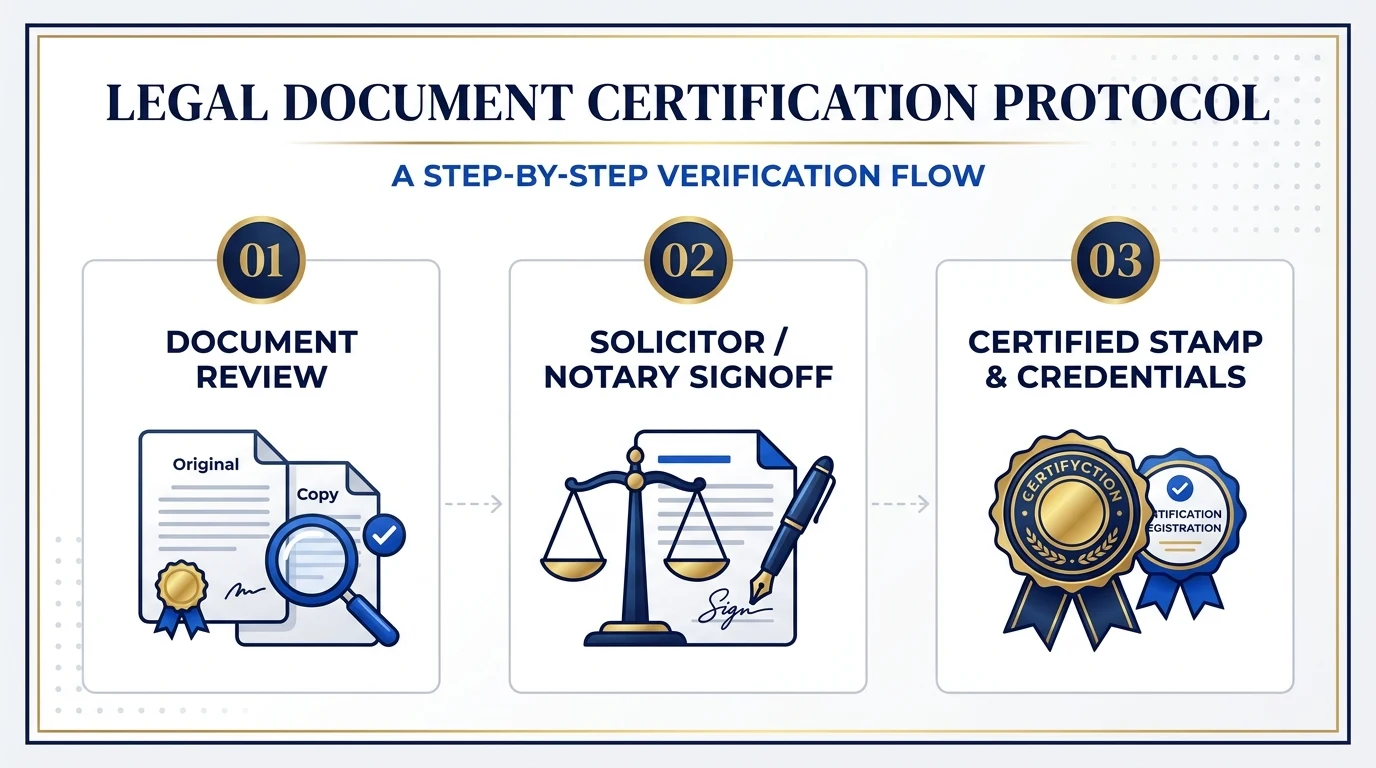
Home Office caseworkers examine submission formats to confirm document legitimacy and legal validity. Digital scans must remain legible, uncompressed, and presented in standard PDF formats without password protection.
When original documents cannot be submitted, certified true copies become mandatory under Home Office rules. A practicing solicitor or notary public verifies that the copy matches the original record precisely.
The certifying practitioner includes specific legal phrasing alongside their full name, signature, and professional registration number. Submission of uncertified copies when originals are requested leads to document refusal.
Formatting standards require precise execution:
Scan original documents in color with a minimum resolution of 300 DPI.
Keep file sizes under 5 MB per individual PDF attachment.
Apply official certification stamps containing the practitioner’s practicing certificate number.
Translate non-English documents using certified translators registered with the Institute of Translation and Interpreting.
How Do You Organize Appendix A Evidence for UKVI Submission?
Organizing Appendix A evidence requires categorizing files into clear numerical folders, naming documents with standardized conventions, creating a detailed document checklist, and verifying portal file limits.
Structured submissions accelerate caseworker review times and reduce requests for further information. Applicants group files strictly according to the four selected Appendix A table options.
Clear naming conventions prevent confusion during the Home Office verification process. Filenames identify the specific requirement, document type, and issue date.
A cover letter and comprehensive index summarize the contents of the upload bundle. Proper index structures allow caseworkers to locate specific evidence instantly. Companies seeking streamlined document compilation work with Form My Company to organise structural filings according to compliance standards.
File organization guidelines include:
Label files using standard conventions such as AppendixA_Table1_BankStatement_2026.pdf.
Create an itemized document cover list referencing each mandatory requirement.
Verify that financial statements cover the exact required timeframes without missing months.
Group corporate proof, operational proof, and tax proof into distinct digital folders.
How Do You Prove Operational Premises and Active Trading?
Proving operational premises and active trading requires submitting executed commercial lease agreements, recent business rates bills, utility invoices, and client contracts showing continuous commercial activity.
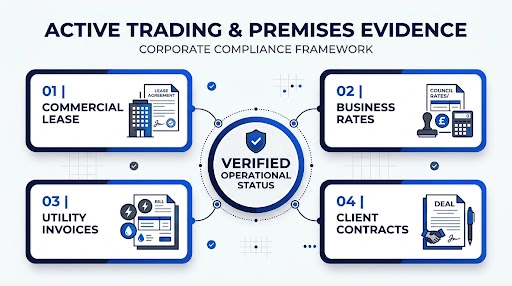
The Home Office requires definitive proof that an applicant operates a genuine business within the UK. Virtual office addresses without dedicated physical space fail compliance checks for standard sponsor categories.
Commercial lease contracts must display signatures from both landlord and tenant alongside valid term dates. Utility bills dated within the last three months validate actual physical occupancy of specified premises.
Active trading evidence demonstrates that the business generates legitimate revenue and requires foreign workforce capacity. Audited financial accounts, corporate tax returns, and commercial sales contracts prove ongoing operations.
Businesses lacking complete corporate records often choose to get sponsor licence-ready company documents from Form My Company to satisfy strict Home Office evidence thresholds.
Trading verification documents include:
Provide commercial lease contracts signed by authorized corporate representatives.
Supply utility bills for electricity, gas, or water showing the operational address.
Submit corporate bank statements reflecting regular customer receipts and supplier payments.
Include executed service agreements with UK-based clients demonstrating ongoing trade.
How Do You Validate Key Personnel Roles and Authorised Officials?
Validating key personnel roles requires assigning qualified UK-based staff to Authorised Officer, Key Contact, and Level 1 User positions while submitting proof of identity and background checks.
UKVI holds key personnel accountable for maintaining sponsorship duties throughout the licence tenure. The Authorised Officer assumes ultimate legal responsibility for the sponsor licence and compliance management.
Key personnel must be settled workers or British citizens residing within the UK, with limited exceptions for foreign-owned entities. Home Office systems automatically check background records, criminal histories, and unspent convictions for nominated officials.
Appointed Level 1 Users manage daily compliance through the Sponsorship Management System (SMS). Organizations verify employment status using official PAYE records or director registration documents.
Key personnel requirements include:
Verify British citizenship or settled status using valid passports or share codes.
Confirm employment status using formal contracts and payroll records.
Check background histories to ensure no previous sponsorship compliance failures exist.
Submit official job descriptions outlining compliance management responsibilities.
How Do You Avoid Common Document Submission Mistakes?
Avoiding document submission mistakes requires verifying date ranges, checking scan legibility, ensuring complete contract pages are included, and confirming all files match registered company details.
Document errors cause over 30% of initial sponsor licence application delays and rejections. Submitting expired insurance policies or bank statements older than the allowed timeframe breaks Appendix A compliance rules.
Caseworkers reject partially scanned documents missing signature pages or schedule attachments. Every multi-page contract must be uploaded in full to maintain legal integrity.
Submitting documents with mismatched business names after a corporate rebranding creates verification failures. Cross-checking every document detail against public databases prevents unnecessary rejections.
Critical error checks include:
Confirm bank statements cover the full required historical range up to the submission date.
Verify that scans display all pages, including terms, conditions, and schedules.
Ensure corporate names match across HMRC, Companies House, and bank accounts.
Re-check file readability and resolution before final upload to the portal.
Explore More Supplementary Company Documents Guide,
How to Prepare Certified Documents for a Government Tender Bid
Solicitor Certification vs Notarisation: Which Does Your Company Need?
Frequently Asked Questions
What Are Supplementary Company Documents in the UK?
Supplementary company documents are official legal records—such as Certificates of Good Standing, solicitor-certified Memorandum and Articles of Association, duplicate Certificates of Incorporation, and board resolutions—that supplement a company’s initial registration. Form My Company provides these Supplementary Company Documents to establish corporate authenticity for bank account openings, regulatory audits, and foreign transactions.
Why Do UK Businesses Need Solicitor-Certified Company Documents?
UK financial institutions, landlords, and regulatory authorities often require certified hard copies to verify that a corporate entity is active and fully compliant with Companies House standards. Form My Company arranges professional solicitor certification of core formation records, ensuring documents carry legal validity for formal due diligence processes.
How Do You Obtain Duplicate Certificates of Incorporation or Articles of Association?
Duplicate certificates and bound constitutional documents can be ordered directly through digital filing portals or dedicated corporate service providers. Form My Company offers a streamlined Supplementary Company Documents service for UK firms to replace lost originals or acquire professionally bound document packs.
What Is the Difference Between Core Filings and Supplementary Company Documents?
Core filings represent baseline incorporation records and mandatory annual submissions like confirmation statements and annual accounts. Conversely, Supplementary Company Documents ordered through Form My Company comprise specialized extracts, certified true copies, and customized corporate records tailored to specific commercial or banking requirements.
When Should a Company Request a Certificate of Good Standing?
A business should request a Certificate of Good Standing when applying for corporate bank accounts, entering public sector tenders, or establishing overseas branches to confirm up-to-date filings. Form My Company delivers verified Supplementary Company Documents to confirm that your company remains active without outstanding compliance penalties.