

Accountants require company formation documents to satisfy UK anti-money laundering regulations, verify corporate identity, confirm share structure details, and validate director authority before providing professional financial services. Official statutory records prove legal existence, prevent fraud, and establish tax compliance parameters for HM Revenue and Customs filings.
Why Do Accountants Need Company Formation Documents for AML Compliance?
UK Anti-Money Laundering legislation forces accountants to verify client identities, confirm legal corporate structures, and trace beneficial ownership before establishing a professional engagement. Failure to collect official formation records exposes accountancy practices to severe financial penalties and criminal liability under Money Laundering Regulations.
The Money Laundering, Terrorist Financing and Transfer of Funds Regulations 2017 require accountancy practices to conduct Customer Due Diligence on every corporate client. Accounting firms authenticate legal corporate status using statutory formation records, including the Certificate of Incorporation and Articles of Association. Verifying these documents ensures the company exists as a legitimate corporate entity registered with Companies House.
Accountants extract specific legal data from formation files to identify Ultimate Beneficial Owners who control 25% or more of corporate shares. Statutory records outline voting rights, ownership thresholds, and control mechanisms necessary for risk assessment protocols. Collecting verified documentation protects accountancy firms from unwittingly facilitating illicit financial transfers or fraud.
Firms maintain customer verification records for five years following the termination of a business relationship. When client onboarding fails to include statutory registration records, accountants face immediate compliance breaches. Obtaining valid company formation details satisfies mandatory anti-money laundering checks established by regulatory bodies like the Institute of Chartered Accountants in England and Wales.
How Do Formation Records Prove Director Authority and Ownership?
Formation documents confirm official director appointments, establish shareholder equity allocations, and define legal signing authority within a registered UK company. Accountants review these statutory records to ensure individuals executing contracts hold legal authorization to act on behalf of the corporate body.
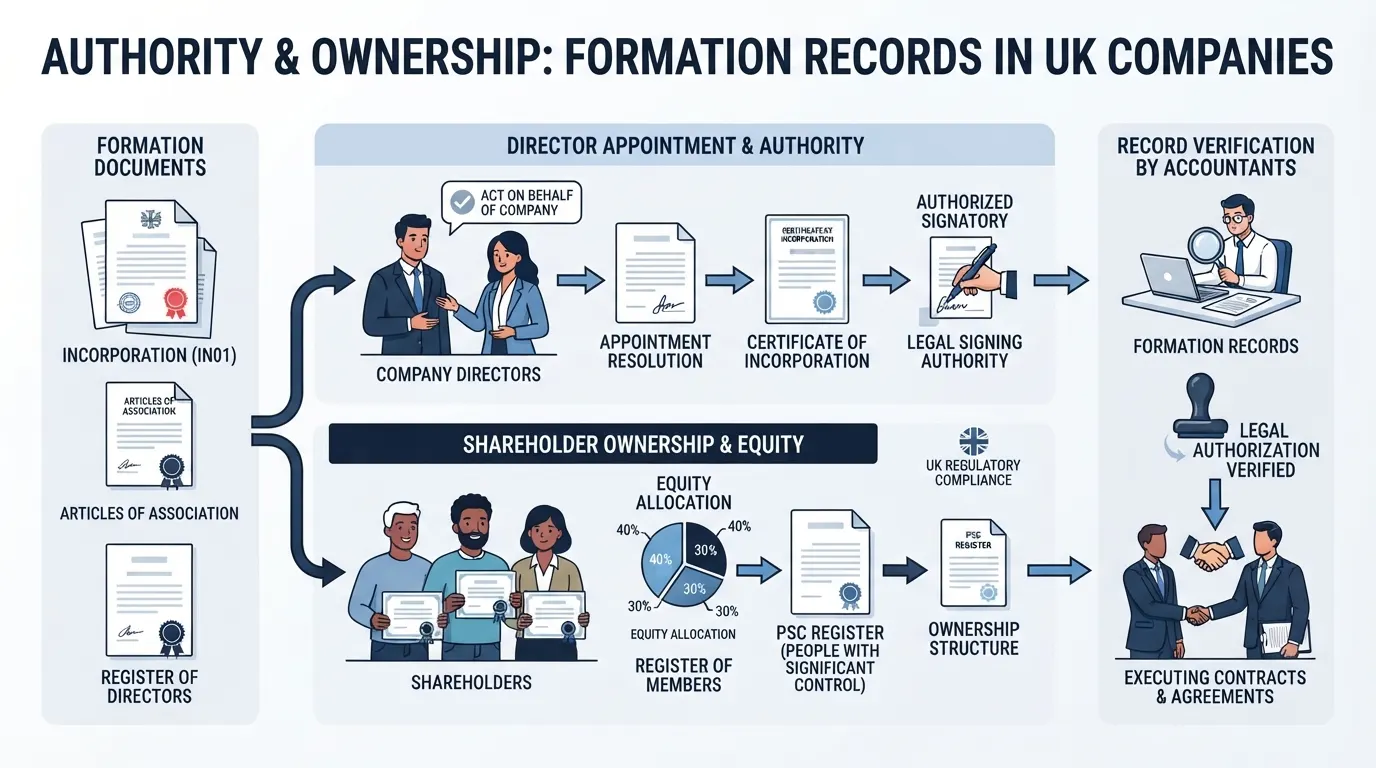
The Certificate of Incorporation acts as legal proof that a business entity officially registered under the Companies Act 2006. Accountants inspect this document to confirm the exact registered corporate name, unique company number, and precise incorporation date. Official incorporation records confirm that officers possess corporate authority to instruct financial professionals.
Articles of Association establish the internal governing rules of a corporate enterprise. Accountants analyze these provisions to verify restrictions on director powers, borrowing limits, and decision-making procedures. Understanding internal corporate governance rules prevents unauthorized corporate transactions and protects the business from invalid operational commitments.
Share certificates and official incorporation statements list initial shareholder subscriptions and equity splits. Accountancy practices examine these records to calculate dividend distributions accurately and file correct confirmation statements. If you need to replace missing official records for your business, you can obtain official supplementary company documents online to establish clear legal compliance.
What Tax Filing Requirements Depend on Statutory Formation Files?
HM Revenue and Customs filings require precise statutory details found within original formation documents to register for taxes, claim exemptions, and submit accurate returns. Incorrect corporate data leads to delayed tax registrations, miscalculated liabilities, and potential financial penalties.
Accountants use initial incorporation records to register businesses for Corporation Tax, Value Added Tax, and Pay As You Earn schemes. The incorporation date establishes the primary financial year-end and determines statutory accounting reference periods. Accurate financial reference periods ensure timely submissions of annual accounts to Companies House and tax returns to HM Revenue and Customs.
Share allocation details inside formation files dictate the distribution of taxable corporate income. Accountants calculate shareholder dividend vouchers based on equity holdings recorded during corporate registration. Incorrect share records lead to inaccurate personal tax returns for directors and trigger tax authority investigations into misallocated distributions.
Articles of Association outline specific share classes, voting rights, and dividend entitlements. Different share classes carry distinct tax treatments and capital gains implications during corporate restructurings or asset sales. Financial professionals review original corporate filings to ensure statutory compliance across all corporate tax submissions.
How Do Formation Documents Assist in Setting Up Business Banking?
Financial institutions require verified company formation files alongside accounting oversight to open corporate bank accounts, issue business credit, and clear international payments. Banks compare accountant-submitted documents directly against official registry records to mitigate financial crime risks.
Commercial banks execute rigorous identity verification checks before granting corporate accounts or merchant services. Lenders require official confirmation of incorporation, registered office addresses, and officer appointments before issuing credit facilities. Accountants supply authenticated formation packages to banking compliance teams to streamline corporate account approvals.
Inconsistencies between accountancy records and original registration files trigger immediate banking holds. Financial institutions freeze application processes when director names, share ownership percentages, or business activities contradict statutory filings. Providing fully reconciled formation documents eliminates processing delays during commercial banking setup.
International business payments and foreign exchange services demand clear ownership transparency. Global financial networks require proof of ultimate beneficial ownership to comply with international sanctions and cross-border financial regulations. Accountancy professionals present verified statutory documents to international banking partners to clear complex corporate transactions.
Which Specific Documents Do Accountants Request During Onboarding?
Accountants request the Certificate of Incorporation, Memorandum of Association, Articles of Association, Share Certificates, and the initial Register of Officers during onboarding. These five statutory items provide complete legal, administrative, and ownership clarity required for professional engagement.
The Certificate of Incorporation proves national registration and details the legal structure of the commercial enterprise. Accountants verify the company number to query official public registers directly. The Memorandum of Association confirms the original subscribers’ intention to form a corporate entity under UK law.
Articles of Association detail internal operational rules, board meeting requirements, and director authority limits. Share certificates confirm individual equity allocations and total paid-up share capital. The Register of Officers lists appointed directors, corporate secretaries, and Persons with Significant Control.
When onboarding new clients, financial advisers must establish a seamless document transfer workflow. You can review our step-by-step guide detailing how to hand over company documents when switching accountants to prevent operational disruptions. Having organized compliance records ready accelerates professional onboarding and eliminates unnecessary administrative delays.
Explore More Supplementary Company Documents Guide,
What Company Records Do Buyers Ask for When You Sell a Business?
What Documents Do You Need to Apply for a UK Business Grant?
How Does Document Verification Prevent Corporate Fraud?
Verifying formation files against Companies House registries prevents identity theft, fraudulent corporate hijackings, and unauthorized alter-ego registrations. Accountants cross-reference statutory filings to confirm that individuals instructing the firm hold legal corporate status.
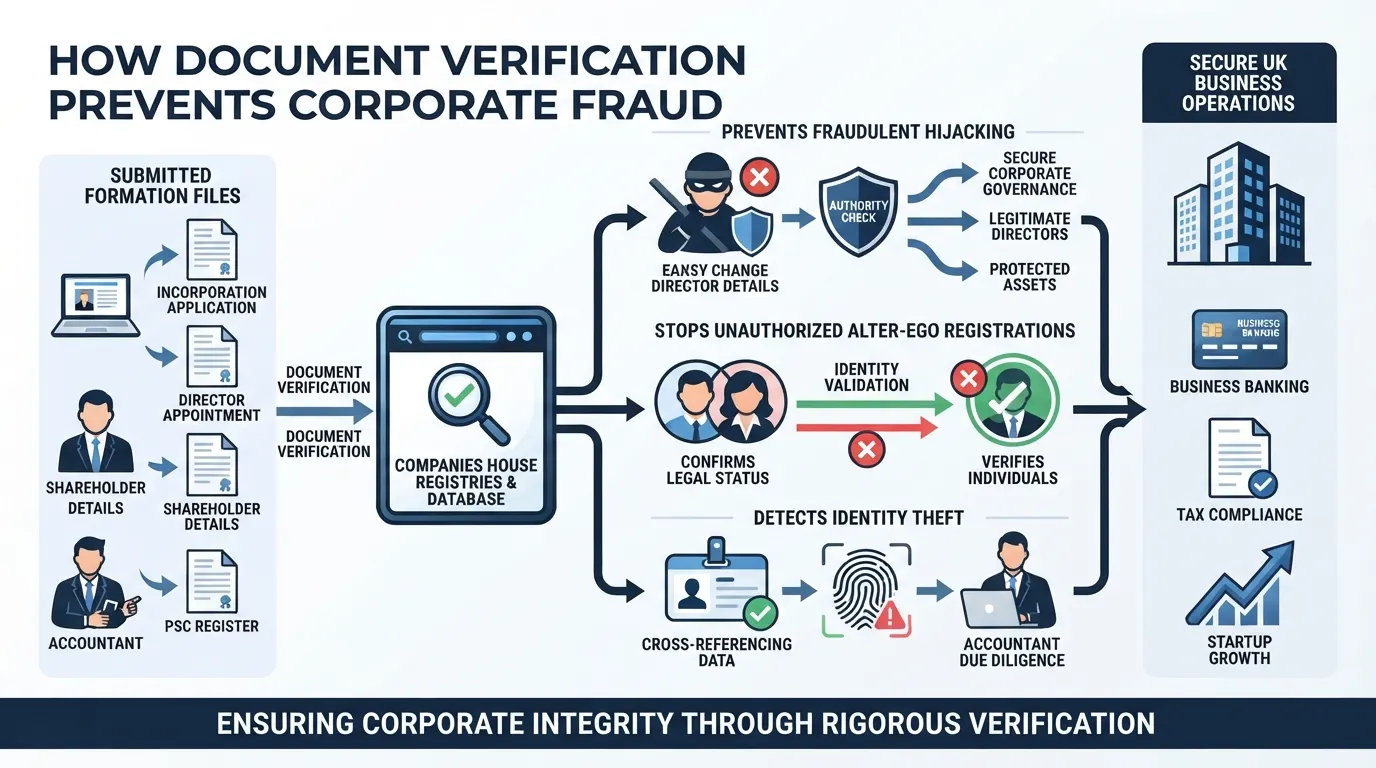
Corporate identity theft occurs when unauthorized individuals alter registered office addresses or director details on public registers. Fraudsters attempt to secure commercial loans, purchase equipment, or open credit lines using hijacked corporate identities. Accountants inspect statutory formation records to verify authentic corporate histories and detect suspicious registry alterations.
Anti-fraud compliance protocols require matching government-issued identification cards directly against statutory director registers. Accountancy practices authenticate passport details, driver licenses, and proof of address against named corporate officers. Rigorous identity matching blocks unauthorized actors from accessing corporate bank accounts or instructing financial advisors.
Firms utilize digital verification tools to validate official company documents directly against government registry databases. Automated cross-referencing highlights discrepancies in officer names, birth dates, or share ownership allocations instantly. Immediate discrepancy detection protects commercial enterprises from fraudulent operational transfers and unauthorized asset asset stripping.
What Happens If You Cannot Provide Original Formation Documents?
Failing to provide statutory formation files prevents accountants from completing legally mandated due diligence checks, halting all professional accounting services. Business owners must order certified duplicate records from Companies House or specialized company formation agents to restore compliance.
When corporate records missing or incomplete, accountancy firms cannot legally render advice, file tax returns, or process payroll. Operating without completed Customer Due Diligence subjects accounting practices to severe regulatory fines from governing bodies. Financial professionals suspend client engagements until clients produce fully authenticated statutory files.
Missing share certificates create disputes regarding equity ownership, dividend entitlements, and voting rights during corporate decisions. Incomplete Articles of Association leave directors uncertain regarding operational borrowing powers and contractual execution rules. Unresolved record deficiencies prevent corporate transactions, business sales, and external equity financing.
Business owners must replace lost, misplaced, or damaged incorporation records through official corporate service providers. To secure complete statutory records quickly, you can order a full set of supplementary documents from Form My Company to satisfy all accounting and anti-money laundering requirements. Restoring official documentation ensures continuous financial compliance and seamless accounting management.
Frequently Asked Questions
What supplementary company documents do UK businesses need?
UK businesses often require supplementary company documents beyond the standard Certificate of Incorporation to verify official business status, equity ownership, and corporate structure. Common documents include duplicate certificates of incorporation, official company registers, Memorandum and Articles of Association, and Share Certificates. Services like Form My Company provide these essential legal records to satisfy bank compliance, accounting audits, and investor due diligence.
Why do banks require supplementary company documents to open a business account?
Financial institutions require supplementary company documents to perform mandatory Anti-Money Laundering (AML) and Know Your Customer (KYC) checks. Banks use official share registers, proof of registered address, and statutory Articles of Association to authenticate director authority and trace ultimate beneficial ownership. Obtaining official records through Form My Company ensures businesses submit verified documentation that meets strict UK banking compliance standards.
How can I replace lost or missing UK company formation documents?
Lost or misplaced statutory company records can be replaced by ordering certified duplicate documents from an official corporate service provider. Business owners can order updated legal filings, statutory register extracts, and missing share certificates directly through Form My Company. Replacing incomplete records promptly ensures uninterrupted operations, seamless tax filings, and legal readiness for commercial transactions.
What is included in a full set of supplementary company documents?
A full set of supplementary company documents includes the Certificate of Incorporation, Memorandum and Articles of Association, initial Share Certificates, and the Register of Directors and Shareholders. These statutory files provide complete administrative, legal, and operational clarity regarding corporate governance. Form My Company supplies complete supplementary document packages to ensure businesses maintain accurate and legally compliant corporate history records.
Are supplementary company documents required when switching accountants?
Yes, new accountancy practices require supplementary company documents to conduct statutory client onboarding and establish proper tax reference details. Accountants inspect Articles of Association, share allocations, and official incorporation dates to confirm director authorization and align accounting reference periods. Providing complete supplementary records speeds up client verification, allowing accountants to take over corporate tax management without delay.


