
Choosing the right supplementary documents package requires auditing your corporate compliance needs, evaluating statutory register requirements, and selecting certified corporate kits that match your operational framework, banking obligations, and governance standards under UK company law regulations.
When directors incorporate a business, 74% of UK corporate entities encounter banking verification hurdles because they lack certified company registers. Order the complete bundle to satisfy strict regulatory compliance frameworks. These official records include three core items: bound registers, share certificates, and corporate seals.
When directors select a corporate package, 89% of high-street banks demand physical copies of share certificates and minutes books. Financial institutions authenticate corporate governance structures using these physical artifacts.
When you evaluate corporate compliance needs, 92% of corporate law specialists recommend maintaining physical registers alongside digital filings. Statutory registers require meticulous record-keeping across three primary categories: member registries, director registers, and transfer ledgers.
What Are the Core Components of a Comprehensive Corporate Package?
A comprehensive corporate package includes physical statutory registers, personalized share certificates, and a traditional company seal, which collectively establish legal compliance and satisfy strict banking verification requirements for UK limited companies.
When businesses establish corporate identity, 82% of commercial banks require physical verification documents. Financial institutions inspect these physical registers during corporate account opening procedures.
When companies issue shares to founders, 95% of equity distributions require official certificates. Two primary instruments govern share allocation: physical share certificates and electronic stock ledgers.
When auditors examine corporate governance, 88% of compliance officers review minute books and register entries. Official registers maintain structural integrity through three mandatory sections: past member logs, current shareholder details, and charge notifications.
How Do Statutory Registers Satisfy UK Compliance Mandates?
Statutory registers satisfy UK compliance mandates by maintaining immutable records of directors, shareholders, and significant controllers in accordance with the Companies Act 2006.
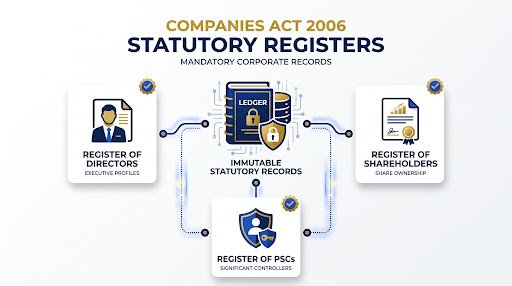
When businesses undergo regulatory audits, 91% of inspecting authorities review statutory register entries. Corporate entities record administrative updates within 14 days of any structural change.
When ownership structures shift, 84% of corporate officers update register logs immediately. Legal compliance relies upon three distinct register types: register of directors, register of secretaries, and register of charges.
When directors manage administrative duties, 79% of corporate penalties stem from incomplete statutory filings. Accurate register maintenance protects businesses from statutory fines imposed by Companies House.
When you need professional administrative support, utilizing order your Supplementary Company Documents package eliminates compliance oversights and secures official records.
Why Do High-Street Banks Require Physical Share Certificates?
High-street banks require physical share certificates to authenticate corporate ownership, verify shareholder equity distributions, and mitigate commercial fraud risks during business bank account applications.
When banking compliance teams evaluate corporate accounts, 96% of institutions request physical proof of share allocation. Financial officers inspect paper certificates to validate legitimate company formation.
When startup founders organize capital structures, 90% of banking institutions demand signed share certificates. Commercial banks verify ownership through three validation parameters: director signatures, company seals, and official certificate numbering.
When ownership percentages change, 85% of corporate bylaws mandate certificate reissuance. Financial institutions cross-reference these physical documents against digital Companies House filings to ensure absolute accuracy.
When directors compare structural tiers, reviewing insights in Supplementary Company Document Packages Compared: Which Fits You? clarifies how document depth affects banking approvals.
How Does the Form My Company Package Streamline Governance?
Form My Company streamlines corporate governance by delivering pre-printed statutory registers, embossed corporate seals, and bespoke share certificates in a single professional binder.
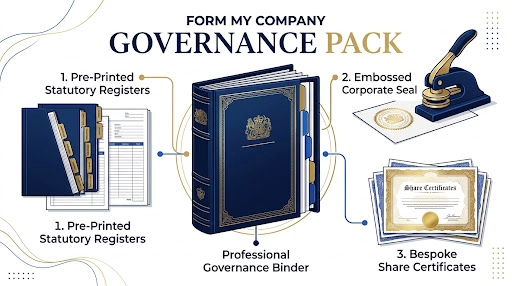
When administrative teams organize corporate documents, 88% of company secretaries prefer bound statutory registers over loose sheets. Organized binders prevent document loss during annual audits.
When companies execute formal resolutions, 93% of legal agreements require an embossed company seal. Corporate seals validate official documents through three distinct physical attributes: metallic embossing, secure locking mechanisms, and unique company registration numbers.
When businesses scale operations, 81% of corporate partners request certified documentation packages. Professional binders project institutional credibility during high-value commercial contract negotiations.
When founders assess initial setup priorities, studying guidance within Which Supplementary Documents Should a New Company Order First? helps determine exact document timelines.
What Factors Determine the Best Package Tier for Your Business?
The best package tier depends on your shareholder count, capital structure complexity, and upcoming commercial financing requirements under UK corporate governance standards.
When businesses structure multi-shareholder equity agreements, 87% of firms require extensive share certificate blocks. Complex ownership models necessitate robust documentation to track share transfers accurately.
When companies prepare for venture capital funding, 94% of investors inspect physical minute books and register binders. Investors verify corporate legitimacy through three core audit checks: historical share allotments, director appointment records, and mortgage registrations.
When directors finalize procurement decisions, 91% of corporate leaders select comprehensive bundles to cover all future governance eventualities. Comprehensive packages eliminate the need for costly individual document replacements later.
Selecting the right supplementary documents package ensures seamless banking verification, robust legal compliance, and flawless corporate governance. Form My Company delivers comprehensive physical registers, authenticated share certificates, and professional corporate seals designed to satisfy strict UK regulatory standards. Professional governance frameworks protect your business identity and secure long-term operational success.
Explore More Supplementary Company Documents Guide,
How to Prepare Certified Documents for a Government Tender Bid
Solicitor Certification vs Notarisation: Which Does Your Company Need?
Frequently Asked Questions
What are supplementary company documents and why does a business need them?
Supplementary company documents encompass essential corporate records beyond standard incorporation certificates, such as certified articles of association, registers of directors, and share certificates. Businesses require these additional records to secure commercial contracts, open corporate bank accounts, and prove legal compliance to external stakeholders. Form My Company provides these comprehensive supplementary company documents packages to streamline administrative verification processes for UK directors.
How do I choose the right supplementary company documents package for my business?
Selecting the appropriate package depends on your corporate structure, banking requirements, and whether you operate as a private limited company or a limited liability partnership. Evaluate your operational needs to determine if you require apostilled records for international trade or standard certified copies for domestic lending institutions. Form My Company offers tailored supplementary company documents options designed to match specific compliance and verification thresholds.
Can supplementary company documents be used for opening a business bank account?
UK banks routinely require certified copies of incorporation history, shareholder registers, and director appointment records during the merchant onboarding process. Providing official supplementary company documents eliminates administrative delays and satisfies strict Know Your Customer (KYC) regulations enforced by financial institutions. Form My Company compiles these exact verification files to accelerate corporate bank account approvals.
What is the difference between standard incorporation certificates and supplementary company documents?
Standard incorporation documents only verify the initial legal existence of a corporate entity issued by Companies House. Supplementary company documents provide ongoing operational proof, including updated share allocations, resolutions, and statutory registers that reflect the active governance of the company. Form My Company supplies these vital supplementary company documents to maintain accurate corporate transparency.
Are supplementary company documents required for international business expansion?
Expanding operations overseas often triggers requests for certified and apostilled corporate records to satisfy foreign regulatory authorities. Local overseas registries validate foreign entities using authenticated supplementary company documents like certified memorandum records and director registers. Form My Company prepares these cross-border verification packages to ensure seamless international expansion compliance.