
UK founders trust Form My Company for VAT registration because expert specialists eliminate application errors, ensure strict HMRC compliance, prevent registration delays, and secure effective VAT dates up to 14 days faster than self-managed applications.
Why Is HMRC VAT Registration Complex for New UK Businesses?
HMRC VAT registration is complex because applicants must navigate intricate tax thresholds, select suitable accounting schemes, verify corporate identity, submit precise supporting financial documentation, and comply with strict Making Tax Digital requirements without making filing errors.
Navigating Value Added Tax compliance demands exact administrative accuracy from company directors. UK businesses must register when taxable turnover exceeds £90,000 within a rolling 12-month period. Directors often miscalculate turnover by counting total revenue instead of taxable sales.
HMRC rejects applications containing mismatched director details, incorrect Standard Industrial Classification codes, or missing bank verification documents. Rejecting an application delays tax processing by 30 to 90 days. Misunderstanding registration deadlines results in strict financial penalties and retroactive tax assessments.
Choosing between the standard scheme, flat rate scheme, or annual accounting scheme requires deep financial analysis. Selecting an improper accounting scheme increases tax liability and restricts input tax recovery. Businesses must also establish Making Tax Digital compatible software to submit quarterly returns accurately.
Professional guidance simplifies complex tax applications and prevents costly administrative errors. Founders who use expert VAT registration assistance avoid common filing mistakes, verify supporting documents before submission, and secure official VAT identification numbers without unnecessary administrative friction.
How Does Form My Company Streamline the HMRC Setup Process?
Form My Company streamlines HMRC setup by collecting business data through a single online portal, conducting thorough document pre-checks, selecting correct tax schemes, and submitting fully compliant registration dossiers directly to tax authorities.
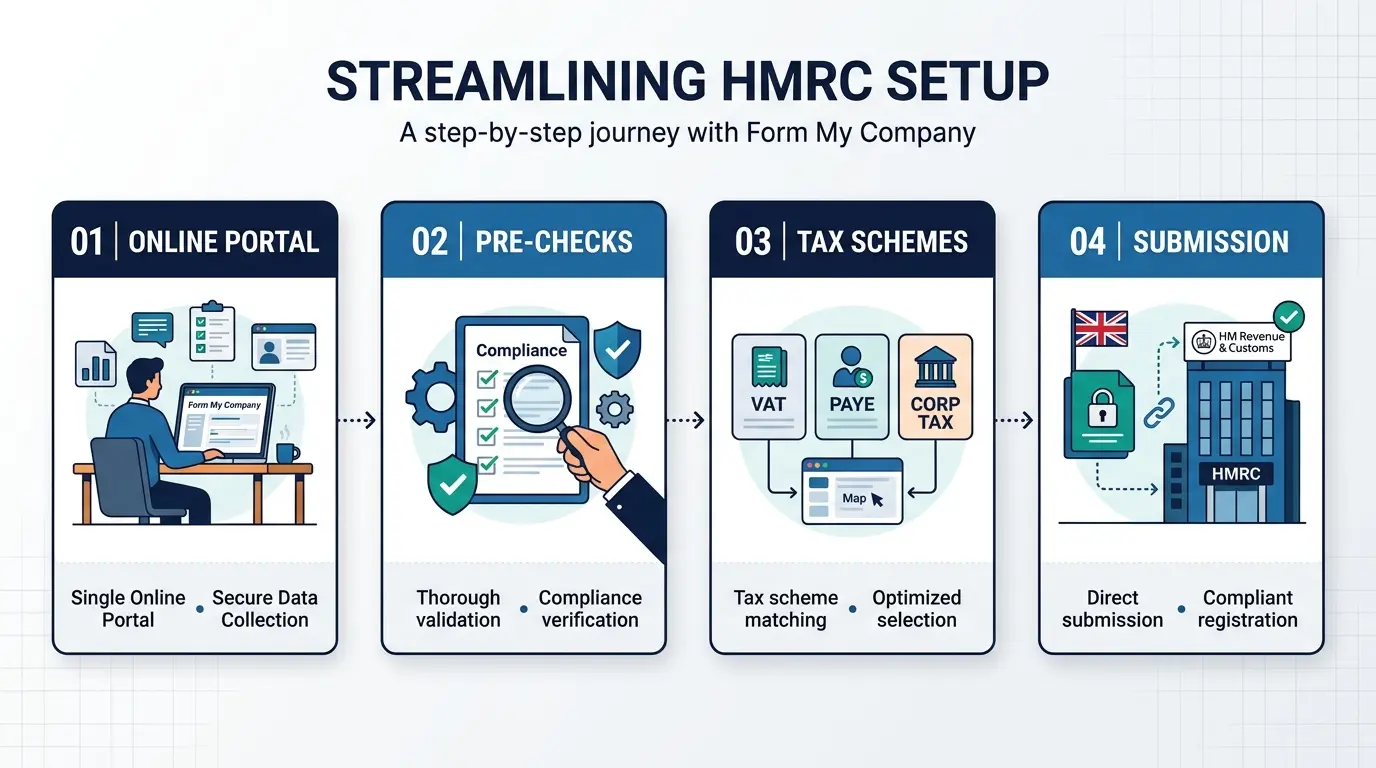
Managing tax registration independently requires hours of administrative research and complex form completion. Professional agents streamline this procedure by deploying standardized data collection systems. Directors submit company details, trade descriptions, and identity credentials through secure digital forms.
Trained compliance specialists review every submission against official HMRC registration standards. Specialists verify three essential documents: proof of business address, director identity verification, and UK bank account details. Pre-checking documentation eliminates common submission errors that trigger manual HMRC reviews.
The setup service includes expert advice on selecting optimal registration dates and accounting methods. Agents align registration filings with business models to maximize cash flow efficiency. Specialist teams handle all correspondence with tax officials until HMRC issues the official certificate.
Delegating administrative tasks allows business owners to focus on core operational growth. Experienced specialists ensure full compliance with Making Tax Digital protocols, giving founders total confidence in their ongoing tax structure.
What Are the Key Risks of Self-Managing VAT Registration?
Self-managing VAT registration risks severe HMRC filing errors, delayed tax number issuance, improper accounting scheme selection, missed statutory deadlines, and substantial financial penalties for non-compliance or inaccurate turnover reporting.
Self-registering businesses frequently select incorrect effective dates of registration. Setting an improper start date prevents companies from reclaiming input tax on pre-incorporation expenses. Reclaiming historical expenses requires precise alignment with HMRC regulations governing purchases up to 4 years prior.
Filing incorrect information leads to formal HMRC verification queries and extended processing queues. Over 25% of self-submitted applications experience delays due to incomplete trade descriptions or unverified business bank accounts. Delayed registrations prevent businesses from issuing legal invoices to commercial clients.
Misunderstanding tax thresholds causes late registration penalties ranging from 5% to 15% of tax due. Unregistered businesses operating above the compulsory threshold remain liable for unpaid tax regardless of whether they collected it from customers. Incorrect filings also increase the likelihood of future tax audits.
Understanding how to navigate the HMRC VAT registration process step-by-step without delays helps directors avoid regulatory setbacks. Proper oversight protects new companies from unexpected back-taxes and maintains clear financial records.
When Should UK Businesses Register Voluntarily for VAT?
UK businesses should register voluntarily for VAT when selling primarily to business clients, incurring significant upfront setup costs with high input tax, or seeking enhanced commercial credibility before reaching the compulsory £90,000 turnover threshold.
Voluntary registration offers clear financial advantages for business-to-business enterprise models. Business clients recover charged VAT completely, making tax charges neutral for corporate buyers. Displaying a valid tax number elevates brand authority during enterprise contract negotiations.
Companies with high initial capital expenditure benefit immediately from early registration. Startups purchasing equipment, inventory, software, and professional services reclaim 20% input tax paid to suppliers. Reclaiming input tax improves cash flow during early trading phases.
Voluntary registration requires careful evaluation of retail customer impacts. Business-to-consumer operations must absorb the 20% tax rate or raise retail prices, potentially reducing market competitiveness. Early registration also introduces quarterly record-keeping obligations under Making Tax Digital rules.
Reviewing accounting rules like what is the standard VAT accounting scheme and how does it operate enables directors to evaluate voluntary registration viability. Strategic timing ensures maximum tax recovery while minimizing administrative overhead.
How Does Professional VAT Setup Ensure Ongoing HMRC Compliance?
Professional VAT setup ensures ongoing compliance by establishing Making Tax Digital infrastructure, structuring accurate record-keeping practices, defining precise quarterly filing schedules, and aligning business accounting software with official tax requirements.
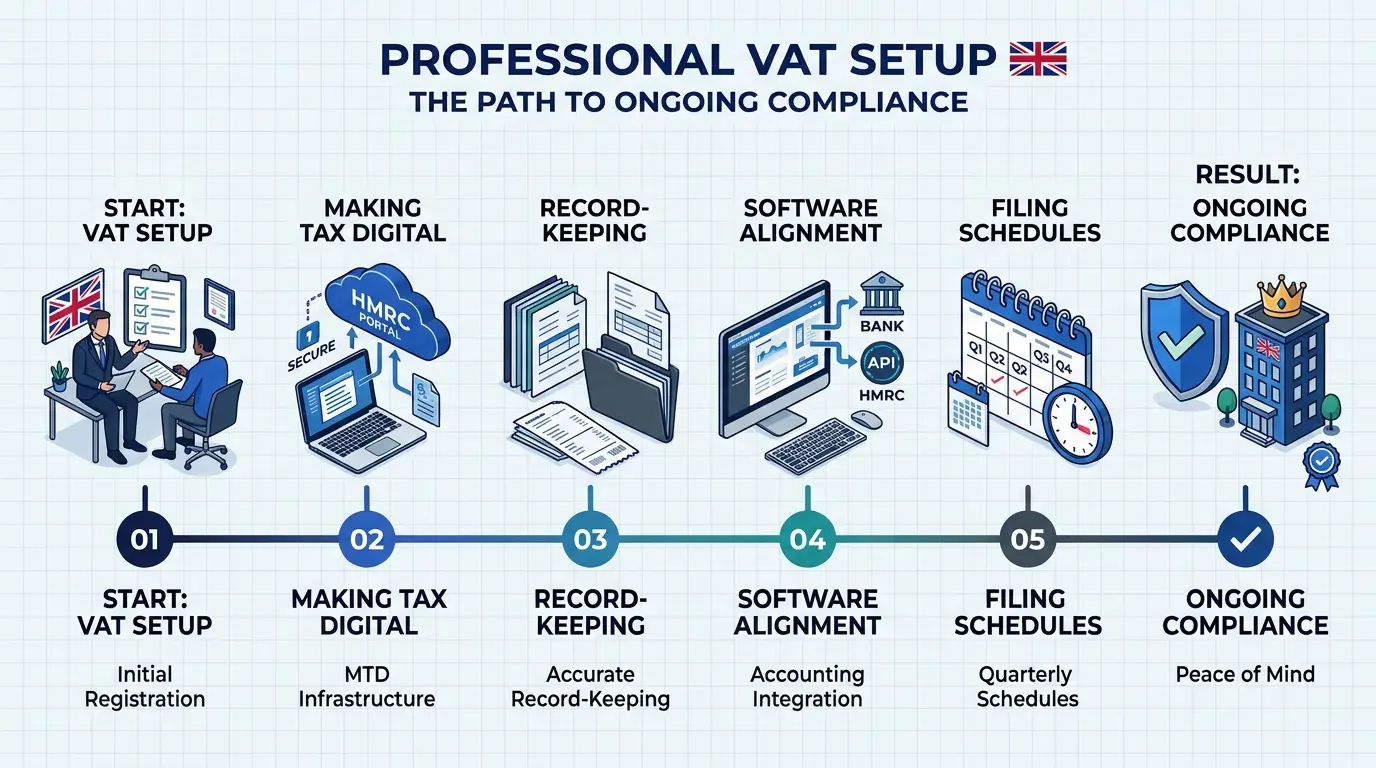
Compliance extends far beyond receiving an official nine-digit registration number from HMRC. Registered entities must keep digital records of all sales, purchases, invoices, and receipts. Maintaining digital links across accounting records is a mandatory statutory requirement.
Professional registration services configure initial account settings to prevent downstream reporting errors. Specialists verify that digital records capture three required data points: invoice date, net value, and applied tax rate. Correct initial setup ensures seamless quarterly return submissions.
Establishing structured filing schedules prevents missed submission deadlines and automated default surcharges. HMRC requires return submissions and electronic payments within one calendar month and seven days following the accounting period end. Accurate setup prevents late filing penalties.
Ongoing compliance protects business owners from interest charges on unpaid tax balances. Structured setup routines build resilient financial operations capable of supporting rapid business scaling without regulatory disruption.
Why Do UK Founders Prefer Form My Company Over DIY Setup?
UK founders prefer Form My Company over DIY setup because dedicated specialists provide guaranteed filing accuracy, end-to-end administration, rapid HMRC processing, transparent fixed pricing, and expert guidance throughout the corporate registration lifecycle.
Managing tax applications without expert support consumes valuable executive time and creates regulatory uncertainty. Form My Company eliminates administrative burden by handling every aspect of tax account creation. Dedicated specialists manage paperwork, verify records, and track application status.
Direct access to experienced corporate specialists ensures immediate resolution of complex filing questions. Specialists identify potential application flags before submission, ensuring seamless approval by HMRC tax officers. High approval success rates provide total peace of mind to new directors.
Form My Company offers transparent corporate service packages without hidden administrative fees. Founders receive clear guidance on corporate obligations, accounting scheme selection, and digital tax record requirements. Efficient processing allows new businesses to start trading legally without delays.
Partnering with established corporate service providers ensures long-term regulatory compliance. Founders secure robust corporate foundations, allowing them to dedicate capital, time, and focus toward sustainable business growth.
Explore More VAT Registration Assistance Guide,
Choose the Right Scheme: How Form My Company Guides You Through Flat Rate VAT Setup
Never Miss the Threshold: How Form My Company Manages Compulsory VAT Registration for You
Frequently Asked Questions
What is included in Form My Company’s VAT Registration Assistance service?
Form My Company provides complete administrative support to prepare, review, and submit your business application directly to HMRC. The VAT Registration Assistance service includes verifying director credentials, selecting the optimal VAT scheme, setting up Making Tax Digital compliance, and securing your official 9-digit VAT number.
How long does HMRC VAT registration take when using professional assistance?
HMRC typically processes VAT registration applications within 5 to 30 working days depending on manual identity verification requirements. Utilizing VAT Registration Assistance from Form My Company reduces delays by ensuring all corporate documents, trade classifications, and UK bank details are accurate prior to submission.
When is a UK business legally required to register for VAT?
A UK business must register for Value Added Tax if its total taxable turnover exceeds £90,000 within a rolling 12-month period or if it expects to exceed the threshold in the next 30 days. Form My Company assists founders in monitoring turnover thresholds to prevent late filing penalties and retroactive tax liability.
Can non-UK residents register for VAT using Form My Company?
Yes, non-UK resident directors trading within the United Kingdom can complete tax registration through Form My Company’s specialized assistance. Non-established taxable persons must register as soon as they make their first taxable supply in the UK, as the standard £90,000 threshold does not apply to non-resident entities.
What documents are required to complete HMRC VAT registration?
Applicants must provide government-issued photo identification, proof of business address, UK bank account confirmation, and primary Standard Industrial Classification (SIC) codes. Form My Company reviews every supporting document during the VAT Registration Assistance process to align filings with strict HMRC submission standards.